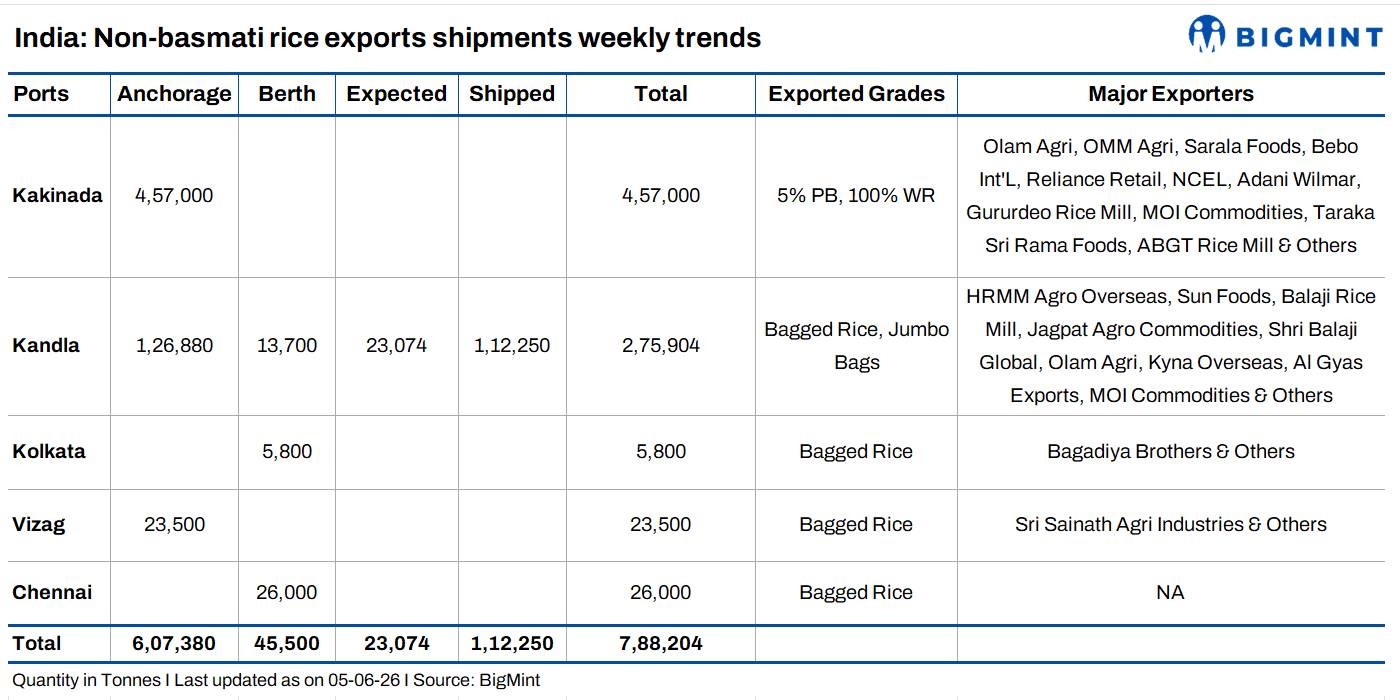
- Shipped volume moderates sharply by 44% w-o-w
- Over 3/4th of total vessel pipeline at anchorage
India’s non-basmati rice export programme remained active during the week ended 5 June 2026, with total shipped volumes reaching 112,250 t across major ports. Although shipments moderated compared to the previous week volume of 200,500 t, the overall vessel pipeline remained sizeable at 788,204 t, indicating continued export commitments and healthy overseas demand for Indian non-basmati rice.
Kakinada continues to dominate export line-up
Kakinada retained its position as the country’s largest non-basmati rice export gateway, with a total vessel line-up of 457,000 t. The port alone accounted for nearly 58% of India’s total export pipeline during the week. The cargo mix largely comprised 5% broken parboiled rice and 100% white rice, reflecting sustained demand from key African and Asian destinations. Major exporters active at the port included Olam Agri, OMM Agro, Sarala Foods, Bebo International, Reliance Retail, NCEL, Adani Wilmar, MOI Commodities and other leading rice exporters. The substantial anchorage volume suggests that a large quantity of cargo remains positioned for loading, providing visibility for continued export movement in the coming weeks.
Kandla leads weekly shipments
Kandla emerged as the most active shipping port during the reporting period, handling 112,250 t of shipments, accounting for the entire reported weekly dispatched volume. The port maintained a total vessel line-up of 275,904 t, supported by 126,880 t of cargo at anchorage, 13,700 t at berth, and another 23,074 t under expected arrivals. Cargo handled through Kandla primarily consisted of bagged rice and jumbo-bag shipments, highlighting the port’s importance in serving containerised and packaged rice demand. Major exporters operating through Kandla included HRMM Agro Overseas, Sun Foods, Balaji Rice Mill, Jagpat Agro Commodities, Shri Balaji Global, Olam Agri, Kyna Overseas, Al Giyas Exports, and MOI Commodities.
Anchorage cargo remains elevated
Total cargo positioned at anchorage stood at 607,380 t, representing more than three-fourths of the total vessel pipeline. Kakinada contributed the largest share with 457,000 t, followed by Kandla with 126,880 t and Vizag with 23,500 t. The high anchorage volume indicates continued export demand and vessel scheduling activity, although it may also reflect congestion-related delays in cargo loading and vessel availability.
Berth and expected cargo support export flow
Apart from anchored cargo, around 45,500 t was positioned at berth across ports, while another 23,074 t was listed under expected arrivals. Chennai accounted for 26,000 t of berth cargo, Kolkata held 5,800 t, and Kandla maintained 13,700 t at berth. These volumes suggest that loading operations remain ongoing across multiple export locations.
Bagged rice exports remain prominent
A notable feature of the current vessel line-up is the dominance of bagged rice exports, particularly through Kandla, Chennai, Vizag and Kolkata. This reflects strong demand from import-dependent markets that prefer packaged cargo for direct distribution and retail channels. Meanwhile, bulk shipments of parboiled and white rice continue to move primarily through Kakinada, supporting large-volume trade flows to traditional importing regions.
Outlook
India’s non-basmati rice export programme remains well supported by a vessel pipeline approaching 0.8 MMT, despite a moderation in weekly shipments. Strong cargo availability at anchorage, steady loading activity across ports, and continued participation by major exporters indicate that export momentum remains intact. Market participants will continue to monitor vessel movements, freight conditions and demand from key African and Asian destinations, which are expected to shape shipment volumes in the coming weeks.
Leave a Reply