- Senegal removes 1-month-long import pause imposed in mid-Nov’25
- Philippines reopens market with higher tariffs, tight delivery window
The Agricultural and Processed Food Products Export Development Authority (APEDA) has resumed issuing Registration-Cum-Allocation Certificates (RCAC) for non-basmati rice shipments from India to Senegal and the Philippines with immediate effect. Both countries recently relaxed import restrictions implemented last year.
APEDA, however, has cautioned Indian exporters to closely monitor policy developments, signalling the possibility of further regulatory intervention should local market conditions warrant.
Country-wise export dynamics
Senegal halts imports for 1 month in mid-Nov’25 amid domestic surplus
Senegal, one of India’s largest non-basmati rice destinations, temporarily halted rice imports for one month in 2025, roughly from mid-November to mid-December, as authorities sought to protect the domestic market amid a surplus of stocks. The West African nation imported around 2.3 million tonnes (mnt) of rice during January-September 2025, underlining its structural dependence on overseas supplies despite steady gains in domestic production.
Imports remain critical to meeting Senegal’s consumption needs, with Asia continuing to dominate Senegal’s supply mix. Thailand, India and Pakistan are the country’s principal suppliers, collectively accounting for the bulk of inflows. The short-term suspension was implemented after Senegal paused the issuance of rice import declarations (DIPA), prompting India’s export promotion agency to halt fresh export registrations late last year. Following confirmation from the Indian Embassy in Dakar that the restriction has been lifted, APEDA announced the resumption of the issuance of export registrations.
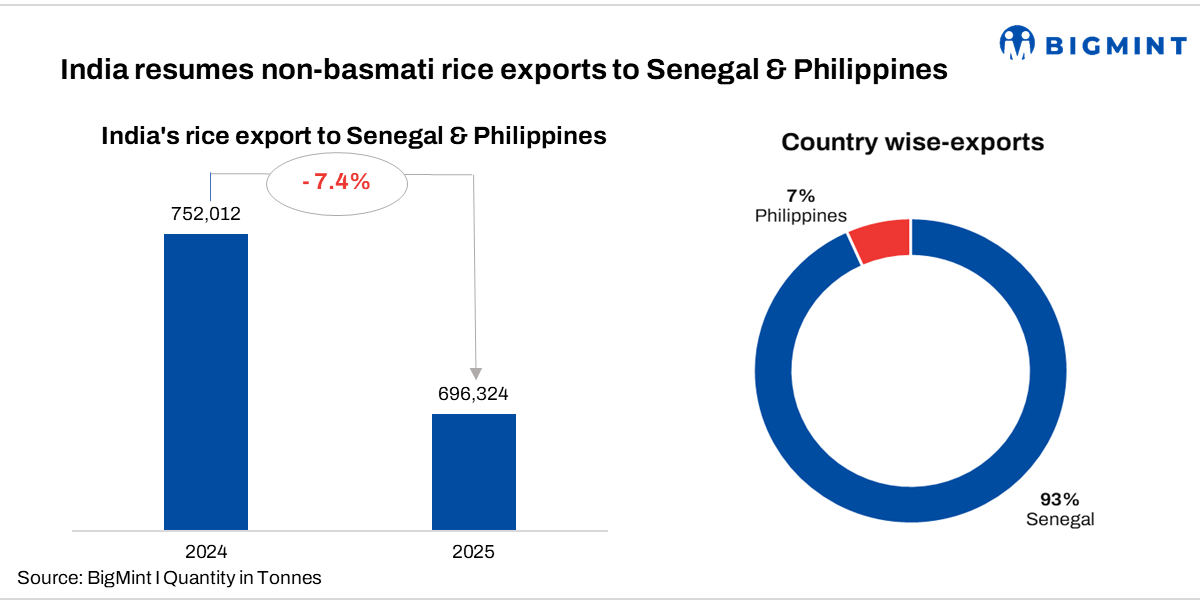
Indian exports to Senegal totalled 649,750.47 tonnes (t) in January-November 2025, down 6% y-o-y, while CY’24 volumes were at 710,482.27 t, according to BigMint’s data. In CY’24, the shipment mix included 448,340 t of broken rice (coarse) and 262,142.27 t of milled rice.
Philippines reopens rice imports with higher duty, stricter timelines
In Southeast Asia, the Philippines also eased import curbs, allowing the resumption of non-basmati rice inflows during the January-February window following restrictions from 1 September to 31 December. The country’s Department of Agriculture has authorised its Bureau of Plant Industry to process applications for Sanitary and Phytosanitary Import Clearances (SPICs) covering around 500,000 t of rice, including 50,000 t earmarked for government agencies.
The reopening comes with tighter controls. Authorities have mandated that all shipments must arrive by mid-February to prevent imported rice from weighing on domestic prices at the onset of the summer harvest. At the same time, Manila has raised the import tariff on rice to 20% from 15%, marking a shift toward a more protective stance.
Rice imports during the window will be permitted through 17 designated ports, including Manila, Batangas, Cebu, Iloilo, Davao and General Santos, providing logistical flexibility while maintaining regulatory oversight.
As per BigMint data, India’s rice shipments to the Philippines stood at 47,708.97 t in January-November 2025, surging 24% y-o-y, while volumes totalled 41,530.41 t in CY’24. The CY’24 volume comprises 100 t of broken rice (coarse), 31,283.90 tonnes of milled rice, and 10,146.51 tonnes of paddy, with milled rice demand remaining strong.
Outlook
The resumption of RCAC registrations for both markets restores access to two key demand centres for Indian rice. However, rising tariffs, tighter delivery schedules and heightened policy sensitivity underscore a more cautious import environment, suggesting that near-term export opportunities will remain closely tied to regulatory signals rather than purely price competitiveness.
Leave a Reply