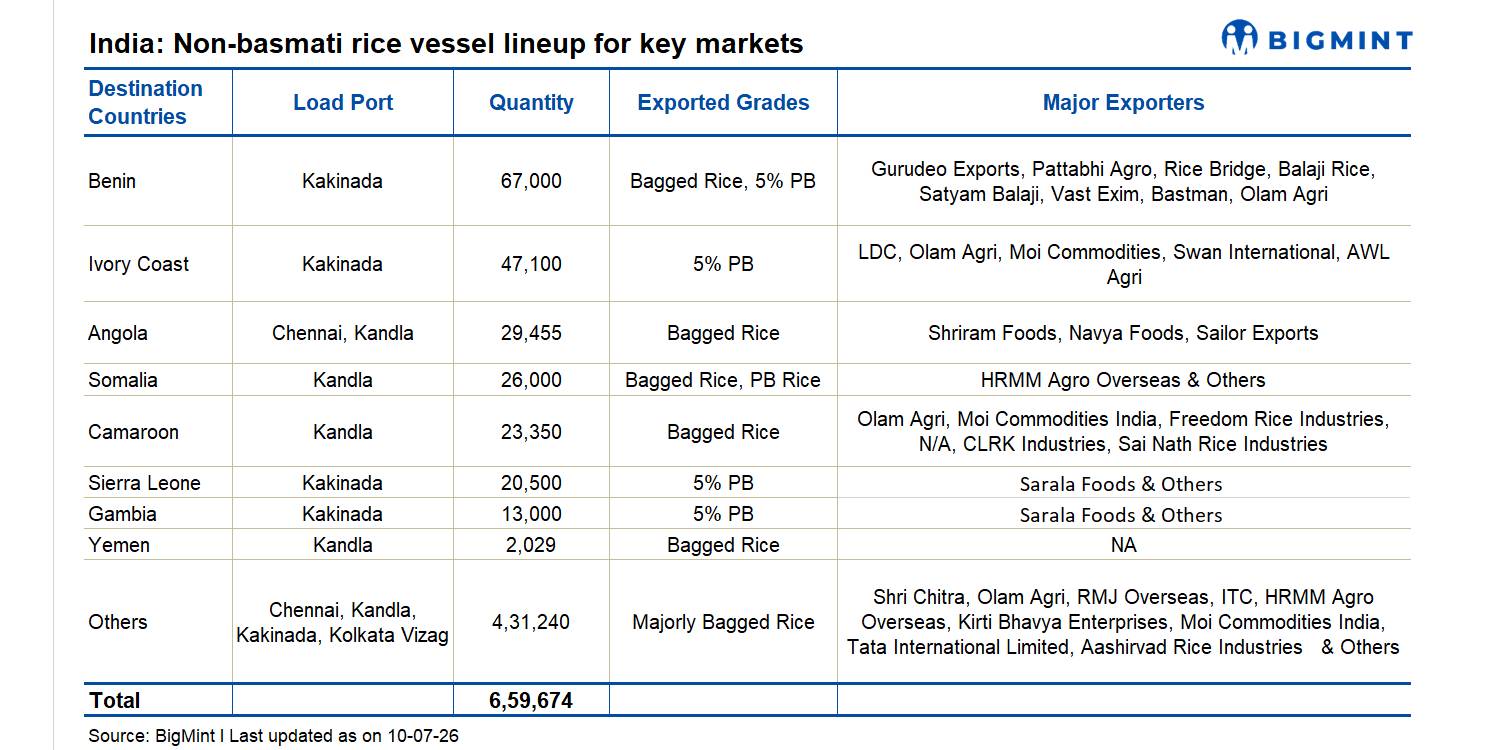
- Over 659,000 t of non-basmati rice is lined up for export.
- Weekly shipments rise to 142,704 t from 99,000 t in the previous week.
India has scheduled 659,674 tonnes of non-basmati rice shipments through its major ports, indicating active export operations despite heightened competition in the global rice market. African countries account for a significant share of the export programme, supported by demand for bagged rice, 5% parboiled rice and other non-basmati grades.
Benin remains the largest identified destination with 67,000 tonnes, followed by Ivory Coast (47,100 tonnes), Angola (29,455 tonnes), Somalia (26,000 tonnes), Cameroon (23,350 tonnes), Sierra Leone (20,500 tonnes), Gambia (13,000 tonnes) and Yemen (2,029 tonnes). An additional 431,240 tonnes has been scheduled for multiple destinations through Chennai, Kandla, Kakinada, Kolkata and Vizag ports.
Kakinada accounts for the largest share of scheduled shipments
Kakinada accounts for the largest share of India’s scheduled non-basmati rice exports, handling cargo primarily destined for Benin, Ivory Coast, Sierra Leone and Gambia. The port continues to play an important role in the country’s rice export programme.
Kandla also accounts for a significant share of scheduled shipments, catering to cargo bound for Somalia, Cameroon and Yemen, while Chennai primarily handles shipments for Angola and multiple destinations. Kolkata and Vizag also contribute to the export programme through multi-destination cargo.
Cargo movement remains active across major ports
Port movement data indicates active loading across India’s key rice export terminals. A total of 190,522 tonnes of cargo is currently at anchorage, while 97,470 tonnes is at berth. Additionally, 228,978 tonnes is expected to arrive for loading, and 142,704 tonnes has already been shipped, taking the total scheduled export programme to 659,674 tonnes.
Kakinada accounts for the largest volume with 343,629 tonnes, including 123,029 tonnes at anchorage and 140,000 tonnes expected for loading. Kandla follows with 240,310 tonnes, supported by 67,493 tonnes at anchorage and 44,970 tonnes at berth. Chennai has 40,735 tonnes scheduled, while Vizag and Kolkata account for 30,000 tonnes and 5,000 tonnes, respectively.
Weekly shipments improve
Weekly shipment volumes increased compared with the previous week. Total cargo shipped during 04-10 July 2026 stood at 142,704 tonnes, up from 99,000 tonnes during 27 June-03 July 2026, reflecting higher vessel movements.
Kakinada recorded the largest increase in shipped volumes, rising to 80,600 tonnes from 67,000 tonnes in the previous week. Kandla shipments also increased to 38,869 tonnes from 32,000 tonnes, while Chennai recorded fresh shipments of 23,235 tonnes during the week. No shipments were reported from Vizag, Dhamra, Kolkata or Haldia during either week.
Africa continues to account for a significant share of exports
The latest vessel line-up shows 659,674 tonnes of non-basmati rice scheduled for export, with African markets accounting for a significant share of shipments. Benin (67,000 MT) remains the largest named destination, followed by Ivory Coast (47,100 MT), Angola (29,455 MT), Somalia (26,000 MT), Cameroon (23,350 MT) and Sierra Leone (20,500 MT). Scheduled cargo largely comprises 5% parboiled rice, PB rice and bagged rice, highlighting the range of grades being exported.
Large exporters such as Olam Agri, LDC, AWL Agri, Moi Commodities India, ITC, Shriram Foods, Gurudeo Exports, Pattabhi Agro, Rice Bridge and several regional exporters account for a notable share of the scheduled shipments, with Kakinada, Kandla, Chennai, Kolkata and Vizag serving as the principal loading ports.
Outlook
India’s non-basmati rice export programme remains active, with nearly 660,000 MT currently scheduled for shipment through major ports. The rise in weekly shipped volumes indicates improved vessel movement. Going forward, export momentum will depend on buyer demand, freight and vessel availability, as well as import policies adopted by key African markets, which account for a significant share of India’s non-basmati rice exports. Any changes in trade regulations, import requirements or procurement policies in these destinations could influence the pace of shipments in the coming weeks.
Leave a Reply