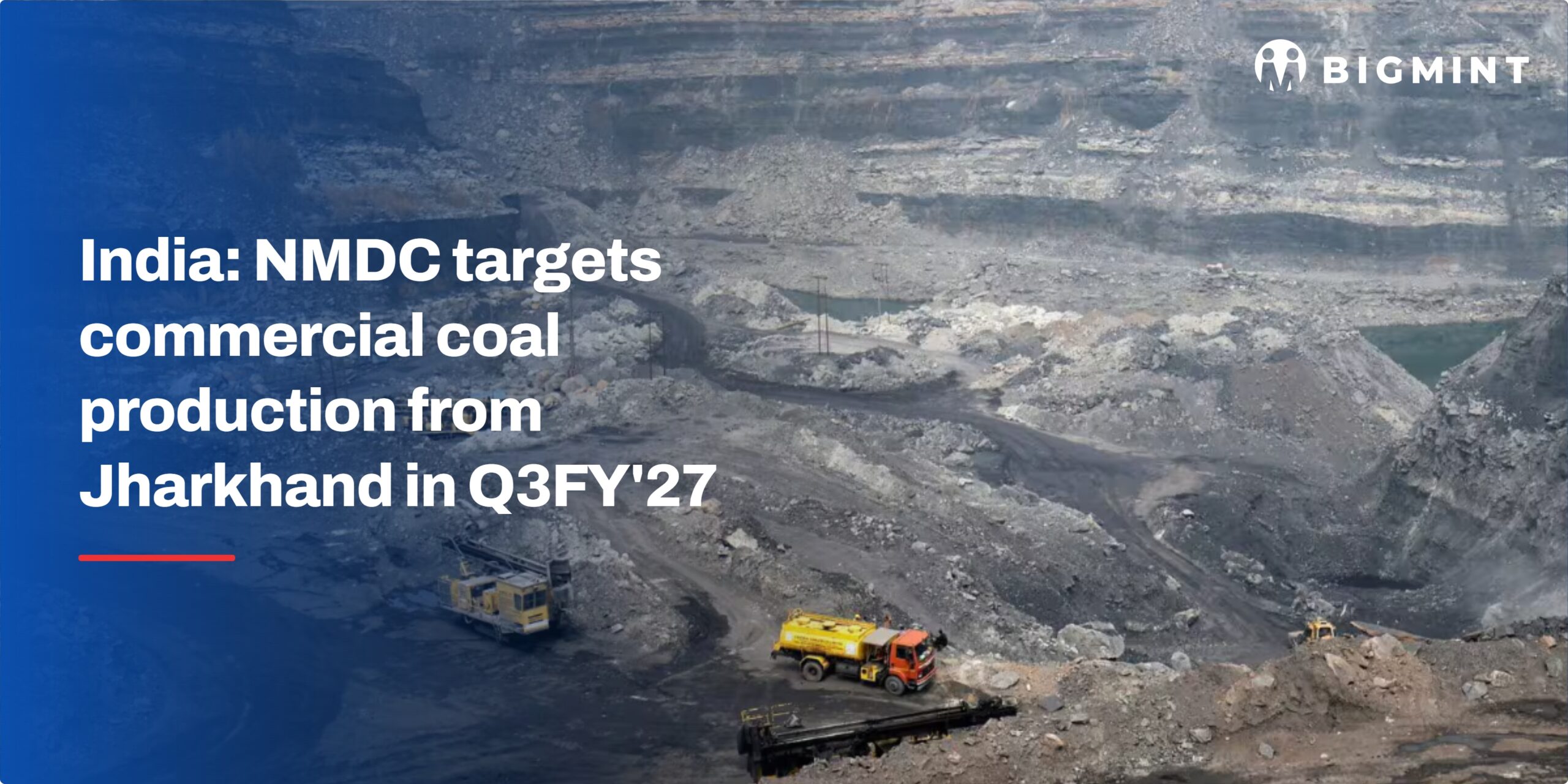
- Miner targets up to 1 mnt coal sales from Tokisud North in FY’27
- Mine has 2.3 mnt/y peak-rated capacity and 52 mnt of reserves
State-run NMDC expects to begin commercial thermal coal production from its Tokisud North mine in Jharkhand during Q3 FY27 (October-December 2026), adding another producing asset to India’s expanding domestic coal mine base.
NMDC Chairman Amitava Mukherjee said the company has reached the coal seam and is targeting sales of up to 1 (million tonnes) mnt during FY27. Tokisud North has estimated reserves of 52 mnt and a peak-rated capacity of 2.3 million tonnes per annum (Mntpa).
The planned FY27 volume therefore represents an initial ramp-up rather than production anywhere close to the mine’s eventual rated capacity.
Commercial production follows earlier mine opening
The timeline is noteworthy.
NMDC formally commenced mining operations at Tokisud North in January 2026, marking its entry into coal mining. At that stage, however, operations were still focused on mine development rather than sustained commercial coal extraction.
In June, NMDC indicated that overburden removal was underway and expected to reach the coal seam during Q2 FY27, while guiding for around 0.75-1 mnt of coal during FY27. The latest announcement confirms that the coal seam has now been reached, although commercial production is expected during the following quarter.
This distinction is important when assessing India’s broader pipeline of new coal capacity. A mine may be auctioned, receive approvals and be classified as operational before meaningful commercial volumes reach consumers, while achieving peak-rated capacity can take considerably longer.
Small addition, but part of larger capacity build-out
Tokisud North’s contribution will initially be modest against India’s annual coal production of more than 1 Bnt.
Its significance is instead as another example of capacity moving through the development pipeline as India targets around 1.5 Bnt of domestic coal production by FY30.
As BigMint has highlighted recently, India’s challenge is increasingly not simply the amount of mine capacity being announced, but how quickly new projects translate into sustained production and whether evacuation infrastructure can keep pace with rising output.
Tokisud illustrates that progression. Even with mining formally inaugurated in January, meaningful commercial output is only expected towards the second half of FY27, with the initial sales target representing less than half of its eventual 2.3 Mntpa rated capacity.
Rohne could be considerably more significant
NMDC is meanwhile preparing to develop its Rohne coking coal block, also in Jharkhand.
Rohne contains estimated reserves of 191 mnt and has a peak-rated capacity of 8 Mntpa, making it substantially larger than Tokisud North. NMDC expects development work to begin during FY27, with production potentially starting from FY28.
However, the timetable remains less advanced than Tokisud. NMDC said in June that several approvals for Rohne were still pending and that no production was expected during FY27. (NMDC Limited)
If successfully ramped up, Rohne could ultimately be more strategically important because India remains heavily dependent on imported coking coal for blast-furnace steelmaking.
Mine ramp-up remains key to India’s 2030 target
NMDC’s entry into commercial coal production reinforces India’s ongoing diversification of coal supply beyond the traditional dominance of Coal India and SCCL.
But Tokisud also demonstrates why rated mine capacity should not be equated with immediately available coal supply.
For India’s production expansion towards 2030, the critical indicators will increasingly be the number of auctioned and operationalised mines that actually commence commercial production, the speed at which they approach rated capacity, and whether rail and first-mile evacuation infrastructure expands alongside them.
Tokisud North is now moving into that next stage: from an operationalised mine to one that actually contributes saleable tonnes to the domestic market.
Leave a Reply