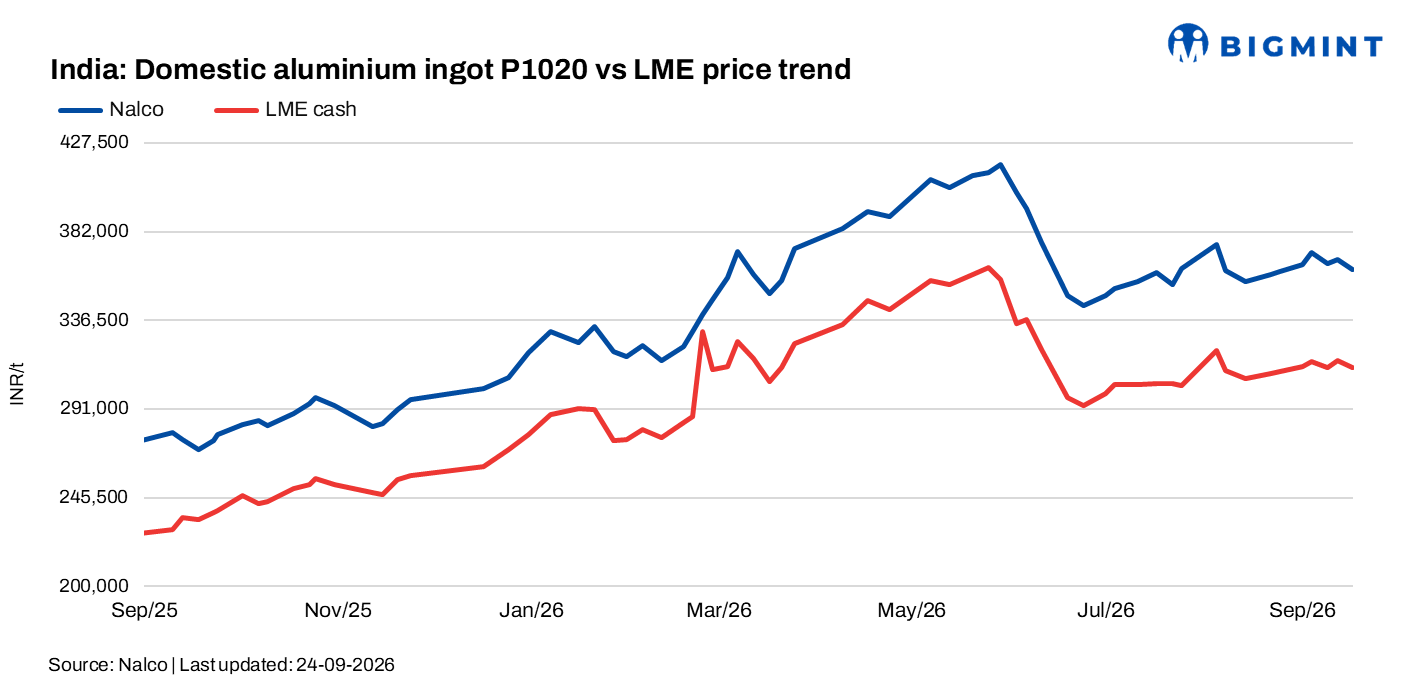
- NALCO cuts aluminium price by 1.3% to INR 362,700/t
- LME aluminium falls 1% in the same period
National Aluminium Company Ltd. (NALCO) has reduced its aluminium price by INR 4,900/t, or 1.3%, to INR 362,700/t on 24 September 2026 from INR 367,600/t on 19 September.
The latest reduction comes amid a softer global aluminium market. LME prices declined during the period as recovering supply and cautious downstream demand offset support from relatively low exchange inventories.
LME aluminium eases amid mixed market fundamentals
The LME three-month aluminium contract closed at $3,255/t on 24 September, down $34/t, or 1.0%, from $3,289/t on 19 September.
Meanwhile, LME aluminium stocks remained broadly stable at 242,125 t on 24 September, compared with 242,600 t on 19 September. Inventories declined marginally by 475 t, or 0.2%.
Despite the correction, LME aluminium stocks remain historically low after falling to their lowest level since 1990 in August amid Gulf supply disruptions. Chinese inventories also declined ahead of the holidays, supporting prices. However, moderate downstream demand and recovering Middle East production have limited further gains, while delays to some new projects continue to provide underlying support.
Domestic aluminium prices decline
Indian aluminium producers also lowered prices during the period, broadly tracking the correction in global benchmarks.
According to BigMint’s assessment, BALCO’s aluminium price declined to INR 366,500/t on 24 September from INR 379,000/t on 19 September. The reduction stood at INR 12,500/t, or 3.3%.
Hindalco’s aluminium price fell to INR 364,750/t on 23 September from INR 370,250/t on 19 September. This represented a decline of INR 5,500/t, or 1.5%.
NALCO’s latest revision follows its previous price increase to INR 367,600/t on 19 September from INR 365,500/t on 16 September. The latest cut therefore partially reverses that increase.
Overall, domestic aluminium prices have weakened alongside the recent correction in LME aluminium. However, low exchange inventories and continuing Middle East supply risks are providing underlying support. Recovering ex-China capacity and cautious downstream demand could keep prices range-bound in the near term.
Leave a Reply