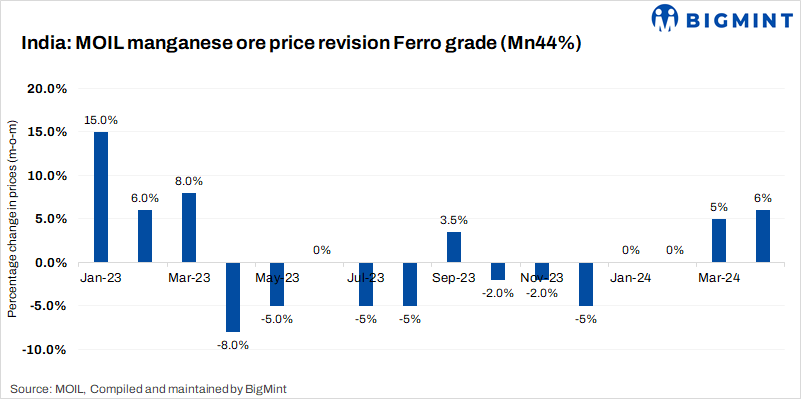
MOIL, India’s state-owned PSU miner, has increased manganese ore prices for April’24. Mn grades above 44% have had a 6% growth in offers m-o-m, while lumps below 44% have increased by 3%.
Factors impacting prices
Imported manganese ore prices rise 5% m-o-m in March: South African origin Mn ore 37% prices witnessed a 5% m-o-m rise to monthly average of $4.15/dmtu in March 2024, compared to $3.95/dmtu in February 2024. Manganese ore buyers remained cautious despite a recent import increase m-o-m. This was viewed more as a short-term blip, rather than an uptrend. Meanwhile, high production costs and limited margins kept buying subdued. Market focus remained on downstream demand to assess if this import bump signified a longer-term shift.
United Manganese of Kalahari (UMK), has hiked offers for South African lumps (Mn 36%) for Apr’24 shipments to $3.95/dmtu CIF China. The miner has opted to increase the offers because the handling and production costs have risen. Meanwhile, increased inquiries from key producing countries have influenced bids for shipments scheduled next month.
Indian domestic silico manganese prices down by INR 1,650/t ($20): The Indian silico manganese market witnessed a price decline in March 2024, with the grade 60-14 dropping by INR 1,650/t ($20) m-o-m to settle at INR 66,200/t ($??/t) exw Raipur. This represents a one-month low for domestic silico manganese prices.
Weak demand from both domestic and export markets was the primary driver behind the price decrease. Limited inquiries from overseas buyers, coupled with muted buying interest within the domestic steel sector, led to a supply glut. As a result, silico manganese producers were forced to adjust their prices to attract buyers and clear their inventories.
Weak global sentiments drive down India’s silico manganese export prices: Silico manganese (60-14) export prices witnessed a 4% m-o-m rise to $815/t FoB India in March 2024, compared to $835/t in February 2024. Silico manganese export prices fell due to a combination of domestic and global market forces. The Indian market has seen a brief oversupply of silico manganese. As a result, vendors have intentionally adjusted their rates in order to speed sales and compete on an international scale. Buyers are becoming more cautious due to a widespread sense of pessimism in the market. This overall negative trait is impeding sustained increases in Indian silico manganese export prices.