- Softer global iron ore benchmark prices weigh on export prices
- Stricter grade checks, continued rainfall tighten low-grade supply
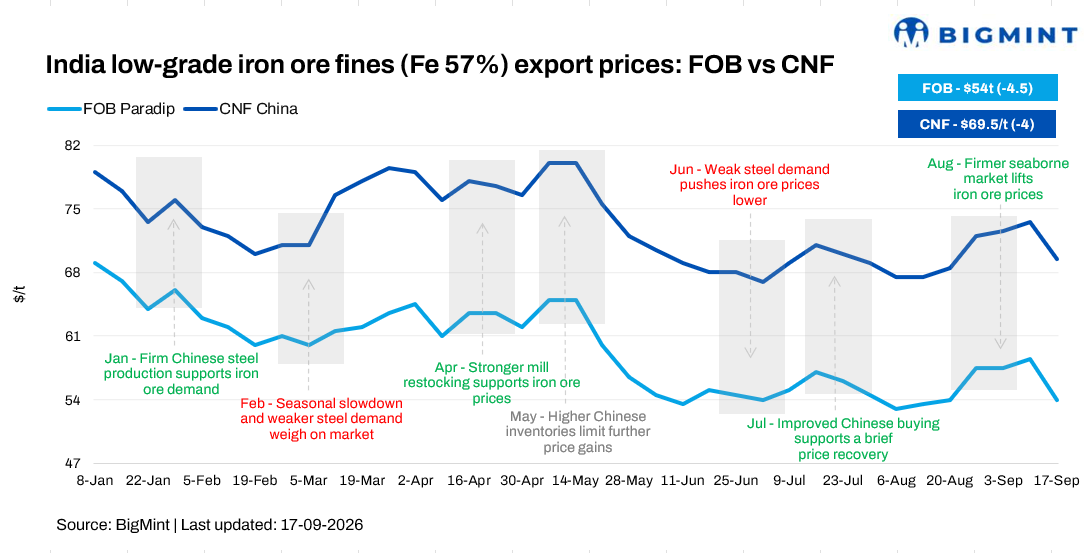
India’s low-grade iron ore fines (Fe 57%) export prices fell sharply by around $4.5/tonne (t) w-o-w to $54/t FOB east coast in the week ended 17 September 2026, equivalent to around $69/t CFR China. Prices moved close to a one-month low, with the previous comparable levels seen on 20 August.
The decline reflects weak Chinese buying interest, subdued spot activity, and limited willingness among buyers to chase cargoes. Softer global iron ore sentiment further pressured export offers, prompting sellers to lower prices to generate enquiries.
Stricter grade checks by Odisha authorities to curb grade misreporting have also reduced the availability of exportable low-grade fines, while the monsoon has also disrupted mining and logistics. India’s iron ore (fines/lumps) exports also declined in August amid these supply constraints.
However, demand remains the key constraint rather than the restricted availability of low-grade material. A trader noted, “Chinese buying, a key demand driver, has remained notably weak this year.”
Additionally, trading activity remained limited as buyers and sellers struggled to agree on prices. Some sellers tried to offer material at increased discount levels, but the persistent bid-offer gap restricted transactions.
Rationale:
- No deals were reported during the current publishing window; consequently, T1 trades received 0% weightage in the index calculation.
- BigMint received eighteen (18) indicative price inputs, of which fifteen (15) qualified as T2 inputs and accounted for the 100% weightage.
Weak global market adds pressure
An iron ore seller told BigMint, “We are selling in the domestic market as export levels are not at all feasible for trade. Global fundamentals are not at all supportive.” This highlights the growing preference among some Indian sellers to divert material to the domestic market when export realisations remain unattractive.
Global benchmark iron ore (Fe 61%) prices fell by around $4/t w-o-w to $95/t CFR China on 15 September, from $99/t a week earlier. Meanwhile, January 2027 iron ore futures on the Dalian Commodity Exchange (DCE) declined by RMB 12/t ($1.8/t) w-o-w to RMB 710.5/t ($105.9/t) on 10 September, from RMB 722.5/t ($107.7/t) a week earlier.
The combination of subdued Chinese mill buying, weaker global benchmarks, and cautious trading activity is keeping Indian low-grade export prices under pressure, despite tighter availability of exportable material from Odisha.
Domestic-export iron ore realisation gap widens amid softer market sentiment
The spread between domestic and export realisations widened to around INR 720/t ($7.5/t) this week, as export realisations declined more sharply amid subdued overseas buying interest. Export realisations fell to INR 2,780/t ($29/t), while domestic ex-mines offers decreased by INR 50/t ($0.5/t) to INR 3,500/t ($36.6/t).
The wider spread reflects relatively firmer domestic demand compared with the export market, although overall market sentiment remained cautious. Softer export realisations were weighed by limited international buying interest and competitive offers, while domestic prices faced comparatively moderate pressure as buyers remained watchful amid weak downstream steel demand.
Outlook
India’s low-grade iron ore fines export market is likely to remain under pressure in the near term, as subdued Chinese buying interest and weak steel-sector demand could limit fresh enquiries. China’s broader property-sector weakness and soft domestic demand continue to weigh on the steel market, while recent industry commentary points to subdued iron ore demand.
However, tight availability of low-grade material in India, particularly from Odisha, could provide some downside cushion. BigMint’s latest assessment also notes that low-grade supply remains tight, even as export realisations have weakened. Therefore, prices could remain range-bound to softer in the next few weeks, with the direction largely dependent on Chinese restocking, steel mill margins and the availability of competitive low-grade cargoes from India.
Leave a Reply