- Investigation follows petition by JSW JFE Electric Steel
- Scope extends to amorphous metal, a commercial substitute
India’s Directorate General of Trade Remedies (DGTR) has launched an anti-dumping investigation into imports of cold-rolled grain-oriented (CRGO) electrical steel and amorphous metal from China, Japan, South Korea, and Russia.
The investigation follows a petition by JSW JFE Electrical Steel Nashik, which alleged that dumped imports from the four countries have caused material injury to the domestic industry. The authority found sufficient prima facie evidence of dumping, injury, and a causal link to justify launching the probe.
The investigation will cover imports made during the period from 1 April 2025 to 31 March 2026, while injury will be assessed over the preceding three financial years.
Imports from 4 countries under investigation, EU excluded
The investigation will focus only on imports originating in or exported from China, Japan, South Korea, and Russia.
The petitioner had sought an investigation into imports from China, Japan, South Korea, Russia, and the European Union. However, DGTR excluded the EU after its preliminary examination found a negative injury margin for imports from the bloc.
Scope extends to amorphous metal
Besides CRGO electrical steel, the investigation also covers amorphous metal used in transformer cores.
Although JSW JFE Electrical Steel does not manufacture amorphous metal, DGTR accepted the petitioner’s argument that the two products are technically and commercially substitutable. According to the notification, both materials are used in transformer cores, serve the same end users, and compete directly in the market.
The investigation excludes amorphous metal used for applications other than power and distribution transformers, as well as magnesium oxide-coated cold-rolled steel coils used as substrates for manufacturing CRGO.
Notably, CRGO is processed to have its grains aligned in a specific direction and is also more expensive to produce and is limited in supply. It is ideal for use in static applications such as transformer cores in the power and distribution segment and inductors.
NLMK excluded from domestic producers scope
A notable aspect of the initiation concerns NLMK India Coating Pvt Ltd, the only other domestic producer associated with CRGO.
The petitioner argued that NLMK India should not qualify as part of the domestic industry because it is related to Russian producers and exporters, while a related company also imports CRGO into India from Russia.
After examining the company’s submissions, DGTR concluded that NLMK India is related to Russian producers, exporters, and an importer of the subject goods. Consequently, it ruled that the company does not qualify as an eligible domestic industry under India’s anti-dumping rules, leaving JSW JFE Electrical Steel as the eligible domestic industry for the investigation.
Japanese suppliers face significant exposure
The investigation could have significant implications for Japanese producers, which count India among their key export markets for grain-oriented electrical steel.
According to industry publication Japan Metal Daily, Japan exported around 90,000 tonnes (t) of CRGO electrical steel to India in 2025, which accounted for more than one-fifth of the country’s total CRGO exports. Nippon Steel reportedly accounted for about 80% of those shipments, while JFE Steel supplied the remainder.
In total, Japan exported around 414,000 t of CRGO electrical steel last year, with the European Union and India accounting for nearly half of shipments. As CRGO is a variety with a high export ratio, Japan’s exports may be heavily impacted by potential trade measures in India and the EU.
The publication noted that JFE Steel occupies an unusual position because it is both a 50% shareholder in JSW JFE Electrical Steel, the petitioner, and one of Japan’s leading exporters of CRGO electrical steel to India. Japanese producers are expected to participate in the DGTR investigation to defend their exports.

India remains heavily reliant on imports
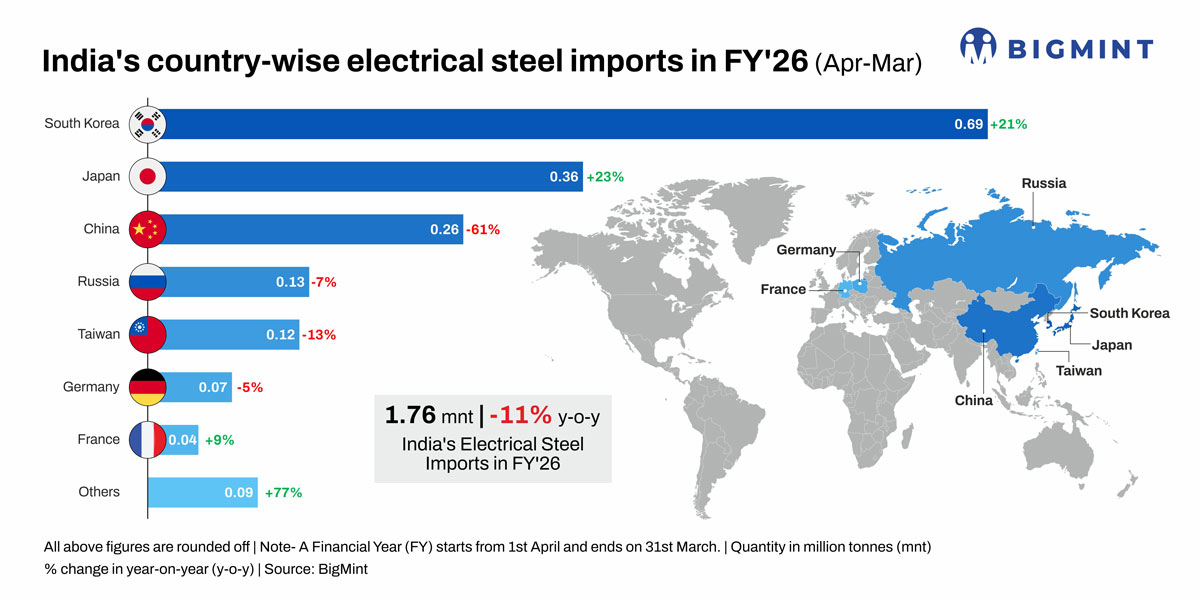
India’s electrical steel (both CRGO and CRNO) production nearly doubled to 0.64 million tonnes (mnt) in FY’25 from 0.35 mnt in FY’21 but remained flat in FY’26, according to BigMint data. Despite higher domestic output, imports stayed elevated at 1.76 mnt in FY’26, compared with 1.97 mnt in FY’25 and 1.41 mnt in FY’24. In FY’26, South Korea remained the largest supplier with 0.69 mnt, while Japan’s shipments rose to 0.36 mnt and China’s fell sharply to 0.26 mnt. The continued reliance on imports underscores the need for domestic capacity additions and partly explains India’s increasing use of trade remedies in the electrical steel sector.
Domestic capacity expansion underpins trade action
The investigation comes as India seeks to increase domestic production of grain-oriented electrical steel, a key material used in transformer cores.
JSW JFE Electrical Steel is developing a new CRGO manufacturing facility at Vijayanagar, Karnataka, while also expanding capacity at its Nashik plant. The investments aim to reduce India’s dependence on imports as transformer demand rises alongside investments in power transmission, renewable energy integration, and electricity distribution.
The case also reflects broader concerns among Indian steelmakers over rising imports of value-added steel products. Earlier, in 2025, the government imposed anti-dumping duties on imports of cold-rolled non-oriented (CRNO) electrical steel from China for five years, following a DGTR investigation that found dumped imports had caused injury to the domestic industry.
India’s investigation also adds to a broader increase in trade scrutiny surrounding grain-oriented electrical steel. Earlier this year, the European Commission initiated a safeguard investigation covering grain-oriented electrical steel and transformer cores.
Leave a Reply