- Production leadership shifts to India as output growth outpaces China
- Yield efficiency and water stress emerge as the next structural tests
India has emerged as the world’s largest rice producer, overtaking China after decades of trailing its northern neighbour, as sustained acreage, varietal innovation and policy support lifted output to record levels of about 152 million tonnes for 2025-26. The shift marks a structural change in global rice supply, even as questions remain over yield efficiency and water sustainability.
India’s rise has also translated into a larger footprint in global supply. The country now accounts for more than 28% of global rice production and ships rice to over 170 destinations, consolidating its position as the world’s largest exporter of both basmati and non-basmati varieties.
A gradual shift in global rankings
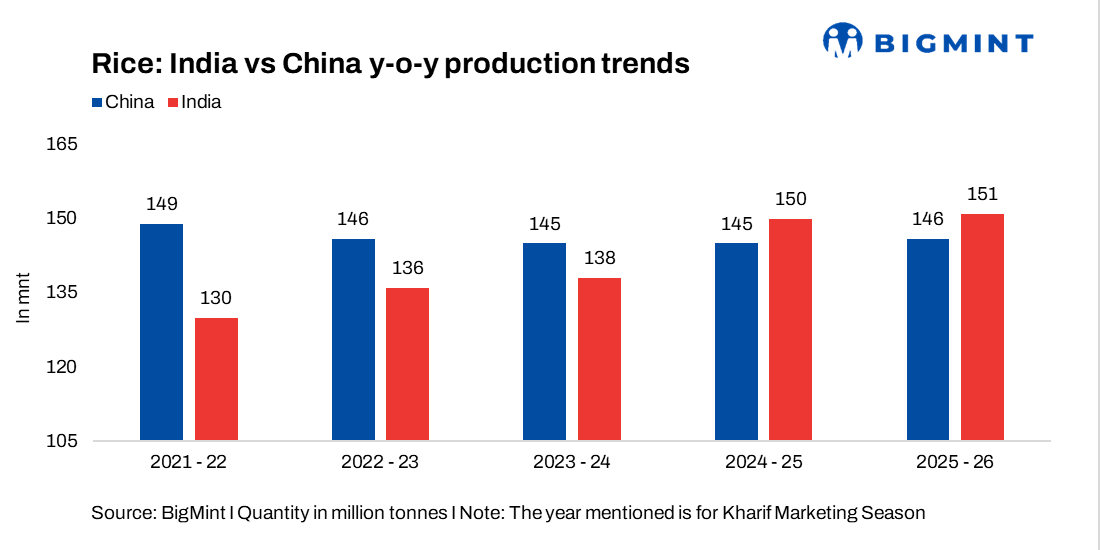
For much of the past decade, China maintained a narrow lead in rice output. In 2021–22, China produced 149 million tonnes against India’s 130 million tonnes. Since then, China’s production has edged lower to the mid-140 million-tonne range, while India’s output climbed consistently, reaching 151–152 million tonnes by 2025–26.
The change reflects not a sudden surge but a cumulative expansion driven by higher acreage under rice, improved seed varieties and favourable minimum support price (MSP) signals that encouraged farmers to retain rice in their crop rotation.
Seeds of the transformation
India’s ascent is rooted in structural changes that began during the Green Revolution. At Independence, the country produced just over 20 million tonnes of rice annually, relying largely on traditional tall varieties with low yields and high susceptibility to lodging.
The turning point came in the 1960s with the introduction of semi-dwarf varieties capable of absorbing fertiliser and irrigation without yield loss. Taiwan’s Taichung Native-1 (TN1), followed by IR-8 developed by the International Rice Research Institute, laid the foundation for modern rice cultivation in India. These varieties sharply lifted yields and enabled multiple cropping cycles.
Indian scientists subsequently developed domestic hybrids such as ‘Jaya’, combining local adaptability with dwarf plant architecture. The shift permanently altered India’s rice production curve and reduced its vulnerability to food shortages.
Yield gap and water stress remain key risks

Despite its production leadership, India continues to lag China in yield efficiency. While India’s average rice yield is projected by the USDA to reach about 4.4 tonnes per hectare in 2025–26, China’s yields are estimated at around 7.19 tonnes per hectare.
The gap reflects differences in mechanisation, varietal intensity and water management. Rice remains one of the most water-intensive crops, and India’s reliance on groundwater-fed irrigation, particularly in Punjab, Haryana and western Uttar Pradesh, has raised concerns over long-term sustainability.
Closing the yield gap without exacerbating water stress will be critical if India’s production gains are to remain durable. Future growth will depend less on expanding acreage and more on productivity improvements, water-efficient cultivation practices and policy alignment with sustainability goals.
India may have overtaken China in volume terms, but sustaining its position as the world’s leading rice producer will hinge on whether output growth can be decoupled from rising environmental costs.
Leave a Reply