- Auction bookings ease as rain hampers material dispatches
- Stable steel prices support selective buying activity
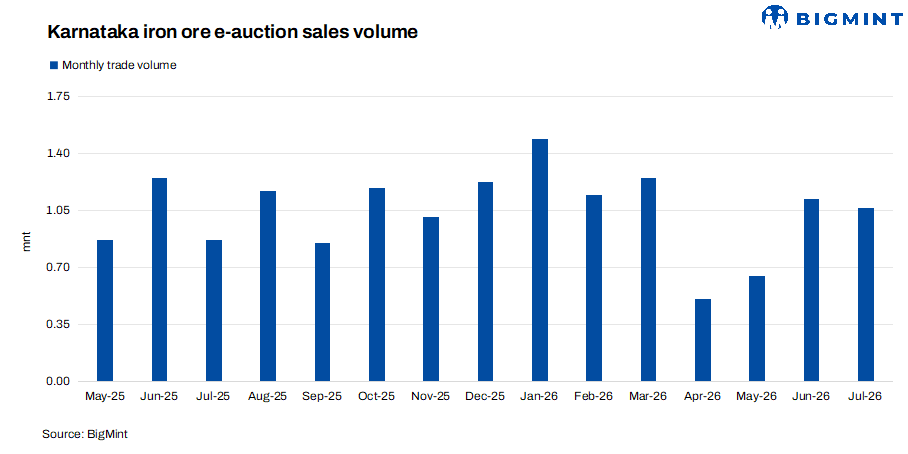
Karnataka’s iron ore e-auction sales declined 4% m-o-m to 1.07 million tonnes (mnt) in July 2026 from 1.12 mnt in June, according to BigMint data. The decline was mainly driven by monsoon-related disruptions to dispatches and pending lifting of previously auctioned material, which limited fresh buying activity during the month.
Of the 1.50 mnt of iron ore offered in July, around 1.07 mnt was booked. Fines accounted for approximately 466,500 tonnes (t), while lumps contributed 604,156 t. Despite logistical constraints, relatively stable sponge iron and finished steel prices provided some support to buying interest.
Rainfall emerged as the key factor limiting auction activity in July. Frequent disruptions to mine-to-market movement affected dispatches and reduced the pace at which buyers could lift material.
Market participants also indicated that a portion of the material booked in earlier auctions had yet to be dispatched. This reduced the urgency among buyers to participate aggressively in fresh auctions, particularly as existing inventories were yet to be cleared and commitments were yet to be fulfilled.
The combination of slower dispatches and pending lifting therefore weighed on auction bookings, even though downstream steel prices remained comparatively stable.
NMDC remains leading seller
NMDC remained the largest seller in Karnataka’s e-auction market, although its sales declined to around 441,439 t in July from 672,000 t in June.
The July bookings comprised approximately 190,000 t of fines and 251,440 t of lumps. Kumaraswamy mines accounted for around 397,440 t of bookings, while Donimalai mines contributed around 44,000 t.
Material from Donimalai mines, being relatively lower grade, saw weaker buyer interest. This, along with the overall reduction in bookings, resulted in a m-o-m decline in NMDC’s auction sales.
Other miners record mixed performance
Karnataka State Minerals Corporation Ltd. emerged as the second-largest seller, with sales rising sharply to around 398,896 t from 238,500 t in June. Higher auction volumes and better availability of higher-grade material supported participation, while both high- and low-grade auctions received relatively good response.
SMIORE ranked third, with sales increasing to around 172,320 t from 104,000 t. Improved auction participation and bookings by sponge iron producers supported the rise.
Sri Kumaraswamy Minerals Pvt. Ltd. sold around 32,000 t, comprising 16,000 t each of fines and lumps, down from 56,000 t in June.
Vedanta’s sales also declined to around 26,000 t from 40,500 t, despite offerings of haematite and siliceous grades.
New miner HG Rangangaouda conducted its second auction, offering 4,000 t, but the entire quantity remained unsold.

Fines prices strengthen while lumps soften
Iron ore prices showed mixed movement in July. The monthly weighted average price of Fe 60% fines increased by INR 150/t m-o-m to INR 3,650/t, while Fe 63% lumps declined by INR 200/t to INR 4,800/t. Prices are exclusive of taxes.
The rise in fines prices reflected stronger buyer participation, as sponge iron makers favoured pellets during the monsoon. In contrast, buyers remained more selective towards lumps at elevated price levels, resulting in softer weighted average prices.
The divergent price movement also suggests that buyers continued to prioritise material offering better economics for sponge iron production, while higher-priced lump ore faced comparatively greater resistance.
Outlook
Karnataka’s iron ore e-auction sales are likely to remain subdued in August as continued rainfall may disrupt mine dispatches and delay lifting of material auctioned in July and earlier months. This could limit fresh auction participation and keep buyers focused on clearing existing commitments.
However, stable sponge iron and finished steel prices may continue to support selective procurement. A recovery in dispatch activity, combined with sustained downstream steel prices, could improve auction participation once logistical constraints ease.
Leave a Reply