- Decision follows mills’ appeal to governor to reconsider bill
- MRT was tabled in Dec’24 to tax non-auctioned iron mines at 3X royalty
In a recent development, Karnataka Governor Thawar Chand Gehlot has returned the state government’s plea for the Mineral Rights and Mineral Bearing Land Tax Bill. During a meeting held yesterday, the governor called for a re-verification of the mineral rights taxation (MRT) bill, along with several other bills on various other agenda, sources informed BigMint.
Commenting on the development, a buyer from the region informed BigMint, “With the heavy charges proposed by the state government, steel mills appealed to the governor to reconsider the bill. Current market conditions, marked by sluggish sentiments, weak demand, and low production levels towards the quarter-end, have already squeezed margins. Buyers are now hoping for positive news, such as that the charges should be applied from the upcoming auctions, allowing them to decide whether to continue sourcing material from the region. Miners must maintain competitive pricing to secure trades.”
On the other hand, a major miner stated, “The governor may delay the bill for a few months by requesting a re-verification but cannot outright reject it.”
As reported earlier by BigMint, as part of the MRT bill, the Government of Karnataka has decided to levy a tax of INR 1/tonne (t) on mineral-bearing areas on auctioned leases. For iron ore-producing regions specifically, an additional tax of INR 100/t will be imposed. Additionally, for non-auctioned iron ore mines, the former tax is far steeper, at three times of royalty. The rates for other commodities vary.
The MRT bill seeks to address revenue shortfalls and streamline Karnataka’s mineral taxation policy. While promoting clarity for mining leaseholders, it underscores compliance and efficient resource monetisation.
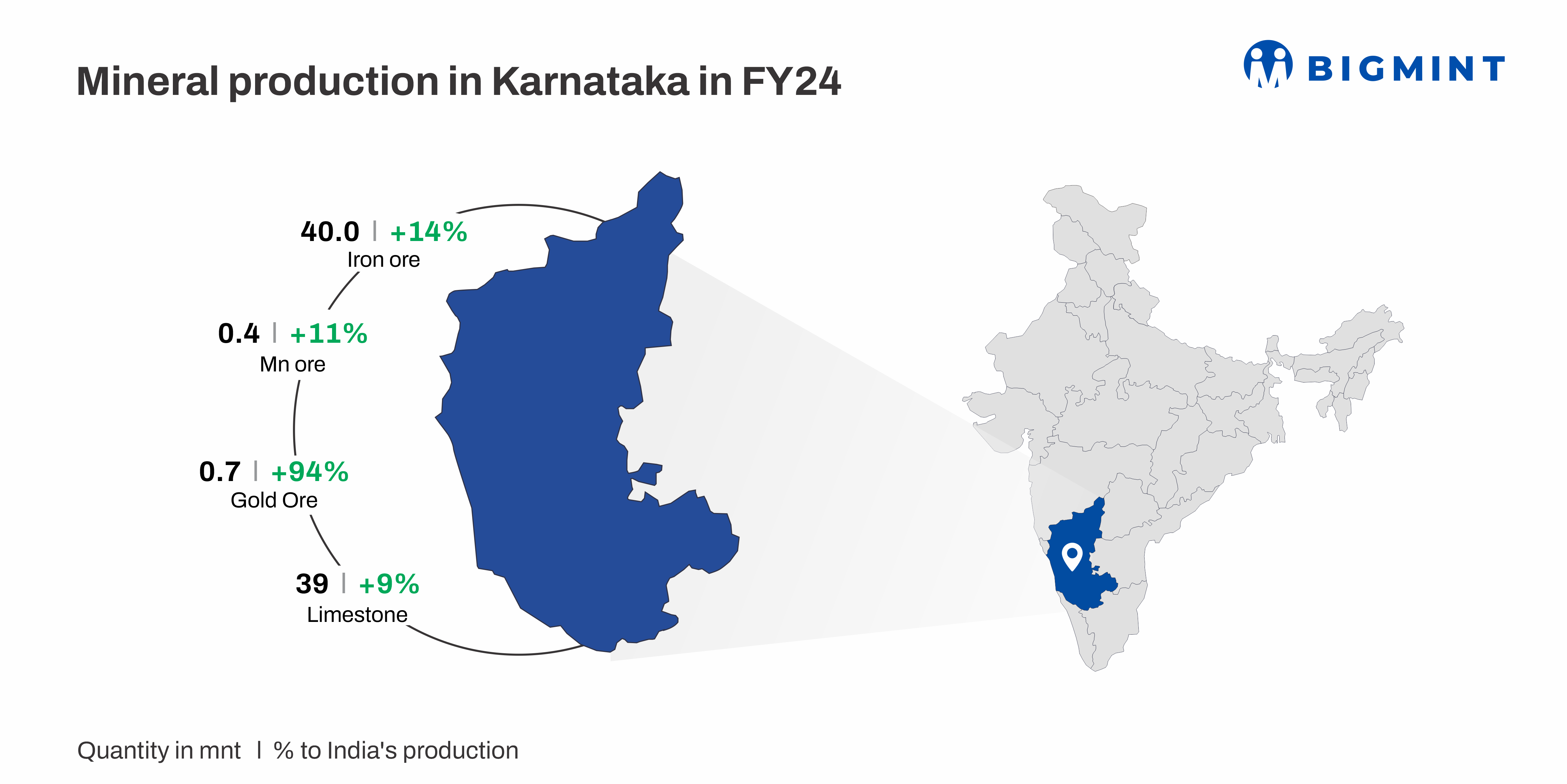
Notably, Karnataka stands as India’s 3rd-largest iron ore-producing state, with volumes at 39.5 million tonnes (mnt) in CY’23, with key producers being NMDC, JSW, Vedanta, SMIORE, and the state’s own Karnataka State Mineral Corporation.
Leave a Reply