- Cement sales rise as North India operations ramp up
- Pricing improves across East, South and West markets
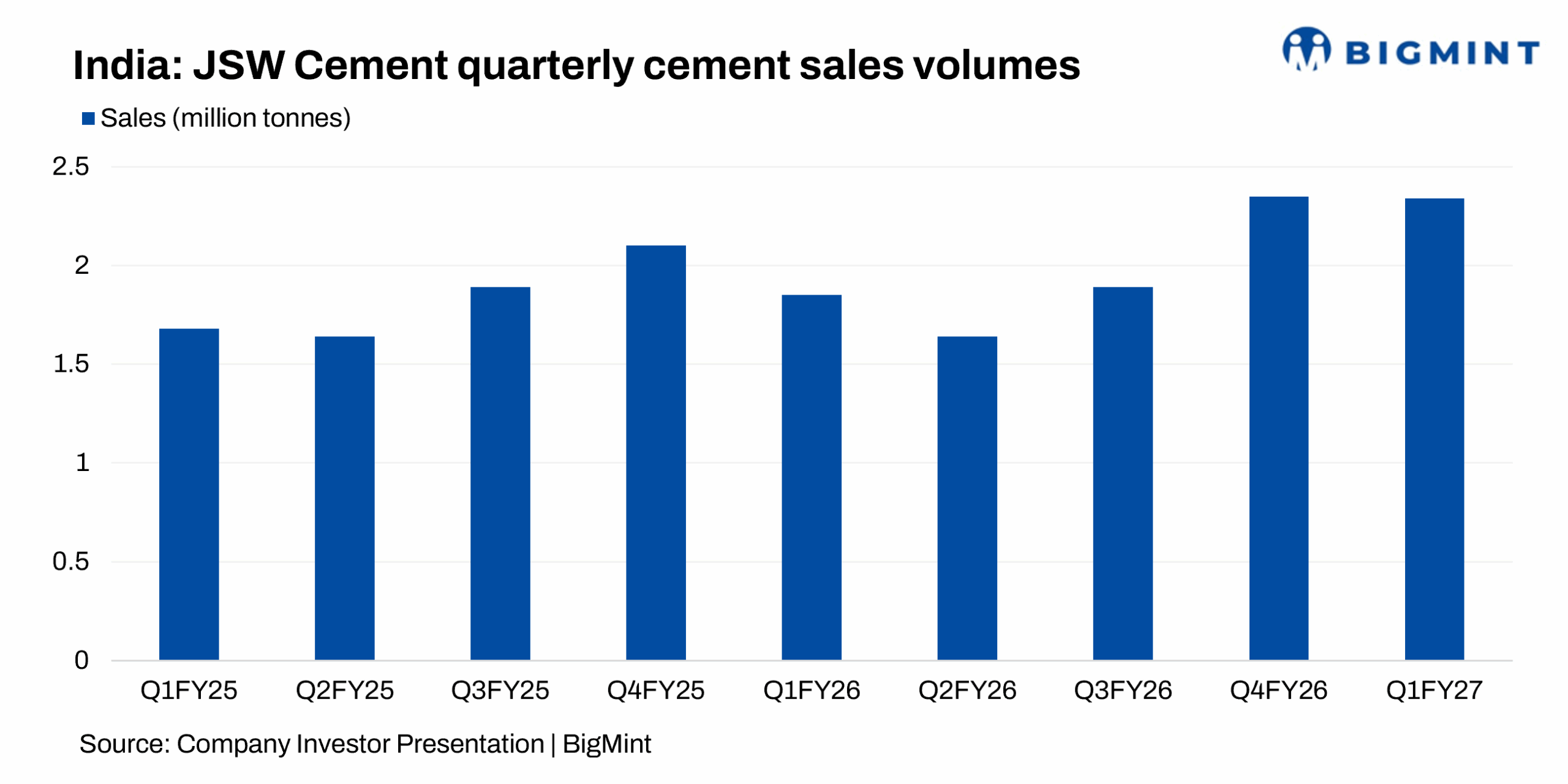
JSW Cement reported a 27% y-o-y increase in cement sales to 2.34 mnt in Q1FY27, supported by growth across existing markets and the ramp-up of its newly commissioned North India operations. Excluding the North business, cement sales increased 8% y-o-y. Overall cement capacity utilisation stood at around 61%, while the Nagaur unit in Rajasthan operated at an average 55% utilisation during the quarter. The company expects strong cement volume growth in FY27, supported by infrastructure activity, residential demand and capacity additions.
Volume growth led by North India ramp-up
The company’s cement sales increased to 2.34 mnt in Q1FY27 from 1.85 mnt in Q1FY26. The North region was a key growth driver following the commissioning of the Nagaur integrated unit in Rajasthan, with sales commencing in April. The facility achieved average utilisation of around 55% in Q1 and exited June at nearly 68%, indicating a faster ramp-up in Rajasthan and Haryana markets.
Excluding North operations, cement sales grew 8% y-o-y, indicating continued underlying growth across the company’s established markets. Demand was subdued during April and early May due to state elections, labor migration and other disruptions, but recovered sharply in June.
The company expects North utilisation to remain above 60% by the end of FY27, although the reported utilization level could moderate temporarily following commissioning of additional grinding capacity.
Regional prices improve amid better market sentiment
Cement realisation increased 6% q-o-q to INR 4,951/t in Q1FY27, with the strongest improvement recorded in the East, followed by the South and West. Excluding North, base cement realization increased around 5.5% q-o-q.
Demand and market sentiments remained constructive across the East and West, while activity in the South was temporarily affected by elections, labor migration and other regional disruptions. Infrastructure and government capex remained key demand drivers, while residential activity in Pune, Hyderabad, Bengaluru and Mumbai supported consumption.
The company expects pricing discipline to remain important as demand improves through FY27, particularly as infrastructure activity and residential construction support cement consumption across its key markets.
GGBS growth remains moderate
Ground Granulated Blast Furnace Slag (GGBS) volumes increased 2.6% y-o-y in Q1FY27, affected by Ready Mix Concrete (RMC) plant closures in the West, aggregate availability constraints in the South, labor migration and an unfavorable OPC-blended mix. The South, which accounts for a larger share of GGBS volumes than the West, was particularly affected by these disruptions.
More than 29 large infrastructure projects received approvals during Q1, supporting the future project pipeline for GGBS demand.
GGBS realisation increased 3.4% q-o-q to INR 3,807/t, primarily reflecting geographical mix rather than a change in pricing strategy. The company expects GGBS volumes growth in FY27, supported by infrastructure and capital expenditure activity.
Input costs remain a margin headwind
Input-cost inflation remained a key operational challenge in Q1FY27. Blended fuel cost increased to around INR 1.80/Mcal from INR 1.49/Mcal in the previous quarter, while packaging costs also increased. Higher fuel costs weighed on operating efficiency despite the improvement in cement realizations.
The company is increasing the use of domestic coal and lignite to reduce exposure to higher-cost fuels. Fuel costs are expected to remain broadly similar in Q2 before declining in Q3 as fuel substitution initiatives take effect.
The commissioning of the overland belt conveyor (OLBC), alternate-fuel handling and co-processing system, and waste heat recovery system at Nagaur is expected to improve energy efficiency and reduce clinker and power costs. These initiatives, together with higher renewable-energy usage, should provide greater cost benefits as the year progresses.
Outlook
The company expects strong cement volume growth in FY27, supported by infrastructure and government capex, residential demand and the continued ramp-up of North India operations. Cement realizations should remain supported by pricing discipline and improving demand conditions. Fuel substitution, WHRS, alternate fuels and renewable energy are expected to improve cost efficiency from Q2 and Q3. Capacity additions at Nagaur and the broader expansion program are expected to support volume growth through FY27.
Leave a Reply