- China demand collapse and Gulf disruptions weigh on export momentum
- Peak arrivals cross 156,000 MT, creating supply overhang in domestic markets
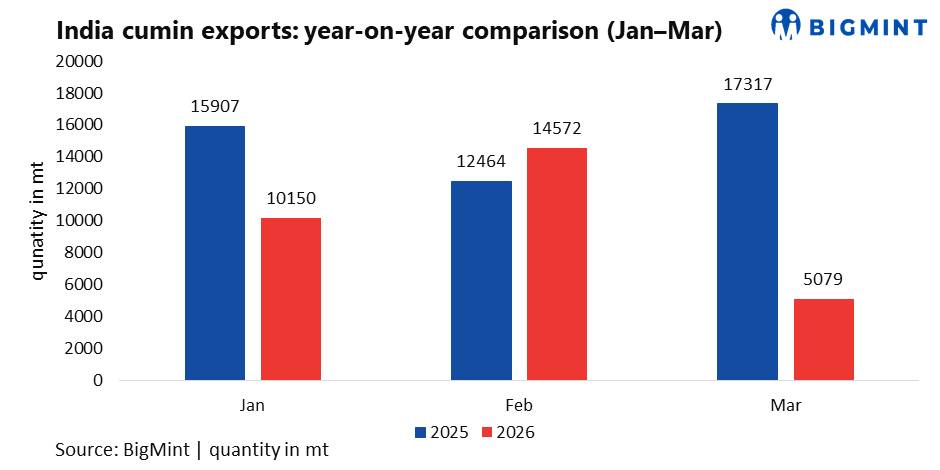
India’s jeera market has weakened in early 2026 as export demand slowed sharply alongside disruptions in key trade routes. Cumin exports in the first three months of the calendar year 2026 declined to 29,801 MT, down 35% year-on-year from 45,689 MT, signalling a clear slowdown in global offtake.
The decline is led by a sharp fall in key markets. China imports dropped to 490 MT from 6,691 MT, down 93%, removing a major bulk buyer. UAE shipments also declined to 4,156 MT from 8,415 MT, down 51%, reflecting weaker re-export demand across the Gulf. Bangladesh became the top buyer at 6,068 MT (20% share), but volumes were still 25% lower y-o-y, indicating a shift driven by contraction rather than growth. The United States imported 2,739 MT (-16%), while smaller markets such as Brazil, Mexico, and Malaysia showed limited gains, insufficient to offset losses from larger destinations.
Monthly trends confirm demand instability. January exports fell 36% y-o-y, followed by a temporary recovery in February at 14,572 MT (+43% m-o-m). However, exports dropped sharply to 5,079 MT in March, down 65% m-o-m and 71% y-o-y, indicating that February shipments were largely backlog-driven rather than reflecting fresh demand.
The slowdown has been compounded by the ongoing Iran-Israel-US conflict, which has disrupted shipping routes through the Gulf. Vessel delays, route diversions, and higher freight and insurance costs have affected cargo movement to key destinations, particularly in the Middle East, limiting export flows.
Rising arrivals intensify supply pressure in domestic markets
Domestic supply has increased significantly with the arrival of the new crop. Total arrivals across key mandis reached 156,211 MT as of 13 April 2026, reflecting peak inflows from Gujarat and Rajasthan.
The higher arrivals are not being matched by demand, resulting in slower offtake and increased mandi-level stocks. Traders report cautious buying, with procurement largely need-based, while stockists remain hesitant amid weak export visibility.
Despite lower crop estimates this season, current arrivals indicate that available supply in the pipeline is sufficient, shifting market focus from production concerns to immediate availability.
Market outlook remains weak amid demand uncertainty
The market is expected to remain under pressure as export demand stays weak and logistics disruptions persist. The absence of China, reduced Gulf demand, and continued supply inflow are limiting upside potential.
In the near term, the market is likely to trade with a downward bias, with any price rise attracting selling interest. A recovery will depend on improved export demand and normalization of trade flows. Until then, weak exports and high arrivals are expected to keep jeera prices under pressure.
Leave a Reply