- Persistent rains hamper mining, material movement
- Sellers focus on fulfilling pending bookings
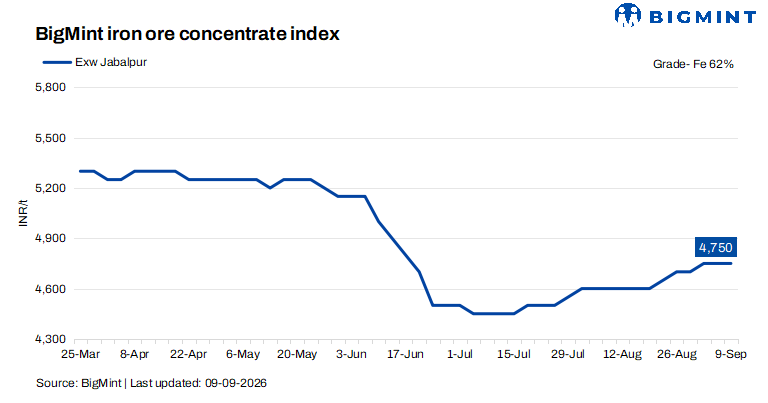
India’s iron ore concentrate prices edged up w-o-w on 9 September amid tightening availability, monsoon-related mining disruptions, and continued support from the pellet and Odisha iron ore markets. BigMint’s bi-weekly assessment for Fe 62% concentrate stood firm at INR 4,750/t ($49/t) ex-works, while Fe 63% concentrate offers were heard at around INR 5,200/t ($52/t). Some sellers were also heard offering 62% material at around INR 5,000/t ex-works.
Market activity, however, remained subdued as continuous rainfall disrupted mining and internal movement of raw materials, limiting the availability of fresh concentrate. Several sellers were also occupied with fulfilling pending dispatches from earlier bookings, restricting their ability to take on new orders until backlogs are cleared. As a result, fresh deals remained largely absent during the week, with buyers reluctant to match the higher offers quoted by sellers.
The bid-offer disparity widened, with buyers seeking lower prices while sellers remained unwilling to reduce offers amid supportive market conditions and limited material availability. The supply tightness was further aggravated by grade deterioration, with market participants reporting difficulty in securing even Fe 62% material. A Jabalpur-based seller told BigMint that “persistent rains had halted new mining and restricted internal movement, while grade availability remained a concern, with Fe 61% increasingly emerging as the practical benchmark.”
Despite limited spot transactions, underlying market sentiment remained supportive, backed by higher pellet prices, firm Odisha iron ore prices and relatively favourable downstream conditions. However, buyers remained cautious and continued to rely on previously purchased inventories, limiting immediate spot demand. A buyer noted that “concentrate consumption has been reduced temporarily and current requirements are being met from earlier purchases, while sellers’ offers are too high.”
Meanwhile, a trader told BigMint that “higher-priced offers are unlikely to be accepted by buyers,” indicating that the prevailing bid-offer gap continues to restrict fresh transactions.
Rationale
- One (1) trade was recorded in this publishing window, which was taken into consideration. Therefore, this category received a 50% weightage.
- Ten (10) offers and indicative prices were heard, in which eight (8) are taken into consideration as T2 trades, receiving 50% weightage.
Factors shaping market dynamics
- PELLEX remain firm w-o-w: PELLEX, BigMint’s bi-weekly domestic pellet (Fe 63%) index for Raipur stood steady w-o-w at INR 11,000/t DAP Raipur on 8 September 2026. Prices continued to hold firm, supported by healthy downstream demand, particularly from the billet and sponge iron segments, which has kept the overall steel market in a relatively favourable position for pellets. Major pellet sellers largely maintained offers at around INR 10,800-10,900/t ($114-115/t) ex-works, with limited pressure to lower prices amid continued downstream support.
- Odisha iron ore prices rise by INR 100/t ($1/t): Odisha iron ore fines prices increased by INR 100/t ($1/t) w-o-w, with BigMint’s Fe 62% assessment reaching around INR 5,100/t ($54/t) ex-mines on 5 September 2026. Despite the increase, spot market activity remained subdued as steelmakers adopted a cautious, wait-and-watch approach and largely restricted purchases to immediate requirements. Sellers, meanwhile, maintained their offers amid limited pressure to reduce prices, resulting in stable-to-firm market conditions despite muted buying interest.
Outlook
Iron ore concentrate prices are expected to remain firm to slightly higher in the coming week, supported by persistent monsoon-related mining and logistics disruptions, limited availability of higher-grade concentrate and continued strength in pellet and Odisha iron ore prices. However, the wide bid-offer gap, cautious buying and reliance on existing inventories are likely to limit spot transactions and cap the extent of further price gains. Any improvement in dispatches or easing of supply constraints could moderate the upward momentum.
Leave a Reply