- Buyers remain cautious about fresh bookings
- Sellers prioritise order completion over fresh offers
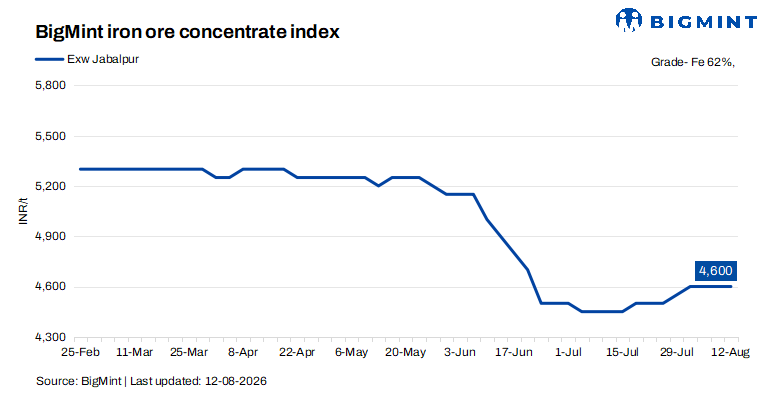
India’s iron ore concentrate market remained stable during the latest assessment, but underlying conditions pointed to a fragile balance between restricted spot availability and increasingly cautious buying. BigMint’s bi-weekly assessment for Fe 62% concentrate stood unchanged at INR 4,600/t ($48/t) ex-works on 12 August 2026 against its last assessment on 8 August, while Fe 63% concentrate offers were heard at around INR 4,900/t ($52/t) ex-works. Sellers continued to defend prevailing levels despite limited fresh bookings, supported by monsoon-related disruptions that have tightened prompt availability in parts of the market.
Railway restrictions and raw material shortages have disrupted both production and dispatches, delaying execution of previously contracted orders. Several sellers are therefore prioritising old commitments over fresh spot sales, while some have temporarily withheld new offers until existing orders are completed. A Jabalpur-based seller said, “We have put our offers on hold as we are currently executing old orders. We will come to the market with fresh offers after completing them.”
On the demand side, buyers have adopted a defensive procurement strategy, relying on existing inventories rather than building stocks during the monsoon. Moisture-related concerns, uncertain consumption and elevated coal costs have further reduced buying appetite, keeping transactions largely need-based. A buyer said, “We are using our inventory rather than buying fresh material because moisture is a concern during the monsoon. Prices may soften going forward.”
At the same time, the market received a softer price signal from NMDC, which reduced its iron ore list prices by INR 100-200/t on 8 August. DR CLO (10-40 mm, Fe 67%) was fixed at INR 5,750/t ($60/t), while Fe 64% fines were reduced to INR 4,500/t ($47/t). The lower benchmark has increased pressure on concentrate sellers, although weather-related supply and logistics disruptions are currently preventing this bearish signal from translating into a meaningful spot price correction.
Rationale
- Zero (0) trade was recorded in this publishing window, which was taken into consideration. Therefore, this category received a 0% weightage.
- Ten (8) offers and indicative prices were heard, and nine (9) were taken into consideration as T2 trades, receiving 100% weightage.
Factors shaping market dynamics
- PELLEX remains stable w-o-w: Concentrate market sentiment continued to receive support from the pellet segment. BigMint’s bi-weekly domestic pellet (Fe 63%) index for Raipur remained unchanged at INR 10,200/t ($107/t) DAP on 11 August 2026 from the previous assessment on 7 August. Raipur-based pellet makers raised offers by INR 100/t amid relatively tight spot availability, but buyers remained cautious due to weak demand in the finished and semi-finished steel segments. Expectations of upcoming maintenance shutdowns at local rolling mills and sponge iron units further weighed on procurement activity. Despite subdued buying, limited spot availability enabled sellers to hold their offers, keeping the index unchanged.
- Odisha iron ore prices increase marginally w-o-w: BigMint’s Odisha iron ore fines (Fe 62%) index remained unchanged w-o-w at INR 5,000/t ($52/t) ex-mines on 8 August 2026. Market activity remained subdued amid the monsoon, with limited offers and need-based procurement. However, rainfall-related disruptions to mining and dispatches provided some price support, while higher coal costs kept sponge iron producers cautious on fresh purchases, limiting upside despite continued inquiries for Fe 60%+ fines.
Outlook
Iron ore concentrate prices may remain stable through the monsoon as production and logistics disruptions restrict spot availability. However, cautious buying, elevated consumer inventories, softer NMDC benchmarks and higher conversion costs could increasingly limit sellers’ ability to push prices higher. A clearer price direction is likely to emerge as monsoon-related disruptions ease and buyers return for fresh procurement.
Leave a Reply