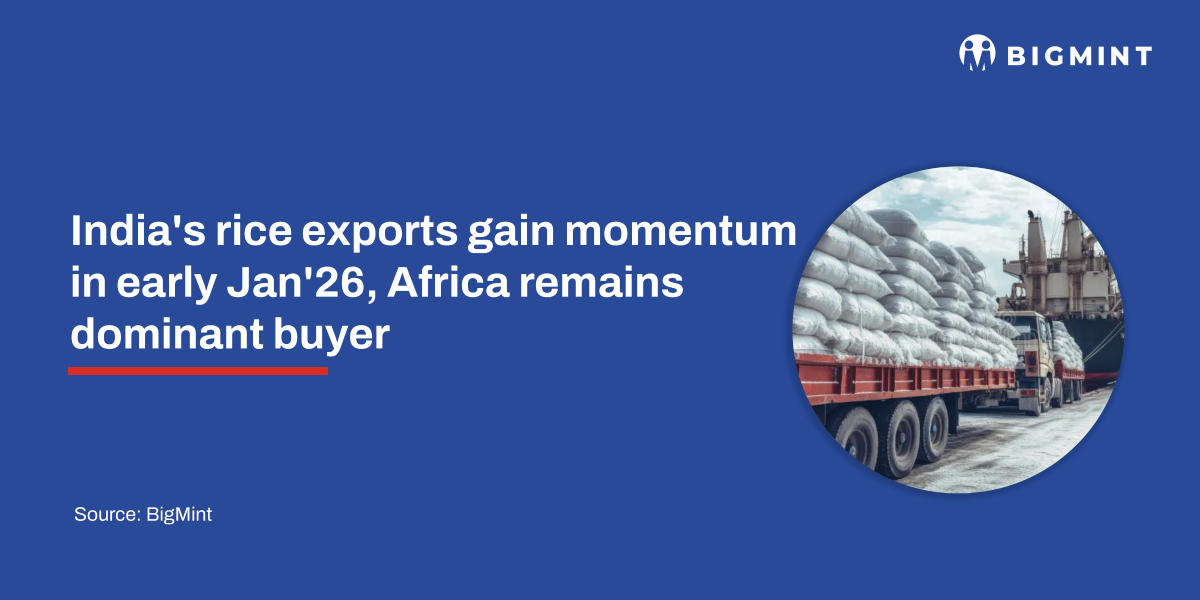
- IR64 parcels to West Africa underpin weekly shipments
- Kakinada and Kandla anchor export flows as buyers diversify origins
India’s non-basmati rice exports gathered pace in early January, supported by firm demand from West and Southern Africa and steady buying interest across a range of parboiled specifications. Between 3 January and 16 January, total shipments reached 312,710 tonnes (t), reflecting continued export momentum despite w-o-w variability in cargo scheduling.
Export activity remained concentrated at Kakinada and Kandla ports, underscoring their importance in servicing African destinations with bulk IR64 shipments as well as containerised bagged rice.
Shipment trends show uneven loading patterns

Shipments during the two weeks under review displayed a marked divergence in loading intensity. Between 3-9 January, exports totalled 178,500 t, driven primarily by large IR64 parcels, including 161,500 t of parboiled rice, alongside 17,000 tof bagged consignments. In contrast, volumes eased to 134,210 t during 9–16 January, with IR64 shipments accounting for 95,210 t, supplemented by 39,000 t of bagged rice.
The variation reflects shipment bunching around vessel availability and buyer-specific delivery timelines rather than a shift in underlying demand.
IR64 dominates flows to West Africa

IR64 parboiled rice continued to anchor India’s export basket, particularly to West Africa. Liberia emerged as the largest destination during the period, absorbing 100,000 t of IR64 5% parboiled and 100% white rice, shipped entirely from Kakinada. Cargoes were split across multiple loadings, with Olam Agri India Limited and Sri Tharaka Rama Rice Mill accounting for the bulk of shipments to Monrovia.
Sierra Leone followed, importing 36,500 t of IR64 rice through Freetown, including higher-broken grades such as IR64 20% parboiled with 5% white rice. Shipments were led by Louis Dreyfus Company India Private Limited and Satya Agro Industries Private Limited, indicating continued acceptance of mixed-specification cargoes in the West African market.
Benin remained another key outlet, with 39,000 t of IR64 25% parboiled rice shipped to Cotonou. Volumes were distributed among multinational exporters and domestic players, including Olam Agri India Limited, Reliance Industries Limited, KRIBHCO, Manasa Agro Products, and Chitra Agro Products, highlighting broad-based participation in the trade.
Bagged rice exports spread across Africa and Asia
Alongside bulk shipments, bagged rice exports remained steady, particularly from Kandla. Ivory Coast emerged as the largest bagged rice destination, receiving over 36,000 t through Abidjan. Cargoes were shipped by a wide range of exporters, from large trading houses to mid-sized millers, reflecting stable retail and institutional demand.
Southern African markets also remained active. Mozambique imported 9,300 t via Beira, while Angola received more than 23,000 t through Luanda, underlining India’s competitiveness in supplying packaged rice to price-sensitive markets.
In Asia, Bangladesh imported 17,000 t through Chittagong, while Yemen received 21,500 t via Hodeidah, largely in bagged form, pointing to continued dependence on Indian rice for food security needs.
Outlook hinges on African demand and logistics
With African buyers continuing to favour IR64 parboiled rice across multiple broken specifications, India’s non-basmati export pipeline remains well supported. The dominance of Kakinada and Kandla ports, combined with participation from both multinational firms and domestic exporters, points to a resilient export supply chain.
Market participants are now monitoring buyer appetite in West Africa and portside logistics in India to assess whether shipment volumes can be sustained at comparable levels through the remainder of January.
Leave a Reply