- Tight power plant stocks support prices, limiting downside despite weak demand
- Rising port inventories and cautious buying keep prices rangebound with a bearish bias
Indian portside prices of Indonesian thermal coal remained largely stable w-o-w during the week ended 23 October 2026, as subdued spot market activity and cautious buying offset the support provided by tight domestic power plant inventories.
While power demand remains firm, limited availability of domestic coal and elevated import prices have kept buyers on the sidelines, with many market participants expecting some downward correction before increasing procurement.
Portside prices firm as buyers adopt wait-and-watch approach
Prices of Indonesian thermal coal at major Indian ports remained unchanged w-o-w across key grades. 5,000 GAR coal was assessed at around INR 11,700/t at Kandla and INR 11,600/t at Vizag, while 4,200 GAR coal remained stable at approximately INR 9,800/t at Kandla and INR 9,700/t at Vizag. Similarly, 3,400 GAR coal at Navlakhi was assessed at around INR 7,750/t.
Market sentiment remains cautious, with participants reporting a pause in buying activity amid relatively weak spot demand. Although power demand is currently elevated, domestic coal allocation remains constrained, limiting the ability of some consumers to fully meet their requirements through domestic supplies. Imported coal is readily available; however, prevailing prices are considered relatively high, prompting buyers to defer purchases in anticipation of a possible decline in international and portside prices. As a result, physical market prices have shown little movement despite the underlying requirement from the power sector.
Tight power stocks keep a floor under imported coal prices
Despite subdued spot-market activity, declining coal inventories at Indian thermal power plants continue to provide an important downside cushion to imported coal prices. Power-plant coal stocks declined by around 3.5% w-o-w to 19.73 million tonnes (mnt) as of 22 October, equivalent to only around six days of consumption. Furthermore, nearly 98 power plants were reportedly operating with critically low coal inventories.
The tightening inventory position is significant because it limits the scope for a sharp and sustained decline in coal prices. While buyers remain reluctant to procure at current elevated levels, the need to replenish depleted stocks — particularly ahead of any improvement in power demand — could encourage restocking activity. This creates a firm price floor for imported coal, even as spot-market liquidity remains subdued.
Rising port stocks signal slower offtake and cautious procurement
The increase in coal inventories at Indian ports, meanwhile, highlights the current weakness in physical offtake. Coal stocks at ports covered under BigMint’s week 42 assessment rose by approximately 0.38 mnt, or 2%, to 19.06 mnt during 11–17 October 2026. Non-coking coal inventories increased by around 2.2% to 13.69 mnt, while coking coal stocks rose by 1.6% to 5.37 mnt.
The rise in port inventories indicates that arrivals are currently outpacing immediate consumption, reflecting cautious procurement by end-users. Higher landed costs and expectations of softer international prices have encouraged buyers to maintain a hand-to-mouth purchasing strategy rather than build substantial inventories. Unless downstream demand improves, elevated port stocks could continue to cap near-term price gains.
Mixed Indonesian benchmarks reflect divided international market
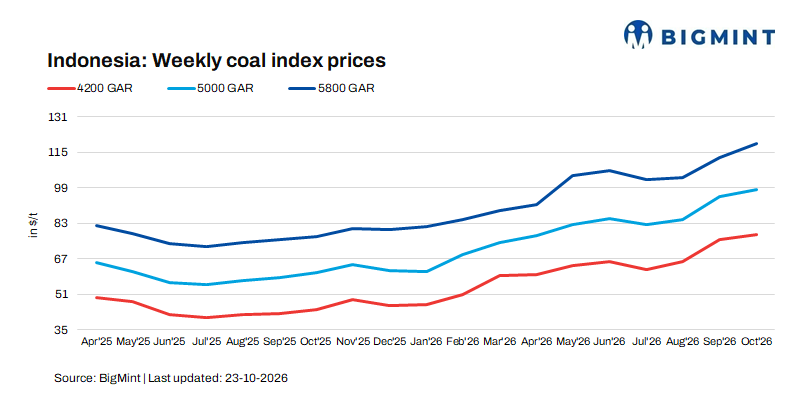
Indonesian FOB benchmarks showed a mixed trend during the week, suggesting differing supply-demand dynamics across coal grades. 4,200 GAR prices declined marginally by around $0.1-0.3/t, while 5,800 GAR prices recorded a more pronounced decline of approximately $1-2/t. In contrast, 3,400 GAR prices increased by around $1-2/t, indicating relatively stronger support in the lower-CV segment.
The mixed benchmark movement points to a market that is not yet witnessing a broad-based directional shift. Softer high-CV prices could provide some relief to Indian buyers in the coming weeks, while firmer low-CV values may limit the extent of any decline in corresponding portside prices.
Outlook
Indonesian thermal coal prices in India are expected to remain largely stable with a mild downside bias in the near term, as weak spot demand, rising port inventories and cautious buying limit upward movement. However, tight power-plant stocks, firm electricity demand and constrained domestic coal availability should provide downside support. The post-Diwali demand recovery will be key. Improved buying and restocking could strengthen prices, while continued weak offtake and higher port inventories may lead to a modest correction. Overall, prices are likely to remain rangebound in the short term.
Leave a Reply