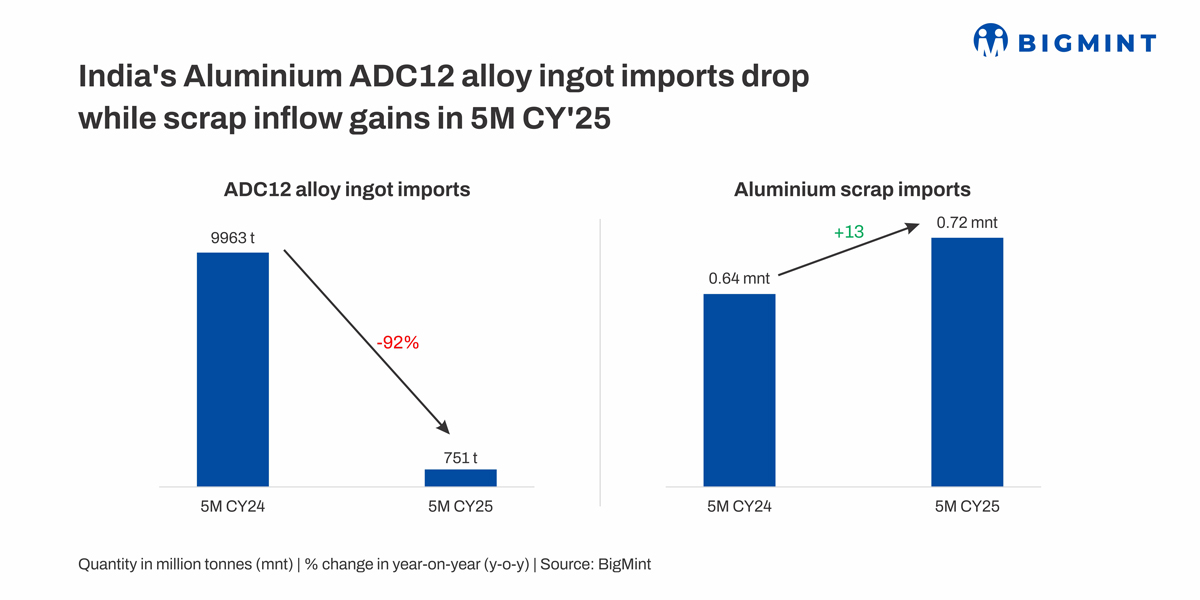
- ADC12 alloy imports plunge 92% y-o-y in 5MCY’25
- Malaysian shipments hit hardest despite FTA advantage
- Tight aluminium scrap supply, rising prices drive up ADC12 rates
Morning brief: India’s ADC12 alloy market witnessed a dramatic contraction in imports during the first five months of 2025 (5MCY25), with inbound volumes plunging by 92% year-on-year. Total ADC12 imports stood at just 751 tonnes (t), down sharply from 9,963 t in 5MCY’24.
The most significant decline came from Malaysia, which had historically been India’s top ADC12 supplier. Imports from Malaysia dropped by 95%, falling to 450 t from 8,398 t a year earlier. This was primarily due to delays in obtaining Bureau of Indian Standards (BIS) certifications, despite the existing Free Trade Agreement (FTA) between the two countries. While most Malaysian producers had applied for BIS approval, the lengthy and complex certification process severely hampered shipments. Notably, all ADC12 imports from Malaysia during this period were directed to southern India.
Domestic ADC12 prices surge
Due to decreasing imports and supply challenges India’s ADC12 prices remained resilient amid ongoing domestic and imported scrap shortages. As per BigMint assessments, in Delhi NCR, ADC12 prices in May 2025 settled at INR 228,000/t, marking a INR 20,000/t increase from January’s INR 208,000/t. In Chennai, prices reached INR 230,000/t, up INR 22,000 over the same period.
The spread between ADC12 and tense scrap has remained consistent between INR 31,000-33,000/t in both key regions, reflecting tight margins due to elevated raw material costs.

As per BigMint’s lastest assesment for June 2025, ADC12 prices in the north as well as south has remained firm m-o-m at INR 228,000/t in Delhi and INR 230,000/t in Chennai amid firm scrap prices.
A major Indian automaker raised its ADC12 settlement prices by INR 12,900/t, from INR 208,000/t in January to INR 220,900/t in May. June settlements rose further to INR 226,750/t, and market participants anticipate additional hikes in July as spot rates continue to outpace contract levels.
As per sources, the scrap shortage is expected to persist throughout the first half of 2025, keeping pressure on ADC12 availability and pricing.
Aluminium scrap imports rise

While ADC12 imports fell, India’s aluminium scrap imports increased by 13% y-o-y to 0.72 mnt in 5MCY’25, up from 0.64 mnt in 5MCY’24. This growth was largely a result of India compensating for lower US scrap supply by sourcing more material from countries like the UAE, UK, and Saudi Arabia.
However, despite the overall volume increase, supply of key grades like Taint Tabor, Zorba, and Extrusion from the US declined sharply, due to recent US trade policies.
US aluminium scrap exports to India declined by 12% y-o-y, dropping from 150,383 t in the first five months of calendar year 2024 (5MCY24) to 132,101 t in 5MCY25. Among the various scrap grades, Zorba remained relatively stable, recording a marginal decrease compared to the previous year. However, Taint Tabor experienced a significant decline of 28%.

Interestingly, Tense was the only major grade to register a rise, increasing by 11%. On the other hand, Extrusion (Tread) imports dropped sharply by 48%. The category of other grades also saw a considerable fall of 24% in 5MCY’25.
In response to the decline in aluminium scrap exports from the US, India significantly ramped up its imports from alternative sources to meet domestic demand. Shipments from the United Arab Emirates surged by 52% in 5MCY’25. Imports from the United Kingdom increased modestly by 4%, while Saudi Arabia’s contribution edged up by 2%. Additionally, imports from a wider pool of other countries grew substantially by 22% during the same period.
Region-wise scrap arrivals
In 5MCY’25, aluminium scrap arrivals across India showed notable regional variation. The northern region accounted for the largest share, receiving approximately 0.31 mnt, a 7% increase y-o-y. The western region followed, registering an 11% rise. The southern region, though smaller in volume recorded the highest growth at 27%. Similarly, the eastern region, also saw a 27% jump, albeit from a lower base.

In terms of the import channel, producers accounted for 60% of total aluminium scrap imports, while traders contributed the remaining 40%.
Global policy shifts drive scrap shortage
The decline in US scrap exports is rooted in tariff hikes introduced by President Donald Trump, who raised aluminium import tariffs from 10% to 25% in March 2025, and then to 50% effective June 4, 2025. Though aluminium scrap was exempt, the US began to consume more domestic scrap due to a 14% drop in finished aluminium imports, which fell to 0.66 mnt from 0.77 mnt in 5MCY’24.
This increase in domestic scrap consumption led to higher prices in the US, making exports to India economically unfeasible. Market sources noted that U.S. scrap offers dried up altogether in some weeks, especially for grades like Taint Tabor, Extrusion, and Zorba.
Scrap prices surge globally and locally
Rising demand and falling LME stockpiles drove global scrap prices higher. The LME aluminium price averaged $2,533/t in 5MCY’25, up from $2,374/t a year earlier. Meanwhile, LME aluminium inventories fell by 20%, from 619,276 t to 498,369 t.
In line with the increase in LME aluminium prices, average prices for both imported and domestic aluminium scrap in India also recorded an upward trend during 5MCY25.

Looking ahead
The global aluminium market continues to shift rapidly. The US’s doubling of import tariffs — while exempting scrap — has intensified scrap demand in North America, especially from Canada and Mexico. This, in turn, has caused a “scrap drain” in Europe, with EU nations now considering export duties, expected as early as July.
For India, which is heavily dependent on imported scrap, the impact is twofold: rising input costs for domestic ADC12 producers and reduced availability of competitively priced ingots from abroad. Until BIS certifications ease and global trade flows stabilise, the ADC12 market is likely to remain tight well into the second half of the year.
Leave a Reply