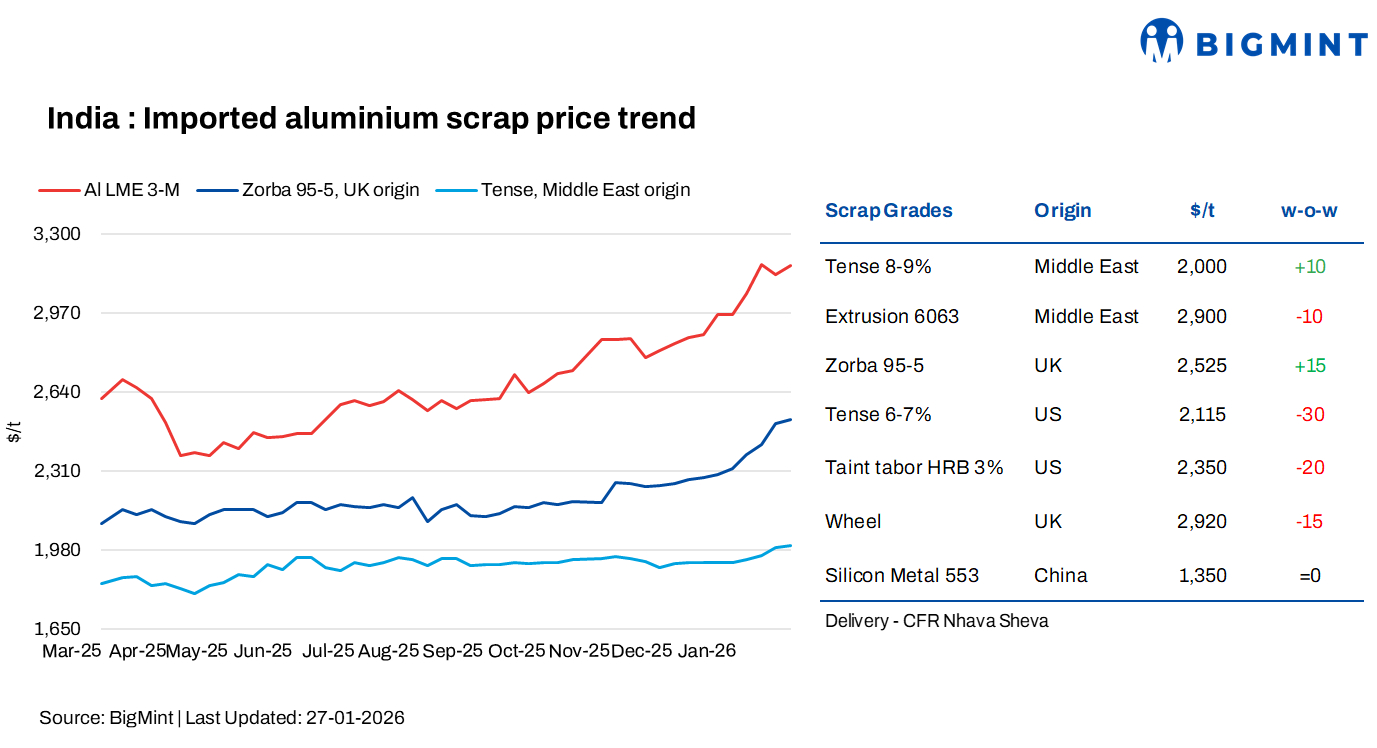
- Scrap import offers stay elevated, bid-offer disparity persist
- Tense scrap trades at premium across southern India
India’s imported aluminium scrap prices showed mixed movements as of 27 January 2026 despite firm prices on the London Metal Exchange (LME) and tight domestic supply. While a few grades registered marginal w-o-w corrections, overall prices remained elevated. BigMint assessed Middle East-origin Tense (8-9%) at $2,000/tonne (t), up $10/t w-o-w, whereas Extrusion 6063 edged down by $10/t to $2,900/t, though demand for the grade remained firm.
Meanwhile, other assessments showed divergent trends across key scrap grades. UK-origin Zorba 95/5 rose by $15/t to $2,525/t, while US-origin Tense (6-7%) declined $30/t to $2,115/t. US-origin Taint Tabor HRB (3%) slipped $20/t to $2,350/t, and UK-origin Wheel scrap fell $15/t to $2,920/t.
LME aluminium prices ease
LME aluminium three-month prices rose by 1% w-o-w to $3,172/t from $3,131/t on 20 January 2026. Similarly, LME aluminium inventories rose by 5% or 22,275 t from 483,000 t to 505,275 t.
Aluminium prices increased w-o-w, as supply-side tightness outweighed mixed demand signals. Market sentiment was supported by China’s strict enforcement of its 45 million tonnes (mnt) smelting capacity cap, which limited incremental supply despite early signs of improvement in domestic consumption. A sharp y-o-y decline in Chinese exports further tightened global availability, while delays and escalating costs in overseas capacity expansions, particularly in Indonesia, added to supply-side pressures.
Market insights
The imported aluminium scrap market remained firm, with overseas offers continuing to stay elevated due to tight global supply and firm seller expectations. While a few buyers accepted higher prices to secure material, most remained cautious amid high price risk and LME volatility, resulting in limited spot buying activity.
Despite a correction in some imported scrap grades, offers remained elevated from the buyers’ perspective. Bid-offer disparities persisted across several scrap grades, reflecting the ongoing gap between seller expectations and buyer willingness. Most buyers remained reluctant to import material amid high price levels and unfavourable currency exchange conditions. Meanwhile, a limited number of secondary producers were compelled to procure scrap at elevated prices in order to fulfil their monthly supply commitments to OEMs.

Meanwhile, the domestic aluminium scrap market remained extremely tight, with acute supply shortages emerging as the primary driver of prices. Availability of key grades, particularly Tense scrap, was severely constrained, intensifying competition for spot material. As a result, Tense scrap in Chennai continued to trade at a premium, with deals reported last week at INR 210,000-212,000/t, underscoring the severity of the domestic supply crunch.
The tightness in domestic availability was largely attributed to a slowdown in imported scrap bookings during November and December, as elevated prices and extreme volatility in imported scrap values discouraged buying. This volatility, driven by sharp fluctuations on the LME amid a global supply crunch, significantly reduced import inflows, exacerbating supply constraints in the domestic market.
“The situation on the ground remains extremely challenging. Tense scrap prices in Coimbatore are currently around INR 212,000-213,000/t, while prices in Kerala are reported to be even higher. There is a severe shortage of scrap across the market, including imported material. With prices remaining highly volatile, it has become difficult to import scrap,” said a source.
The source also added, “At the same time, our customers are unable to revise ADC12 prices easily, which is putting significant pressure on margins. Doing business under these conditions is becoming increasingly difficult, and our volumes are declining as input costs continue to rise. The situation is further complicated by export restrictions on aluminium scrap imposed by several supplier countries, and growing concerns around a potential recession are adding to overall market uncertainty.”
Chinese silicon prices
According to BigMint, China-origin silicon metal 553 prices stood stable w-o-w at $1,350/t on a CFR Nhava Sheva basis, supported by firm demand from aluminium alloy producers amid tight availability.
Outlook
India’s aluminium scrap market is likely to remain firm in the coming weeks, supported by persistent supply tightness across both imported and domestic segments. Limited availability of key grades, ongoing import constraints, and cautious buying are expected to keep prices elevated. Meanwhile, LME aluminium prices are anticipated to remain firm in the near term, lending additional support to scrap price sentiment.
Leave a Reply