- US scrap unviable due to high prices
- Buyers face higher costs, increased competition
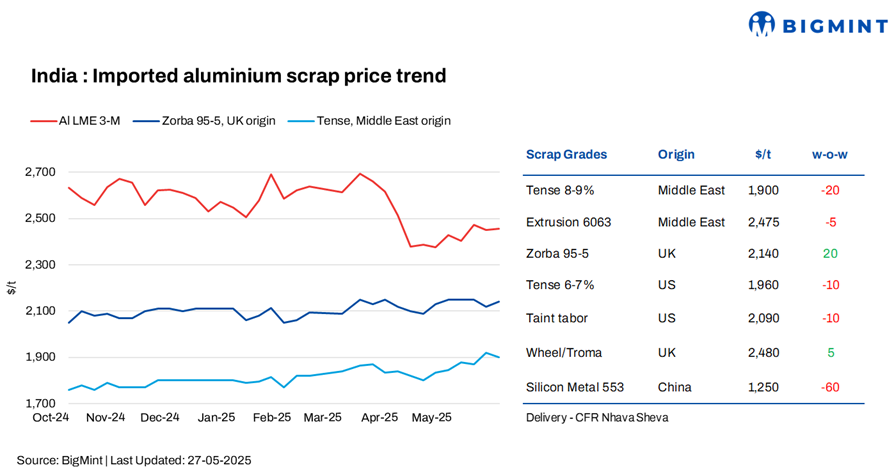
India’s imported aluminium scrap prices remained largely range-bound w-o-w, influenced by robust global demand, fluctuating LME prices, and ongoing supply constraints. Tight raw material availability persists, with a major automaker’s high price settlements keeping scrap prices elevated.
BigMint assessed Tense scrap from the US at $1,960/t, down by $10/t w-o-w, while Wheels from the UK were up $5/t w-o-w to $2,480/t, both CFR west coast, India. At the time of reporting, LME aluminium prices stood at $2,456/t, range-bound w-o-w.
Additionally, a major Indian automaker has raised its ADC12 settlement prices by INR 5,850/t m-o-m to INR 226,750/t for June, a 3-year peak, last seen in May’22. The increase is driven by strong imported aluminium scrap prices and lower aluminium alloy imports. Consequently, the scrap-to-ADC12 spread in May narrowed by INR 4,150/t m-o-m to INR 31,000-32,000/t due to an increase in tense scrap prices.
Market sentiments
Amid trade tensions between the US and China, direct trade has been disrupted by tariffs and other restrictions. Consequently, scrap that would typically be shipped to China is increasingly diverted to Southeast Asian countries like Malaysia, Thailand, and Indonesia. There, it is processed into clean or alloyed ingots before being re-exported–often commanding a premium in global markets.
A source commented that Indian buyers are particularly concerned about reduced access to high-quality raw aluminium scrap, such as Tense and Taint/Tabor. With more material being processed and re-exported from Southeast Asia, Indian buyers now face higher costs and increased competition, as persistent supply shortages and strong global demand continue to keep prices elevated.
A market participant noted, “US scrap is not being imported as prices are currently unviable for Indian buyers, making it more expensive compared to supplies from other countries. Also, some grades were at a premium in the US domestic market.” As a result, Indian buyers are actively seeking alternative sources, but the supply of quality scrap remains tight and costly.
An Indian market participant noted that a strategic rethink was essential. “India may need to increase domestic scrap collection, invest in local processing capacity, and secure long-term contracts with reliable suppliers to ensure stable raw material access,” he said.
As per reports, India, now the world’s third-largest automotive market, is driving strong growth in secondary aluminium demand, projected to rise at a CAGR of 7-11% through 2028. This surge is fuelled by steady vehicle sales and expanding production capacity.
However, supply of quality aluminium scrap remains tight, creating a supply-demand imbalance. This shortage has pushed up prices for imported scrap in recent months.
A buyer source commented, “To sustain growth, India must address these supply constraints by enhancing domestic scrap collection and processing capabilities, ensuring a stable raw material base for the booming automotive sector.”

Silicon price trends
According to BigMint’s assessment, silicon 553 prices from China dropped by 60/t to $1,250/t CFR Mundra on a w-o-w basis.
Outlook
Tightening supply is expected to drive scrap prices higher for Indian buyers, especially as imports of alloyed ingots are also on the decline. Manufacturers, already dealing with elevated import costs and intensified competition for quality scrap, may adopt a cautious wait-and-watch approach in the near term.
Leave a Reply