- LME aluminium hits three-year high amid tight supply
- South Indian market sees price dip on low demand
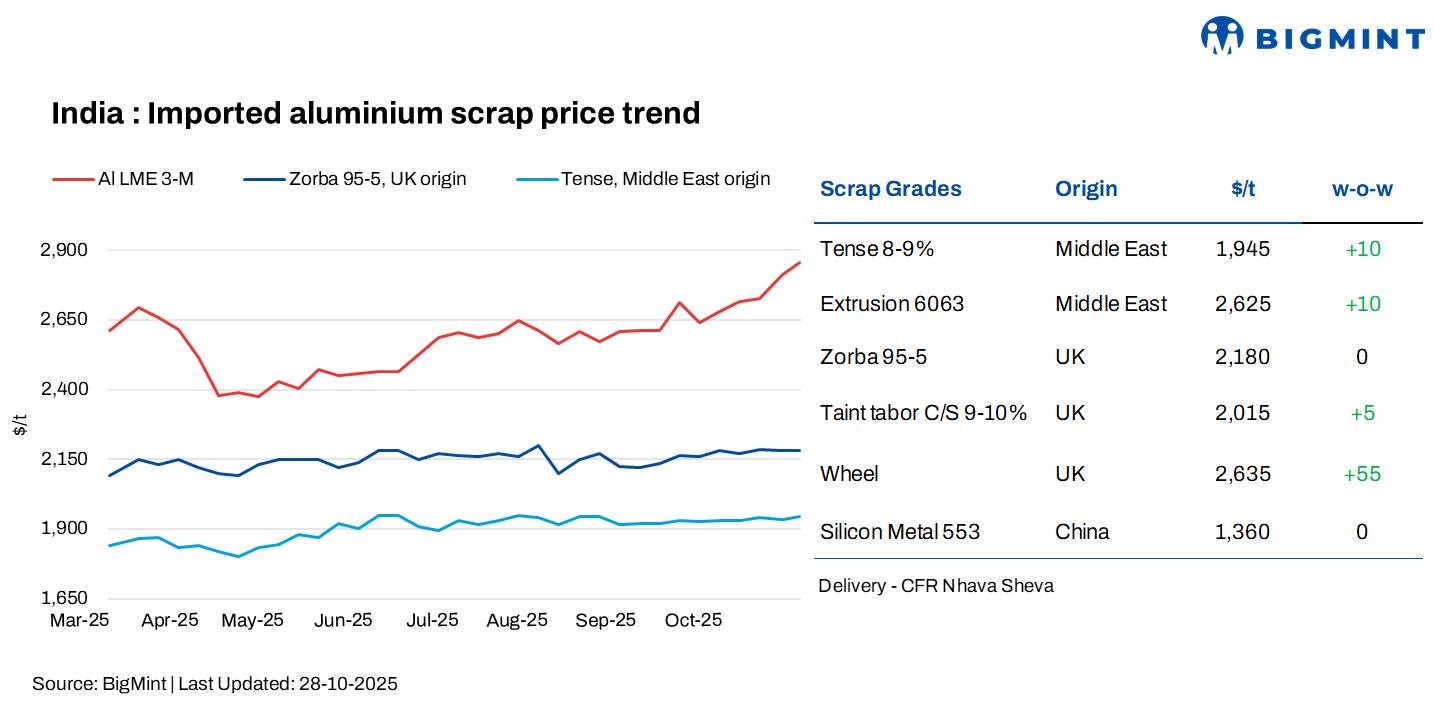
India’s imported aluminium scrap prices inched up w-o-w, though London Metal Exchange (LME) benchmarks witnessed positive movements. BigMint assessed UAE-origin Tense scrap at $1,945/tonne (t), up by $10/t w-o-w, while UK-origin Taint Tabor C/S (9-10%) stood at $2,250/t, up by $5/t w-o-w.
UK-origin Zorba 95/5 remained stable at $2,180/t w-o-w, while UAE Extrusion 6063 inched up by $10/t, stood at 2,625/t w-o-w. Meanwhile, UK-origin Wheel increased by $55/t to $2,635/t w-o-w.
LME prices increase w-o-w; inventories decline
At the time of reporting, LME aluminium prices stood at $2,856/t, up by around $73/t as compared to $2,783/t last week.
London Metal Exchange (LME) aluminium prices climbed to a three-year high during week 43 of CY’25, surpassing the $2,850/t mark. The surge was fueled by tightening supply concerns and renewed optimism over a potential US-China trade agreement, which boosted overall market sentiment.
Meanwhile, aluminium inventories at registered warehouses declined significantly by 14,850 t to 469,275 t from 484,125 t in the previous week, indicating tightening supply conditions.
Market scenario
The imported aluminium scrap market continues to witness subdued activity despite LME aluminium prices reaching a three-year high. Market sentiment remains cautious, with buyers refraining from making large purchases amid price volatility and uncertain demand trends.
Trading volumes have been particularly weak in Taint Tabor, where most buyers consider the segment risky due to inconsistent offers and limited liquidity. In contrast, Zorba scrap is showing relatively better movement, supported by slightly improved demand and stable pricing from select secondary producers.
Currently, there are no fresh offers in the market as sellers await clearer direction before quoting new prices. Many market participants expect conditions to improve in the first week of November, once price clarity returns and buyers begin restocking after the festive lull. However, for now, overall imported scrap trading remains slow, reflecting a cautious and wait-and-watch approach across the segment.

Domestic aluminium Tense scrap prices held steady at INR 191,000-192,000/t amid a sluggish local market and weak demand.
Meanwhile, Tense scrap prices in the southern region fell to INR 186,000-187,000/t, as Chennai’s market saw a notable week-on-week decline. The drop was driven by reduced demand, improved scrap availability in the domestic market, and tighter enforcement of GST compliance, all contributing to downward price pressure.
In the utensil segment, prices increased by INR 4,000/t w-o-w to INR 217,000/t ex-Delhi, supported by consistent demand, while extrusion and Taint Tabor scrap prices remained range-bound w-o-w.
India’s aluminium ADC12 alloy ingot prices remained steady across both southern and northern regions, supported by robust automotive demand following recent GST reductions. The firm trend in ADC12 offers was mainly driven by a surge in September auto sales, spurred by the government’s GST 2.0 reforms that enhanced consumer confidence and improved vehicle affordability.
Furthermore, a major Indian automaker has raised its ADC12 settlement price by INR 2,900/t month-on-month to INR 231,800/t for November 2025. The revision reflects strong auto demand momentum, as the GST cut has significantly boosted vehicle sales to record levels.
Silicon price trends
According to BigMint’s assessment, silicon 553 prices from China remained stable at $1,360/t CFR Mundra, due to softening demand amid the recent Chinese holidays, along with improved availability from Chinese producers.
Outlook
The imported aluminium scrap market is expected to see gradual improvement in early November as buyers return after the festive lull and market participants gain clearer price direction. While demand remains cautious in segments like Taint Tabor, activity in Zorba and utensil scrap is likely to pick up amid firm LME prices and tighter global supply. However, volatility in exchange prices and domestic demand recovery trends will continue to influence short-term price movements.
Leave a Reply