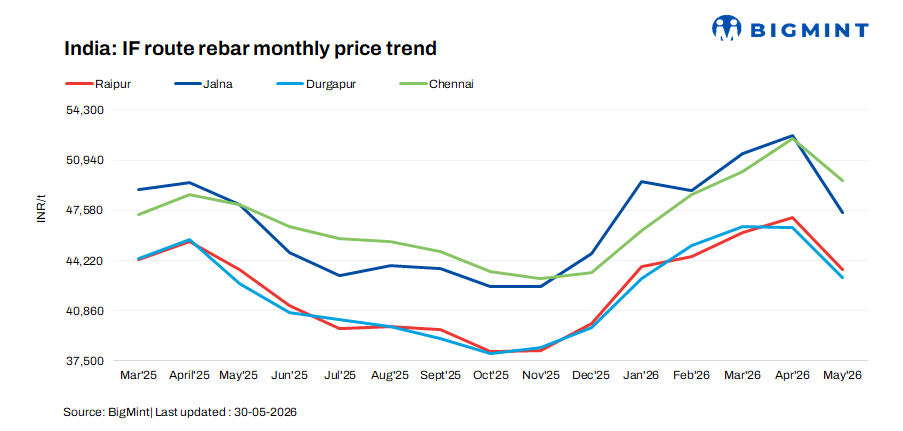
- IF-route rebar prices hit four-month low
- Lower raw material costs weigh on prices
IF-route rebar prices across India declined by INR 1,800-4,200/t m-o-m in May 2026 amid subdued market activity, weak end-user demand, and limited order bookings. Extreme heat conditions, labour shortages, and geopolitical uncertainties disrupted construction activity across several regions, resulting in slower steel consumption and cautious procurement. Buyers largely remained on the sidelines, restricting purchases to immediate requirements. Following the sharp correction during the month, rebar prices fell to a-month low, with prevailing levels last seen in January 2026.
Trading activity remained largely need-based, with buyers procuring material only to meet immediate requirements. To stimulate sales and improve cash flow, manufacturers reduced offer prices and extended discounts in the market. Mill inventory levels rose to around 10-15 days, compared to 10-12 days in the previous month, due to sluggish demand and slower sales.
As per Joint Plant Committee (JPC) data, India’s rebar production through the IF and BF routes stood at 58.5 million tonnes (mnt) in FY’26, marking a significant 9% rise from around 53.8 mnt in the same period of FY’25.
Region-wise price movements
The northern region recorded the steepest correction in IF-route rebar prices in May, with prices in Mandi Gobindgarh, Delhi, and Jaipur declining by INR 1,800-2,100/t m-o-m. The fall was driven by weak construction activity amid severe heatwave conditions and labour shortages during the harvest season, which weighed on steel demand. Additionally, market elections in Mandi Gobindgarh on 26 May disrupted trading activity and slowed order bookings, further pressuring prices.
Western India also witnessed a notable correction, with rebar prices in Mumbai, Ahmedabad, and Jalna declining by INR 2,000-3,500/t. Weak construction demand kept overall market activity subdued. In Jalna, a few mills also reduced operating levels amid lower demand. Meanwhile, persistent sluggishness in offtake led to inventory accumulation across the western region, with stock levels rising to around 12-15 days, particularly in the Jalna market.
The central region saw a steeper correction in rebar prices during May, with Raipur and Raigarh prices falling by INR 3,500-3,800/t m-o-m. Demand remained largely need-based amid heatwave-led disruptions to construction activity. Additionally, central and eastern India primarily use sponge iron for steelmaking, unlike scrap-based markets. Continued weakness in sponge iron and billet prices lowered production costs, putting greater pressure on rebar prices. Logistical constraints in the latter half of the month further weighed on trade activity and market sentiment.
In the eastern region, rebar prices in Durgapur and Rourkela declined sharply by INR 2,200-3,400/t m-o-m amid weak market sentiment and subdued demand. Lower buying interest from the North-East market weighed on trading activity, while conversion margins narrowed significantly from around INR 3,400/t at the beginning of the month to nearly INR 1,900/t by month-end, impacting sellers’ profitability. Additionally, sluggish demand and slow material movement during the festive period led to inventory build-up, forcing sellers to lower prices further to support sales.
In south India, prices across Chennai, Hyderabad, and Bangalore declined by INR 3,200-4,500/t in May’26 amid sluggish, need-based demand. Slowed project segment demand, while retail demand remained the primary market driver across the southern regions impacted trade activities. Inventory levels rose by 10-15 days which compelling manufacturers to reduce the offers or to given huge discounts. Additionally, material comes from Central regions at lower prices create further pressure on sales. Prices likely to remain under pressure in the June month as per current scenario.

Raw material price trends
The drop in finished steel prices was mainly driven by lower prices of key raw materials — steel billets and sponge iron — used in IF-route rebar production.
Prices of key raw materials, including billet and sponge iron, softened amid sluggish demand from the finished steel segment. Market activity remained muted, with buyers maintaining a cautious stance and restricting purchases to need-based requirements. Reduced consumption from rebar and structural producers exerted downward pressure on raw material prices.
Considering Raipur as the benchmark, billet prices recorded a sharp decline of INR 2,950/t m-o-m to INR 39,200/t ex-works in May while sponge iron (PDRI FeM 80% ±1) also weakened, falling by INR 650/t m-o-m to INR 25,050/t ex-works.
BF rebar sentiment
Indian primary steelmakers have rolled over rebar list prices for May 2026, indicating efforts to maintain market stability despite mixed demand conditions.
Post-revision, list prices stood at INR 56,000-57,000/t on a landed basis. Trade-level BF rebar prices (distributor-to-dealer) were assessed at INR 56,100/t exy-Mumbai .Market participants noted that buying activity remained largely need-based, while distributors maintained adequate inventory levels to meet ongoing requirements.
In the projects segment, rebar prices were heard at around INR 56,000-57,000/t FOR basis. Project-related demand continued to support market activity, although fresh inquiries remained moderate. Construction activity in some regions was affected by election-related labour shortages, leading to selective procurement. Buyers largely adopted a wait-and-watch approach amid recent price movements, while mills focused on servicing ongoing project commitments and maintaining supply discipline.
Outlook
IF-route rebar prices are likely to remain under pressure in June amid seasonally weak demand and the onset of the monsoon, which typically slows construction activity across key consuming regions. High inventory levels and cautious buying are expected to keep procurement largely need-based, while mills may continue to offer competitive prices to support sales and manage stock levels. However, any recovery in construction activity or stability in key raw material prices could help limit further downside in the near term.

Leave a Reply