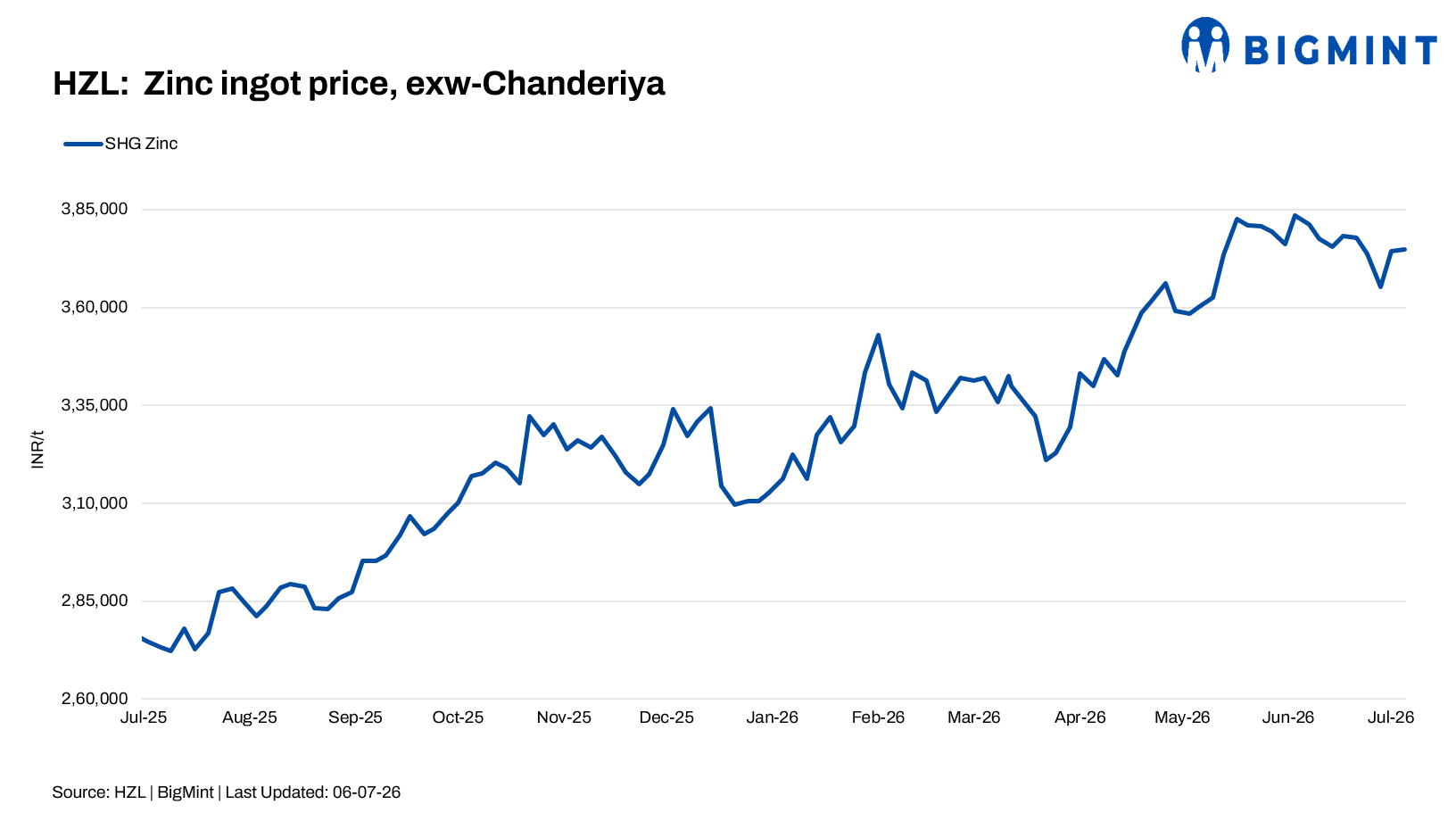
- HZL’s SHG zinc premium over domestic spot market remains firm
- Critical minerals strategy gathers pace as HZL targets rare earth magnets, potash and tungsten
Hindustan Zinc Ltd (HZL) on 6 July 2026 increased zinc ingot prices by INR 300/t ($4/t) while reducing lead ingot prices by INR 100/t ($1/t) compared with its previous revision announced on 1 July.
Following the latest revision, HZL’s benchmark Special High Grade (SHG) zinc ingot prices were raised to INR 374,800/t ($4,381/t), while lead ingot prices were lowered to INR 210,300/t ($2,458/t).
On the London Metal Exchange (LME), zinc prices were trading at $3,539/t, down 0.24%, while lead prices stood at $1,889/t, down 0.13% as of 2:00 PM IST. Base metals remained under mild pressure as market participants continued to assess global macroeconomic cues, US dollar movements and the outlook for industrial demand.
Despite the marginal increase, HZL’s SHG zinc prices continued to command a premium over domestic spot market levels. According to BigMint’s assessment, SHG zinc ingot prices were assessed at INR 371,400/t ex-Delhi on 3 July, placing HZL’s benchmark SHG prices at a premium of around INR 3,400/t. Market participants indicated that procurement activity remained largely need-based, with consumers maintaining cautious buying amid volatile overseas prices and mixed demand from downstream galvanising and die-casting sectors.

On the corporate front, Hindustan Zinc is sharpening its focus on critical minerals as part of its long-term diversification strategy, with plans to enter rare earth magnet manufacturing while advancing domestic production of potash and tungsten. Speaking at the company’s 60th Annual General Meeting, Chief Executive Officer Arun Misra said the company has already secured mineral blocks for rare earth elements in Uttar Pradesh, potash in Rajasthan and tungsten under the government’s Critical Mineral Mission. HZL has also signed the mining agreement for its Uttar Pradesh rare earth block, which is expected to produce neodymium—a key input for permanent magnets used in electric vehicles and clean energy technologies. The company intends to participate in upcoming government auctions for magnet manufacturing as it expands its presence across the critical minerals value chain.
The diversification strategy complements HZL’s ongoing capital expenditure programme of INR 40,000-50,000 crore, with INR 17,000 crore already approved for the first phase in FY26. Alongside expanding into critical minerals, the company is progressing with its plan to nearly double annual metal production capacity from around 1.1 million tonnes to 2 million tonnes over the next five years, reinforcing its long-term growth strategy and supporting India’s ambitions for greater self-reliance in strategic minerals.
Fundamentally, the zinc market continues to draw support from expectations of constrained refined metal availability. Tight concentrate availability, relatively low exchange inventories and the International Lead and Zinc Study Group’s projected refined zinc deficit for 2026 continue to underpin medium-term market sentiment, although near-term price movements remain sensitive to macroeconomic developments, currency fluctuations and demand trends in key consuming regions.
Overall, domestic zinc prices are expected to remain supported by resilient supply fundamentals and HZL’s elevated benchmark prices. However, cautious downstream procurement, uncertainty surrounding global economic growth and persistent volatility in international base metal markets may continue to limit aggressive buying in the near term.
Leave a Reply