- Need-based buying persists as working capital constraints keep fresh procurement subdued.
- OEM demand lends limited support, with broader market sentiment remaining cautious.
India’s hot-rolled coil (HRC) market remained subdued during the week ended 21 July 2026, as weak downstream demand and persistent liquidity constraints continued to suppress trading activity. Trade-level HRC offers were reported at INR 54,900-58,500/t ($570-607/t), while buyers largely restricted purchases to immediate requirements amid limited order inflows and cautious market sentiment.

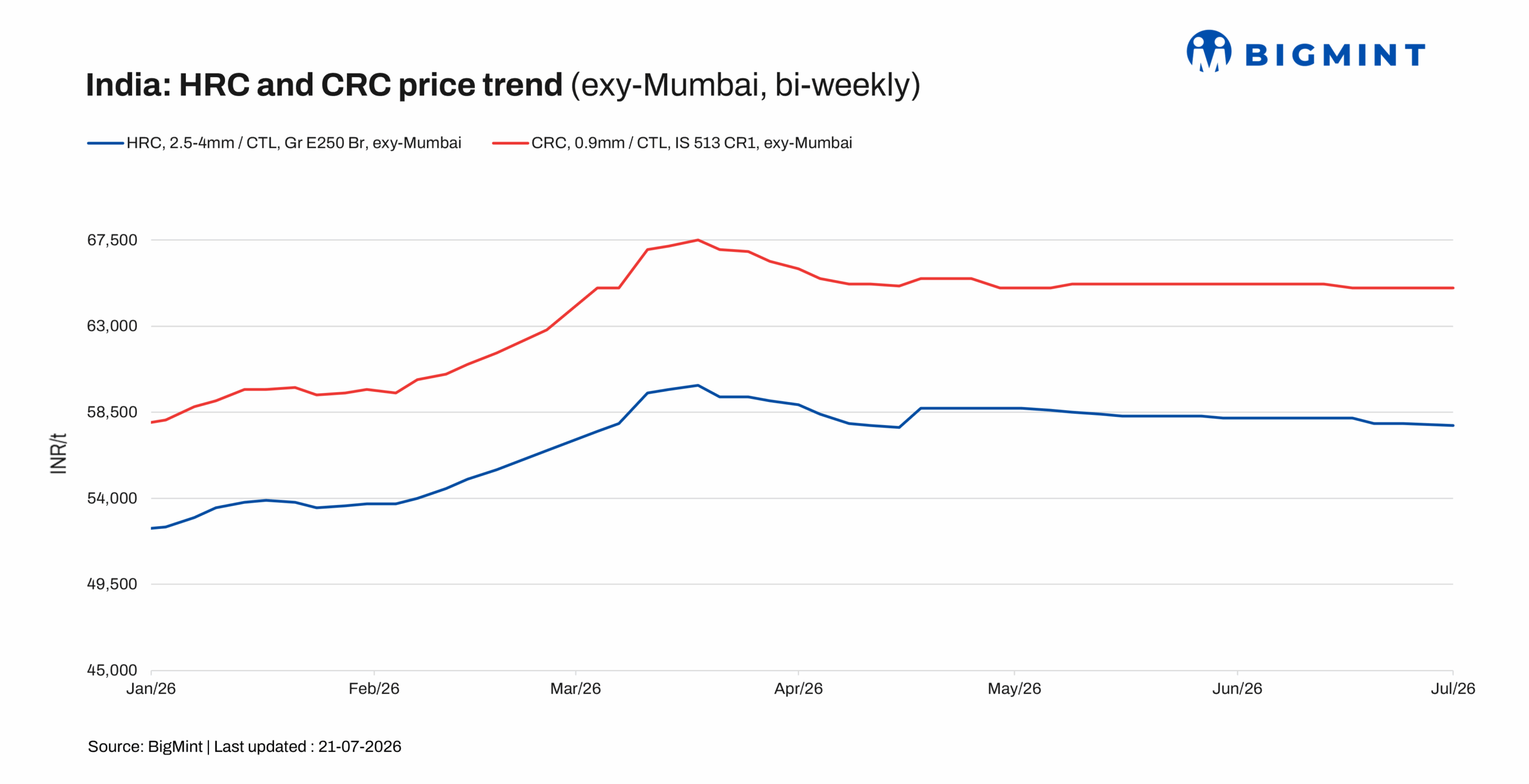
BigMint’s bi-weekly benchmark assessment for HRC (IS2062, Grade E250, 2.5-8 mm/CTL) remained stable w-o-w at INR 57,800/t ($600/t) ex-Mumbai as of 21 July 2026. Similarly, the benchmark assessment for CRC (IS513, Grade O, 0.9 mm/CTL) was unchanged at INR 65,000/t ($675/t) ex-Mumbai, exclusive of 18% GST.
Market update
Market activity remained sluggish as distributors and stockists reported limited enquiries from downstream consumers. Procurement continued to be driven by immediate production requirements rather than inventory replenishment, reflecting cautious sentiment across major consuming sectors.
Liquidity constraints emerged as another key factor limiting market activity. Tight working capital availability prevented many traders and service centres from undertaking bulk purchases, resulting in widespread hand-to-mouth buying. The absence of meaningful restocking kept transaction volumes subdued despite relatively stable price levels.
A trader said, “OEMs are still buying, even if nothing else is moving. That’s the only real support the market has right now.” Steady procurement from original equipment manufacturers (OEMs) continued to provide a base level of demand, partially offsetting weak buying from other downstream segments.
There is no shortage of supply in the market. But the trade cycle of time taken from booking an order to selling the goods, has become longer. This means goods are taking more time to get cleared. Because of this longer trade cycle, inventory is building up with dealers, even though supply itself is not under strain.
Raw Materials
BigMint’s premium hard coking coal (PHCC) index fell by $2 per tonne from last week, reaching $248 per tonne CNF Paradip on 21 July 2026, even though weak demand for steel usually keeps such price effects under control. At the same time, higher freight rates for ships coming from Australia to India added more pressure to the expenses of steelmakers.
Iron ore prices came down from INR 5,962 per tonne in June to INR 5,833 per tonne in July. Since iron ore is a key raw material for making steel, this fall can lower the cost of producing steel. However, with steel demand already weak, this drop in raw material cost is unlikely to bring any major relief or push steel prices further down.
Trade flows
India’s bulk HRC imports reached 152,538 t as of 17 July, with cumulative arrivals expected to touch 232,245 t by the end of August. South Korea, China and Indonesia remained the leading suppliers to the Indian market. A large share of these volumes continues to move under Advance Authorization, keeping their direct bearing on the domestic trade market limited.

On the export front, shipments remained comparatively healthy. Bulk HRC exports stood at 198,712 t as of 17 July, with an additional 93,402 t expected by the end of July, indicating continued overseas demand for Indian Steady demand from UAE and Oman has played an important role in keeping domestic prices stable. Without this support, the market would likely have ended up with a surplus of steel, adding more pressure to an already weak trading environment.
Market implications
The combination of subdued domestic demand and restricted liquidity continues to limit trading activity despite stable benchmark prices. While resilient export volumes and steady OEM procurement are helping prevent a sharper market correction, they have not been sufficient to trigger broader buying interest or inventory rebuilding.
Outlook
The Indian HRC market is expected to remain under pressure through August, with need-based procurement likely to continue as long as downstream demand and cash flow conditions remain weak. OEM demand is expected to provide some support; however, a broader recovery in trading activity will depend on improved liquidity, stronger post-monsoon consumption, and increased buying confidence across key steel-consuming sectors.
Leave a Reply