- Trade parity improved as distributor losses narrowed.
- Buying activity remains largely requirement-driven and cautious.
India’s hot-rolled coil (HRC) market edged up during the week ended 11 August 2026, with prices increasing by around INR 100-800/t across select markets amid cautious buying activity, with trade-level offers broadly at INR 55,250-59,000/t ($579-618/t).
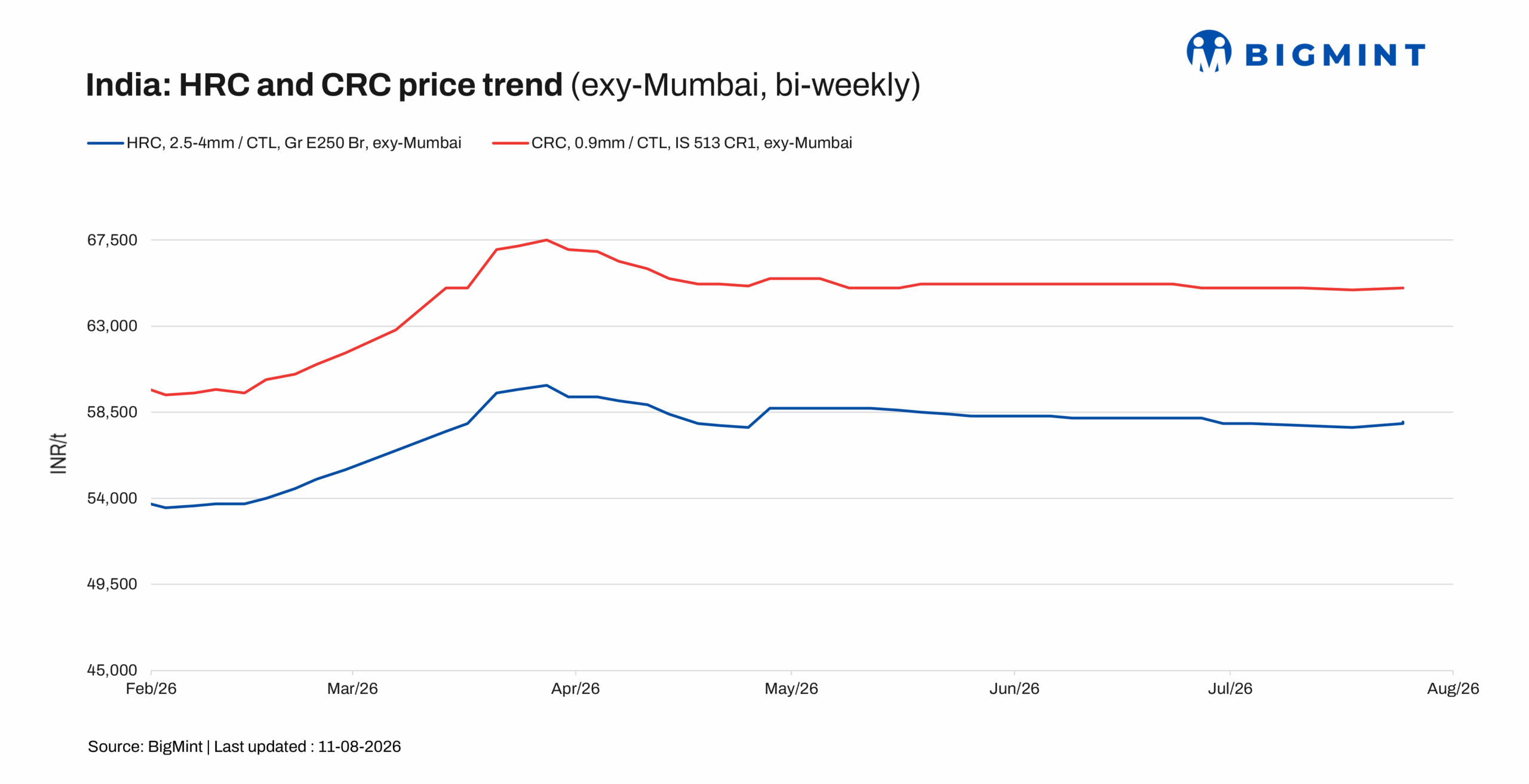
BigMint’s bi-weekly benchmark assessment for HRC (IS2062, Grade E250, 2.5-8 mm/CTL) increased w-o-w by INR 100/t ($1/t) to INR 58,000/t ($608/t) ex-Mumbai as of 11 August 2026, from INR 57,900/t ($607/t) in the previous week.

Similarly, the benchmark assessment for CRC (IS513, Grade O, 0.9 mm/CTL) remained stablw w-o-w at INR 65,000/t ($681/t) ex-Mumbai, exclusive of 18% GST.
Market Update
India’s trade-level (distributor-to-dealer) HRC prices saw a slight uptick following the withdrawal of mill rebates at the start of August, which provided support to domestic HRC prices. The adjustment narrowed earlier distributor losses, bringing trade prices closer to prevailing mill levels and improving trade parity. While demand has yet to show a meaningful recovery, the improved price alignment is viewed positively by market participants and could provide some support to trading liquidity.
A market participant quoted that “the market is not moving currently, and people are procuring less than they used to,” indicating that purchases remain below usual levels.
Industry sources indicated that hot-strip mills (HSMs) are operating at full production capacity, while supply availability remains broadly manageable despite pockets of tightness in selected markets. Buyers continue to remain cautious amid recent price volatility, with some ageing inventory being liquidated and procurement remaining largely need-based and restricted to immediate requirements.
Imports and Exports
India’s bulk HRC imports stood at 79,533 t in the first week of August, with a further 224,195 t expected by month-end, led by South Korea, China and Indonesia. However, the sequential rise was largely attributed to Advance Authorisation-linked procurement and captive consumption, particularly by pipe and tube manufacturers producing API/line pipes for overseas oil and gas projects, limiting the impact of these imports on the domestic spot market.

India’s bulk HRC exports stood at 161,539 t during the first week of August, while export offers showed divergent trends across key destinations. EU offers increased amid strong quota-driven bookings, whereas offers to the Middle East and Southeast Asia declined on cautious buying, geopolitical uncertainty and weak demand, with Vietnam bids remaining below workable mill levels.
Market outlook
India’s trade-level HRC market is expected to remain stable to marginally firm in the near term, supported by improved trade parity following recent mill price revisions. The narrowing of distributor losses likely to provide some relief and support selective procurement. However, demand remains need based, with buyers continuing to procure largely against immediate requirements amid recent price volatility. With supply remaining broadly balanced, the market is likely to focus on price stability and a gradual recovery in trading activity.
Leave a Reply