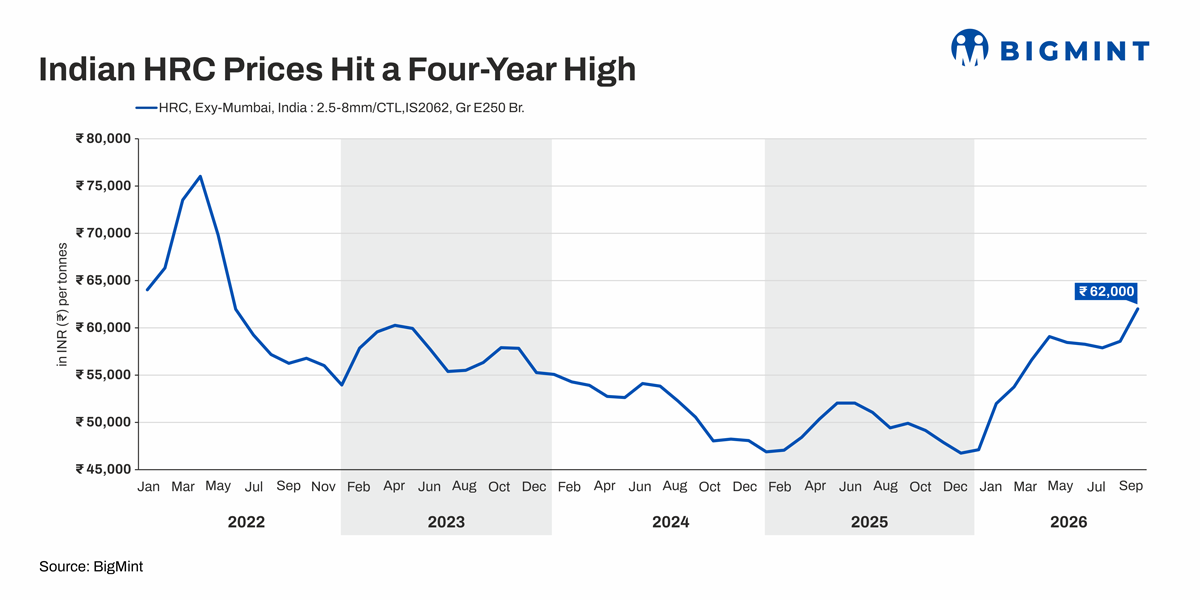
- BigMint’s benchmark reaches INR 62,000/t, highest since Jun’22
- Maintenance shutdowns, controlled dispatches tighten spot availability, boost prices
- HRC exports surge over 140% y-o-y in Jan-Aug’26, bulk imports drop 9%
Morning Brief: India’s benchmark hot-rolled coil (HRC) price has returned to levels last seen during the commodity rally of 2022, supported by a tightening domestic market rather than a sudden surge in demand. BigMint’s benchmark HRC (2.5-8 mm/CTL, IS2062, Grade E250 Br) was assessed at INR 62,000/t exy-Mumbai in September, surpassing the previous four-year high of INR 61,960/t recorded in June 2022.
The move follows a broad tightening across the flat steel value chain during August. Iron ore, pellets and coking coal all strengthened, lifting replacement costs for steelmakers. At the same time, maintenance shutdowns reduced primary steel availability, mills tightened allocations to the trader channel and buyers began replenishing inventories ahead of anticipated price increases. Production and consumption continued to grow through the year, while lower imports and sharply higher exports further tightened the domestic supply-demand balance.
Higher raw material costs lifted replacement values
Iron ore, pellet and coking coal prices all increased during August, raising production costs across the flat steel value chain. BigMint’s Odisha iron ore fines index (Fe 62%) rose to INR 5,000/t as persistent monsoon rainfall disrupted mining activity and constrained material availability. Pellet prices increased to INR 10,430/t DAP Raipur on firm demand from sponge iron, pig iron and billet producers, while limited availability and tight lump ore supplies kept the market supported.
Coal markets also strengthened with BigMint’s domestic RB3 non-coking coal index moving higher during the month, while premium hard coking coal reached $280/t CNF Paradip, the highest level since the BigMint index was launched in August 2024. Tight Chinese domestic coal supplies following mine safety inspections and lower Russian coal production continued to support seaborne metallurgical coal prices.
Higher input costs flowed quickly through the metallics chain, with sponge iron prices rising 12% m-o-m, pig iron gaining 2% and billet prices rising 4%, increasing replacement costs for flat steel producers. Higher met coke and iron ore costs encouraged mills to pass through part of the increase and maintain firmer price indications for September deliveries.
Controlled dispatches tightened the trader market
Major integrated steelmakers increased flat steel list prices by INR 750-1,500/t for September deliveries as improving demand expectations from the construction, infrastructure and automotive sectors coincided with rising input costs. Planned maintenance shutdowns further reduced primary steel availability.
Material availability became increasingly tight in the trader channel. Mills reportedly fulfilled only around 75% of desired distributor allocations as supplies were increasingly directed towards automotive and other B2B customers. Lower trader-channel availability strengthened sellers pricing power and reduced the scope for discounting.
Buying activity also improved. Buyers increasingly replenished inventories ahead of expected price increases while continuing to procure for immediate requirements. Although overall demand remained moderate and stable rather than exceptionally strong, firmer CRC-linked demand continued to support HRC consumption and trade activity.
Lean trader inventories reinforced the tighter market. Traders became more selective in extending credit, shortened payment periods and prioritised previously committed orders while maintaining cash surpluses. The combination of controlled dispatches, lean inventories, stronger CRC demand and anticipatory procurement provided a firm foundation for spot prices.
BigMint’s benchmark HRC assessment consequently increased by INR 2,600/t week-on-week to INR 62,000/t as of 1 September, while trade-level prices across major markets rose by around INR 1,000-2,900/t.
Trade flows reinforced the tighter balance

India’s HRC market was also supported by changing trade flows as domestic production increased 9.1% y-o-y to 41.9 mnt during January-August 2026, while apparent consumption rose 7.8% to 42.0 mnt. Imports declined 8.6% to 1.60 mnt over the same period, reducing the share of overseas material in the domestic market. Exports expanded much more rapidly. Overseas shipments reached 2.30 mnt during the first eight months of the year, up 142.1% y-o-y, tightening domestic availability despite higher production.
Current shipment data point to the same trend. Bulk HRC imports totalled 301,131 t as of 21 August, with a further 137,931 t expected to arrive by the end of September. Exports stood at 367,994 t over the same period, with an additional 127,812 t scheduled by early September and another 28,559 t expected by mid-September.
Stronger domestic realisations and largely booked export allocations also reduced mills incentive to pursue additional overseas sales. Export offers remained limited across the UAE, Vietnam and Europe as producers prioritised the strengthening domestic market.
Outlook
Benchmark HRC has returned to INR 62,000/t for the first time since June 2022 as rising replacement costs coincided with tighter spot availability. Higher raw material costs, maintenance shutdowns, controlled dispatches, lower imports and stronger exports have all contributed to a materially tighter domestic market. The next test will be whether post-monsoon demand strengthens sufficiently to sustain current price levels once maintenance programmes conclude and supply normalises.
Leave a Reply