- Controlled mill dispatches strengthen sellers’ pricing power
- Firm mill indications reinforce positive market outlook
India’s hot-rolled coil (HRC) market witnessed a sharp increase during the assessment week ended 1 September 2026, with trade-level prices rising by around INR 1,000-2,900/t across key markets, supported by firmer mill indications and tighter spot availability despite cautious buying activity. Trade-level offers were assessed at INR 58,000-62,000/t ($611-653/t).
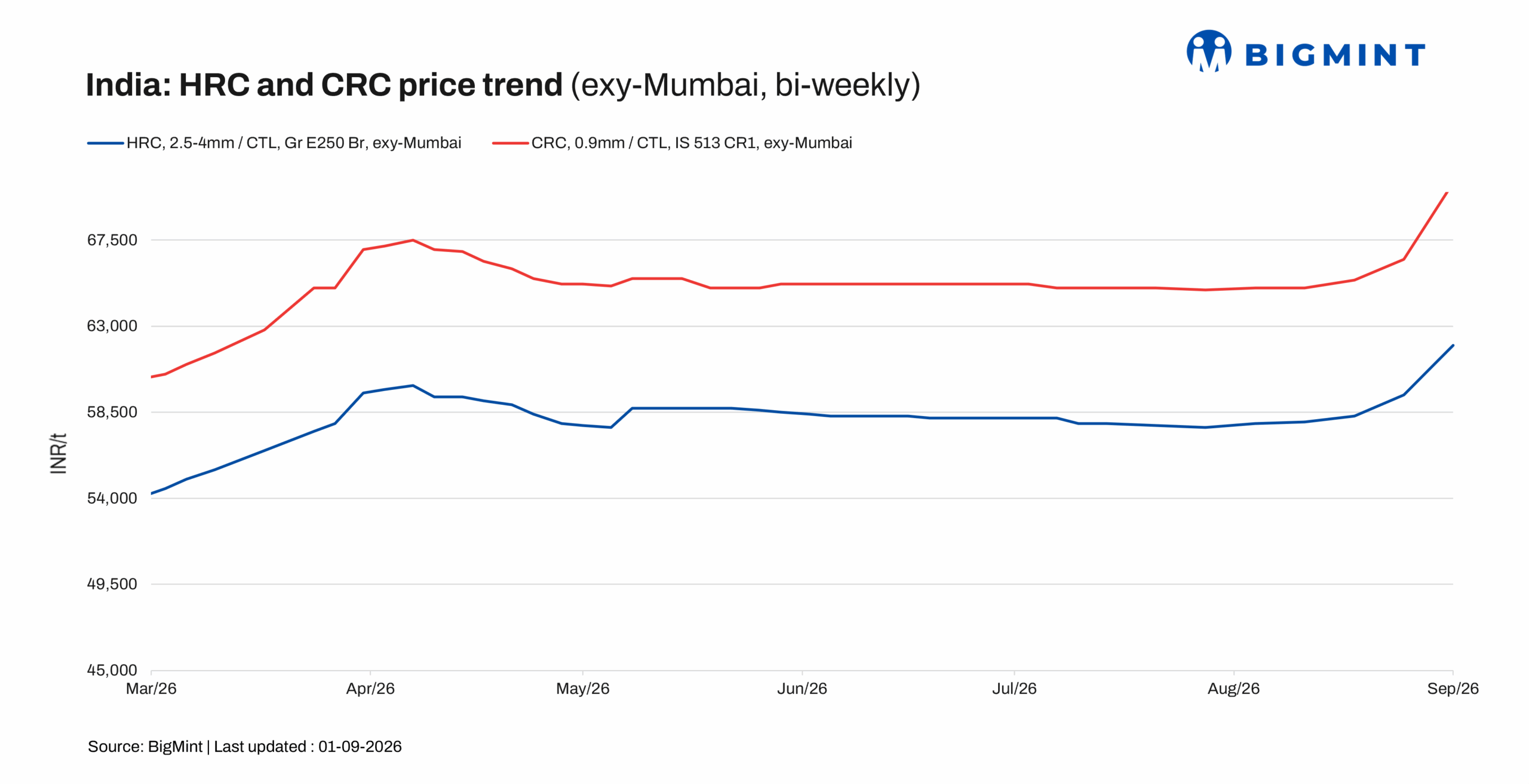
BigMint’s bi-weekly benchmark assessment for HRC (IS2062, Grade E250, 2.5-8 mm/CTL) increased by INR 2,600/t ($27/t) w-o-w to INR 62,000/t ($653/t) ex-Mumbai as of 1 September 2026, from INR 59,400/t ($626/t) in the previous week.

Similarly, the benchmark assessment for CRC (IS513, Grade O, 0.9 mm/CTL) increased by INR 4,000/t ($42/t) w-o-w to INR 70,500/t ($742/t) ex-Mumbai, from INR 66,500/t ($700/t) in the previous week, exclusive of 18% GST.
Market scenario
India’s trade-level HRC market continued to witness a positive undertone, with leading domestic mills hiking flat steel prices for September, supported by improving demand and rising input costs. Higher met coke and iron ore prices have increased production cost pressures, encouraging mills to pass on part of the cost increase and maintain firmer price indications. Improving demand expectations from construction, infrastructure and automotive sectors, along with stronger CRC-linked buying, have further supported the market. Meanwhile, planned mill maintenance and controlled dispatches have kept spot availability relatively tight, strengthening producers’ pricing power. Buyers have also started selectively replenishing inventories in anticipation of further price increases, indicating that the market has largely absorbed the previous month’s lean patch.
Material availability remained a key concern in the trader channel, with mills fulfilling only around 75% of desired distributor-level quantities as allocations shifted towards automotive and B2B customers. Lower trader-channel supplies and tighter availability of material strengthened sellers’ pricing positions and limited scope for discounting.
Buying activity improved as buyers increasingly procured material in anticipation of further price increases, alongside immediate requirements. Overall demand remained moderate and stable, providing a steady base for the market without triggering a sharp uptrend. Stronger CRC-linked demand continued to support HRC consumption and trade activity.
Meanwhile, traders holding relatively leaner inventories are exercising greater caution in sales, particularly on credit. With limited material availability, traders are looking to maintain cash surpluses by restricting credit exposure and offering shorter payment periods, while continuing to cater to previously committed orders without disruption. This combination of lean inventories, controlled dispatches, stronger CRC demand and anticipatory procurement is providing a firm foundation for spot prices, keeping the near-term market outlook positive
Imports, exports
India’s bulk HRC imports stood at 301,131 t as of 21 August, with a further 137,931 t expected to arrive by the end of September.

India’s bulk HRC exports stood at 367,994 t as of 21 August, with an additional 127,812 t expected to be shipped by the first week of September and a further 28,559 t likely to leave by mid-September.
Indian HRC export offers showed mixed trends in the week ended 1 September, as stronger domestic realisations and largely booked export allocations reduced mills’ incentive to pursue overseas sales. Offers remained limited across the UAE, Vietnam and Europe.
Outlook
India’s trade-level HRC prices are expected to increase in the near term, supported by recent mill price hikes, higher met coke and iron ore costs, and continued tightness in trader-channel availability. Mills are likely to maintain controlled dispatches, while lower fulfilment of trader requirements is keeping spot supplies constrained. Strong CRC-linked demand and procurement ahead of expected price increases should provide further support, while lean trader inventories may limit selling pressure. Although overall demand remains moderate, firmer mill indications, higher input costs and limited availability point to further upside in HRC prices in the near term.
Leave a Reply