- EU sentiment cautious amid country-wise quota allocation uncertainty
- Hormuz disruptions continue to constrain Middle East trade flows
Indian HRC export activity remained subdued during 5-12 May 2026, with shipments to Europe and the Middle East constrained by regulatory uncertainty, logistical disruptions, and persistent geopolitical tensions.
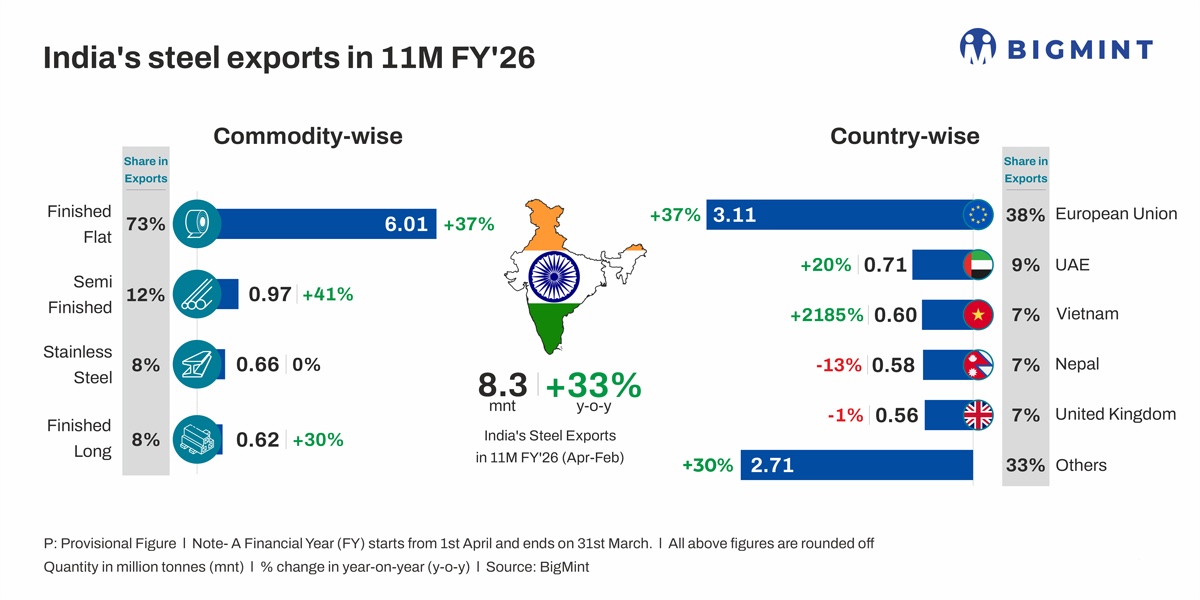
In the EU, although offers declined w-o-w, no bookings were reported as buyers remained cautious amid-concerns over country-wise quota allocations under upcoming safeguard revisions, alongside CBAM-related compliance costs.
Meanwhile, in the Middle East, ongoing geopolitical tensions disrupted cargo movement, keeping overall export activity muted.
HRC exports to Europe: Indian HRC export index to the EU declined by $10/t w-o-w to around $700/t CFR Antwerp, down from $710/t in the previous week. However, no bookings were reported during the assessment window, reflecting continued cautious buying sentiment.
Overall import activity across the European market remained subdued ahead of the revised safeguard measures scheduled to take effect on 1 July 2026. Under the updated regime, the annual tariff-rate quota (TRQ) is expected to stand at around 18.3 million tonnes (mnt), while imports exceeding the quota will attract a steeper 50% duty, compared with the earlier 25%. The proposed tariff hike has heightened concerns over additional duty liabilities, discouraging buyers from committing to fresh overseas cargoes.
At the same time, evolving regulatory requirements, including the Carbon Border Adjustment Mechanism (CBAM) and proposed “melt and pour” norms, are increasing compliance complexities and cost burdens for importers, further weighing on procurement decisions.
Trade sentiment has also been affected by continued logistical disruptions arising from the Middle East conflict. Persistent security concerns in the Red Sea-Suez Canal corridor have forced shipping lines to reroute vessels via the Cape of Good Hope, resulting in transit delays of around 15-20 days, along with elevated freight and war-risk insurance costs.
Additionally, sluggish downstream demand and elevated inventory levels within the EU market continued to suppress buying interest, keeping overall market sentiment cautious.
HRC exports to the Middle East: Indian HRC export offers to the Middle East remained absent w-o-w, as ongoing geopolitical tensions and persistent disruptions around the Strait of Hormuz continued to weigh on regional trade flows and keep market sentiment subdued.
Meanwhile, a Middle East-based source noted that, “only a handful of Chinese mills are currently active in the market, offering HRC at around $580-590/t CFR Jeddah, while an unconfirmed deal from Rizhao was also heard at approximately $590/t CFR Jeddah.”
Market participants further reported that, “ongoing disruptions in the Strait of Hormuz have severely impacted shipments, particularly to and from the UAE, with no signs of improvement so far. With the route remaining constrained, both inbound and outbound cargo movements are restricted, effectively bringing regional trade to a standstill. As a result, most export offers to the region have been suspended.”
Overall, the Middle East imported HRC market remained under pressure, with geopolitical uncertainty, logistical bottlenecks, and limited visibility on trade flows continuing to sustain a cautious market environment.
Outlook
Indian HRC export activity is expected to remain under pressure in the coming week amid policy uncertainty, geopolitical risks, and logistical constraints in key markets. In Europe, buying interest is likely to stay subdued ahead of the revised safeguard regime, with uncertainty over country-specific quota allocations weighing on sentiment. In the Middle East, ongoing disruptions around the Strait of Hormuz are expected to continue pressuring trade flows. Overall, export activity is likely to remain muted unless regulatory clarity improves, geopolitical tensions ease, and shipping conditions normalize.
Leave a Reply