- Cement fuel costs rise sharply in September 2026
- Price hikes face resistance amid weak lifting
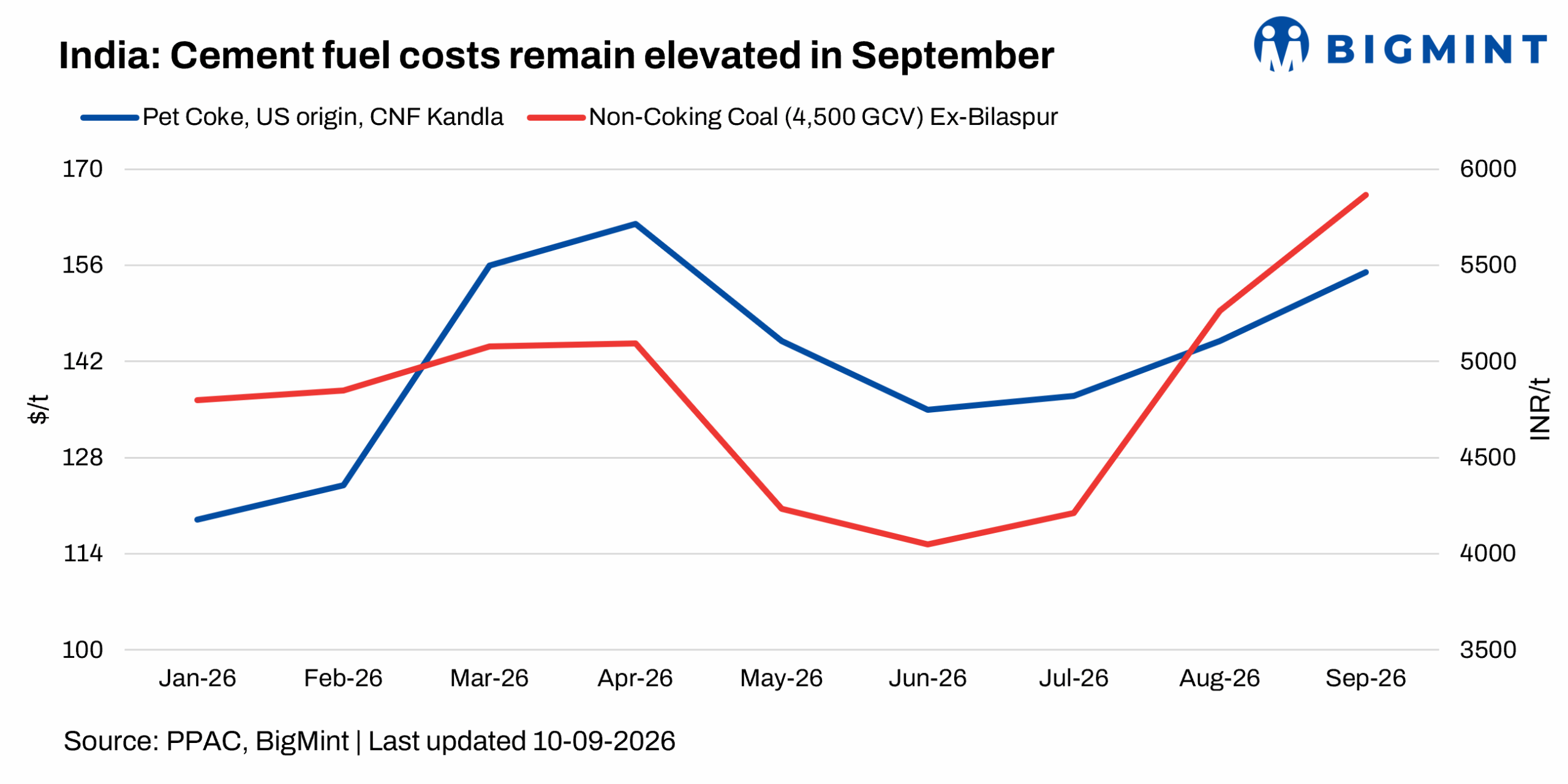
India’s cement industry is facing increased margin pressure as higher fuel and other input costs coincide with subdued monsoon demand. BigMint’s non-coking coal prices were averaged at INR 5,867/t in September, up 11.4% m-o-m, while US-origin petcoke prices increased 6.9% on the month to $155/t. The rise in fuel costs comes as demand weakness limits cement producers’ ability to fully pass higher costs on to customers.
Cement fuel costs rise sharply in September
Non-coking coal prices increased to monthly average of INR 5,867/t in September from INR 5,264/t in August, according to BigMint. The September price was also around 22% higher than the June levels of INR 4,050/t, indicating a significant recovery in coal costs during the Q2FY27.
Pet coke prices also increased to $155/t in September from $145/t in August, following a 7% m-o-m rise. Prices remained below the April peak of $162/t but have recovered from the $135/t level recorded in June.
Crude oil prices also moved higher in September. The Brent crude oil benchmark, CIF India, increased to $104.1/bbl from $90.2/bbl in August, a 15% m-o-m rise, based on PPAC data. Higher crude and diesel costs can add further pressure through transportation and freight expenses.
The combined increase in fuel and logistics costs is likely to keep pressure on cement production and delivered costs.
“One of India’s leading cement manufacturers has said that higher coal, petcoke, packing material and other input costs are likely to have a bigger impact on costs in FY27”.
Demand remains weak across regions
Monsoon continue to weigh on construction activity and cement lifting across several markets. Western remains relatively resilient, with Mumbai showing better demand, while Gujarat remains subdued amid festivals.
Eastern markets have experienced a sharper slowdown, particularly West Bengal and Bihar, as rainfall affects construction activity.
South and Central region markets continue to face weak demand amid slow project execution and subdued rural activity, although some improvement is visible in Telangana.
Pricing discipline becomes critical
Cement Producers have announced price increases across several markets in September to offset higher operating costs. However, dealer resistance and weakness in demand could limit the extent of price retention.
Cement prices showed largely stable to downtrend movement from market to market in August despite monsoon-related weakness. The effectiveness of September price increases will depend on whether construction activity improves sufficiently to support higher trade-level realisations.
For Cement producers, the key challenge is balancing volume retention with price realisation. Aggressive price increases without corresponding improvement in demand could weigh on offtake, while limited price action would leave a larger portion of higher fuel and freight costs unabsorbed.
Outlook
Cement margins are likely to remain under pressure through the monsoon period as elevated fuel costs coincide with slow regional demand. The sharp September price increase in coal and pet coke prices adds to the cost challenge, particularly if higher energy and freight expenses persist through the post-monsoon period.
Margin recovery will depend on producers’ ability to retain September price increases, improvement in construction activity after the monsoon and moderation in fuel costs. Continued strength in energy prices could delay margin recovery despite an improvement in cement demand.
Leave a Reply