- High tax rates continue to incentivise fake invoicing
- Industry calls for data-led reform over enforcement-heavy approach
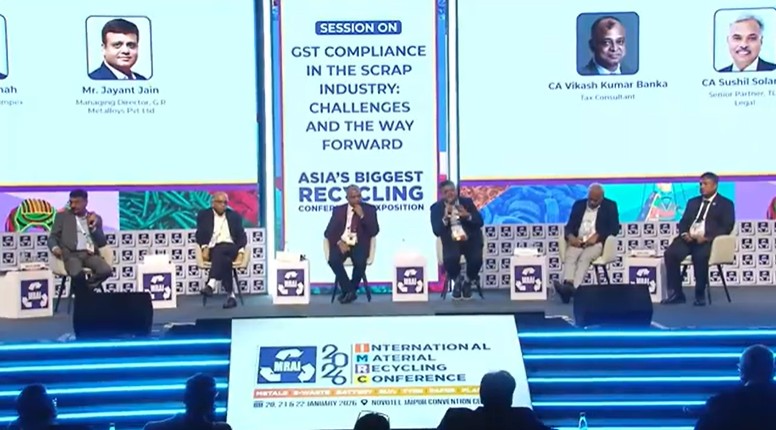
India’s scrap and recycling industry remains under sustained GST compliance pressure even as enforcement tools grow more sophisticated. A recent industry panel discussion highlighted that fake invoicing continues to rise, while genuine steelmakers, recyclers, and traders are increasingly exposed to retrospective tax demands, underscoring systemic weaknesses rather than isolated non-compliance.
Setting the tone, Rahul Goyal, Managing Director at Waste to Energy Solutions Pvt Ltd, noted that GST is now a permanent tax framework. While organised steel producers can navigate compliance through advisory support, smaller scrap aggregators, who form the backbone of secondary steelmaking, operate with limited guidance. He stressed that education-led compliance, not fear-driven enforcement, will determine long-term sector stability.
Structural GST shifts and unintended arbitrage
CA Vikas Kumar Banka traced the shift from the excise-VAT regime to GST, noting that the elimination of trader-manufacturer distinctions enabled seamless ITC flow. However, scrap taxation at 18%-versus around 5% pre-GST-created a strong incentive for circular trading. Over the past five years, detected ITC fraud has crossed INR 1.66 lakh crore, yet recoveries remain at just 5-7%, exposing enforcement inefficiency.
RCM, TDS raise costs without curbing fraud
Policy tools such as RCM on B2C scrap and 2% GST TDS were introduced to tighten audit trails. Industry participants argued that in a multi-layered scrap supply chain, cumulative TDS can approach 8%, straining working capital for compliant traders, while fake operators remain elusive.
Legal exposure and enforcement imbalance
Advocate Sushil Solanki highlighted rising GST notices demanding ITC reversals years after transactions. Courts, including the Tripura High Court, have consistently held that buyers cannot be penalised if goods receipt and payment are proven. He cautioned that provisional bank attachments during investigations risk crippling viable steel and recycling businesses.
Outlook
Panelists suggested a data-driven pilot-sharing verified transaction data from 100-200 recyclers over six to twelve months-to evaluate whether lower GST rates can improve compliance and reduce fraud without revenue loss.
Leave a Reply