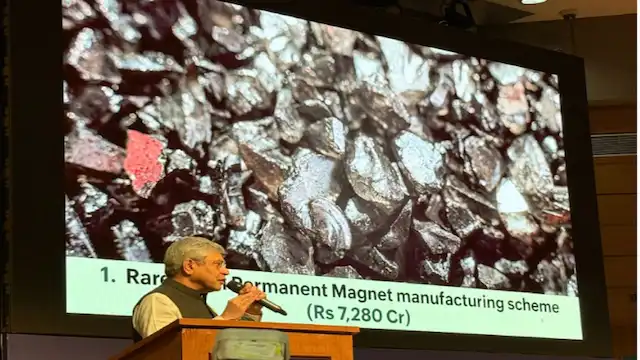
- REPMs critical to EVs, renewables, electronics and aerospace
- Scheme supports creation of integrated manufacturing facilities
India has approved an INR 7,280 crore scheme to promote domestic manufacturing of rare earth magnets. The much anticipated ‘Scheme to Promote Manufacturing of Sintered Rare Earth Permanent Magnets’ was approved during a Cabinet meeting chaired by Prime Minister, Narendra Modi on 26 November 2025 with the aim of establishing 6,000 metric tonnes per annum of integrated Rare Earth Permanent Magnets (REPMs) in India.
REPMs are vital to electric vehicles, renewable energy, electronics, aerospace, and defence applications. India’s consumption of REPMs is expected to double by 2030 from 2025. India, however, like much of the world, is dependent on imports, with a very high dependence on China.
This new scheme will help India become more self-reliant, an agenda undertaken in mission mode since January this year, when the government announced the National Critical Mineral Mission.
With a financial outlay of INR 7,280 crore, the scheme supports the creation of integrated REPM manufacturing facilities, involving conversion of rare earth oxides to metals, metals to alloys, and alloys to finished REPMs.
A large part of the fund, or INR 6,450 crore, will go towards sales-linked incentives of INR 6,450 crore on REPM sales for five years, the remaining INR 750 crore is being committed as capital subsidy for setting up an aggregate of 6,000 t per annum of REPM manufacturing facilities. This capacity will be divided between five beneficiaries picked through a global competitive bidding process, with each beneficiary allotted up to 1,200 t per annum of capacity.
Valid for seven years, the scheme includes a two–year gestation period for setting up an integrated REPM manufacturing facility, and five years for incentive disbursement on the sale of REPM.
Leave a Reply