- Programme covers 2.07 lakh commercial vehicles in Delhi-NCR
- Scheme could help generate around 2 mnt of ferrous scrap
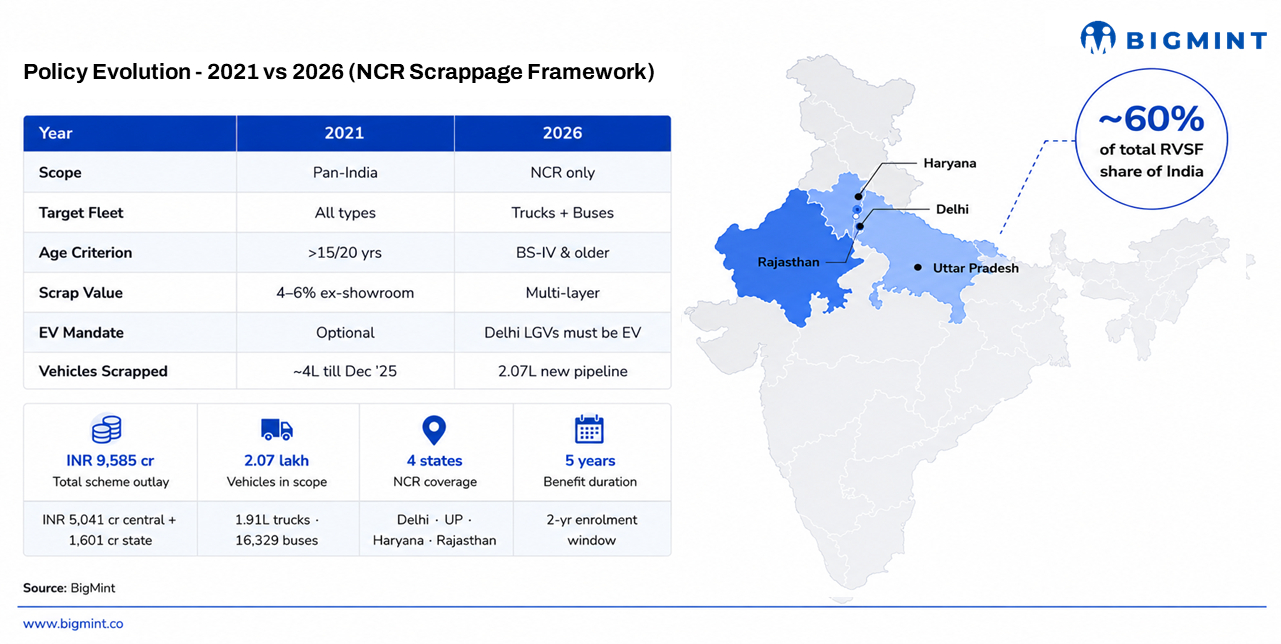
India’s Union Cabinet has approved an INR 9,585 crore, two-year targeted scheme to phase out BS-IV and older trucks and buses in Delhi-NCR and replace them with BS-VI-compliant or electric vehicles. The programme covers approximately 2.07 lakh commercial vehicles across four states — Delhi, Uttar Pradesh, Haryana, and Rajasthan — and marks a significant shift from the 2021 National Vehicle Scrappage Policy.
Unlike the earlier nationwide initiative, which relied primarily on fitness tests to identify unfit vehicles and covered all vehicle categories, the new scheme focuses specifically on commercial vehicles in Delhi-NCR and adopts an incentive-led approach to accelerate fleet replacement. Market participants expect the scheme to retire ageing commercial vehicles faster, improve regional air quality, and create a substantial increase in end-of-life vehicle generation — with positive downstream implications for ferrous scrap suppliers, recyclers, vehicle dismantlers, and e-auction platforms.
Key components of the incentive package
The scheme offers a multi-layer incentive structure designed to reduce the financial burden on fleet operators and encourage rapid transition to cleaner vehicles.

A key departure from the 2021 policy is the mandatory EV requirement for light goods vehicles (LGVs) in Delhi. Under the 2026 scheme, Delhi LGV replacements must be electric, reflecting a stronger regulatory push towards zero-emission urban transport.
Although trucks and buses account for only around 3% of the total vehicle fleet in the NCR, they contribute disproportionately to regional air pollution.

The environmental case for replacing these vehicles is compelling. A pre-BS vehicle emits up to 14 times more pollutants than a BS-VI vehicle, while BS-IV vehicles emit around 2.7 times more. This underscores both the air quality and scrap generation opportunity embedded in this scheme.
Scrap supply potential – why this matters for steel
The retirement of ageing trucks and buses is also expected to boost domestic ferrous scrap availability. Commercial vehicles contain significant quantities of recoverable steel. As they are dismantled through registered vehicle scrapping facilities (RVSFs), the resulting HMS and shredded scrap will flow into the domestic recycling ecosystem, benefiting EAF and induction furnace steelmakers and helping reduce India’s dependence on imported scrap.

BigMint estimates that 191,000 trucks and 16,300 buses are eligible for scrapping. Considering that an average of 10 tonnes (t) of ferrous scrap can be generated from one truck and 12 t from one bus, full implementation of the policy has the potential to generate around 2.1 million tonnes (mnt) of scrap, as per BigMint’s calculations. In FY’26, India’s scrap generation stood at around 30 mnt.
Policy evolution: 2021 scrappage policy vs 2026 NCR vehicle replacement scheme
The 2026 NCR scheme is more targeted and stricter than the 2021 National Vehicle Scrappage Policy across every dimension.
Unlike the pan-India, age-based framework, the NCR scheme specifically targets BS-IV and older trucks and buses, regardless of age, to address high-emission commercial vehicles.
It also offers a broader incentive package, including interest subsidies, fuel vouchers, OEM discounts, tax waivers, and liability relief, while mandating EV replacement for light goods vehicles in Delhi. Additionally, the scheme targets around 2.07 lakh vehicles within a two-year period in NCR, creating a significant near-term scrap generation opportunity compared with the approximately 4 lakh vehicles scrapped nationwide under the 2021 policy by December 2025.
Outlook
The NCR vehicle replacement scheme presents a potentially significant opportunity for India’s ferrous scrap market. The use of digital enrolment platforms for vehicle registration and recycling could improve throughput at RVSFs, while the mandatory shift to electric LGVs in Delhi may also create additional recycling streams from end-of-life batteries in the coming years.
However, several risks could limit the scheme’s near-term impact on scrap generation:
- Diversion risk: Fleet operators may choose to sell older vehicles outside NCR rather than scrap them, reducing the volume entering formal recycling channels.
- Capacity constraints: Limited RVSF processing capacity in the region could create bottlenecks in vehicle dismantling and scrap recovery. Uttar Pradesh, Rajasthan, Haryana, and Delhi currently have around 125-130 RVSFs, of which only 72 are operational, while approximately 54 are yet to commence operations. Even among functioning facilities, capacity utilisation remains low at around 30-40% in several locations due to the lack of timely feedstock availability, including vehicles reaching scrappage age, and delays in obtaining necessary approvals. As a result, on-ground operational constraints may slow the pace of vehicle scrapping and limit the growth in ferrous scrap generation.
- Implementation delays: Coordinating state-level agreements across four NCR jurisdictions — Delhi, UP, Haryana, and Rajasthan — could slow enrolment timelines and delay scheme execution.
As a result, actual scrap volumes generated may fall short of the scheme’s full potential in the near term, even as the structural direction remains firmly positive for the domestic scrap ecosystem.
Leave a Reply