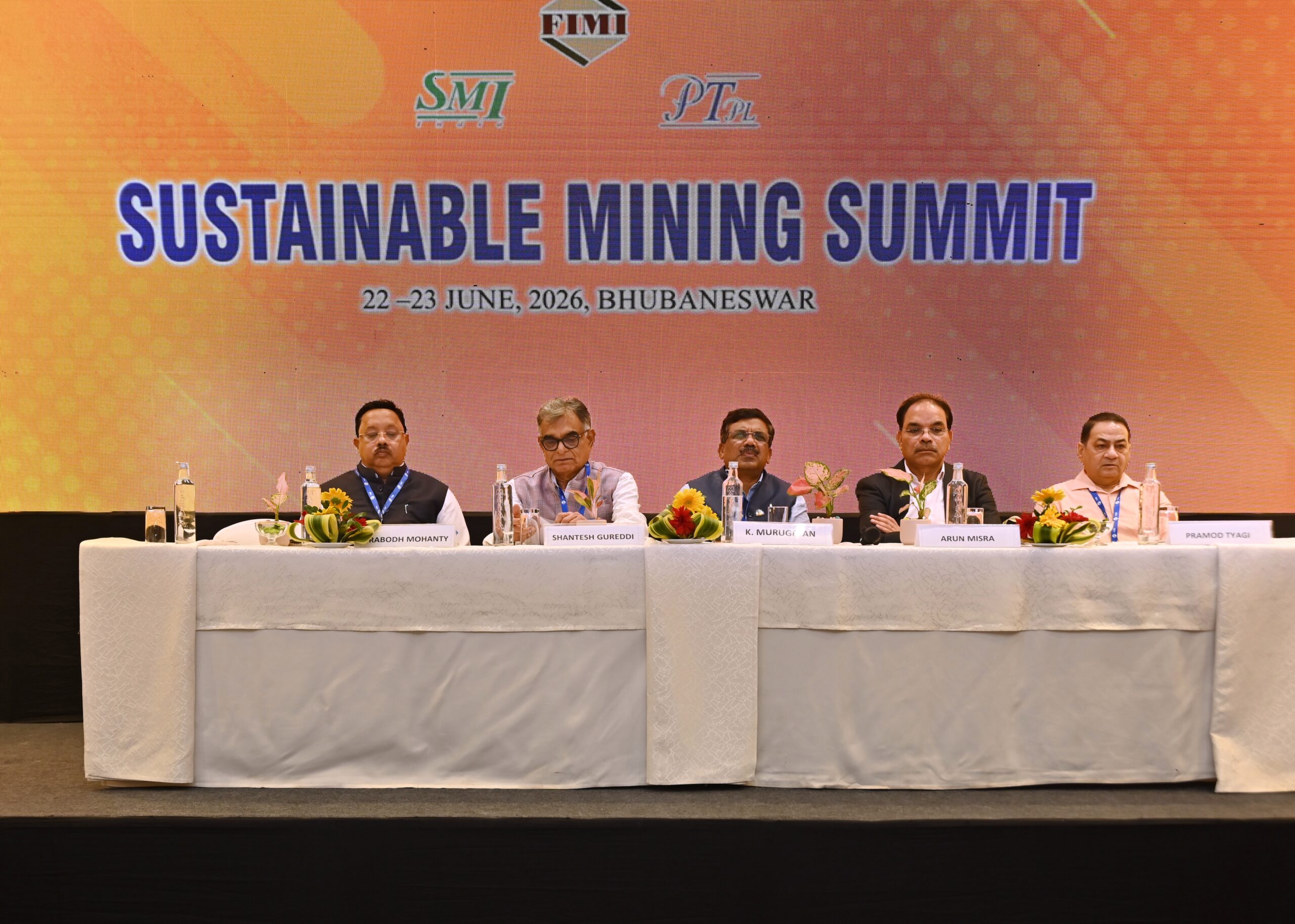
- Industry discussions focus on Mining 5.0, ESG and critical minerals
- Automation, cleaner technologies and digital mines emerge as key priorities
India’s mining industry is steadily moving towards a more technology-driven and sustainability-focused future, as discussions at the FIMI Sustainable Mining Summit 2026 in Bhubaneswar highlighted growing industry focus on digitalisation, cleaner technologies and responsible mineral development.
The summit brought together mining companies, policymakers, consultants and technology providers to discuss how the sector can balance rising mineral demand with environmental responsibility and operational efficiency.
The opening session, led by representatives from FIMI, IBM and the Government of Odisha, focused on sustainable mining, ease of doing business and the importance of responsible resource development as India looks to strengthen its domestic mineral ecosystem.
Mining 5.0 and digital mines gain traction
A key theme across the conference was the industry’s transition toward “Mining 5.0”, where automation, AI-driven systems and digital technologies are increasingly becoming part of mining operations.
A presentation during the summit traced the industry’s evolution from conventional mining practices to more integrated and technology-enabled operations. Discussions centred around the growing use of drone surveying, digital mine planning, RFID-enabled dispatch systems and automated mine management platforms to improve productivity, transparency and resource recovery.
Participants noted that mining companies are gradually recognising that future competitiveness will depend not just on production volumes, but also on operational efficiency, safety standards and environmental performance.
Sustainability and net-zero mining remain in focus
Environmental sustainability remained one of the key talking points during the summit.
Participants showcased various sustainability initiatives, including afforestation programmes, biodiversity enhancement measures and water conservation efforts across mining locations. Discussions also highlighted the industry’s increasing shift toward net-zero mining practices and ESG-led operational frameworks.
Several sessions focused on environmental compliance, land rehabilitation, community participation and responsible mining practices, reflecting the sector’s growing efforts to align with global sustainability expectations.
Critical minerals strategy gains importance
India’s ambitions around critical minerals and rare earth elements (REEs) also featured prominently during the summit.
Industry experts highlighted India’s opportunity to strengthen its position in the REE and permanent magnet value chain, particularly as demand from electric vehicles, renewable energy and advanced manufacturing sectors continues to grow.
However, participants acknowledged that China continues to dominate the global rare earth supply chain, making domestic exploration, policy support and downstream processing capacity increasingly important for India’s long-term resource security.
Odisha iron ore dispatch issue sparks discussion
One of the most closely watched discussions during the summit revolved around the recent pause in iron ore dispatches from Odisha.
During the technical sessions, officials explained that the move was aimed at strengthening monitoring mechanisms and ensuring greater transparency in grade declarations and mineral dispatches. Discussions highlighted the government’s focus on improving resource accountability, streamlining compliance practices and safeguarding state revenues.
The issue attracted considerable attention from miners and steel sector participants, given Odisha’s critical role in India’s iron ore supply chain. Industry stakeholders largely viewed the discussions as part of broader efforts to improve operational transparency and encourage more efficient resource management across the mining sector.

Industry calls for collaborative mining approach
During the valedictory session, officials emphasised the importance of collaborative mining practices, improved recovery of resources located between adjacent leases and stronger long-term mine planning.
Discussions throughout the summit suggested that sustainability is increasingly being viewed as a core operational requirement rather than a standalone compliance obligation.
Industry interactions and business discussions
Beyond technical sessions, the summit also provided opportunities for networking and business discussions among mining and metal sector participants. Discussions during the event covered iron ore sales opportunities, upcoming coal mining projects in Odisha, raw material availability, mine digitisation, export prospects and future expansion plans across the mining value chain.
Participants from mining, metals, logistics and allied industries exchanged views on operational challenges, sustainability goals and upcoming investment opportunities within the sector.
Outlook
The discussions at the FIMI summit reflected a broader shift underway in India’s mining sector, where sustainability, digitalisation and resource security are becoming central to long-term growth strategies. While challenges such as infrastructure gaps, high technology costs and regulatory hurdles continue to slow the pace of transition, the industry appears increasingly aligned on the need for cleaner operations, improved recovery rates and technology-led mining practices.
Going forward, the pace of adoption will depend largely on policy support, financing availability and how quickly mining companies can scale digital and sustainable solutions across operations.
Leave a Reply