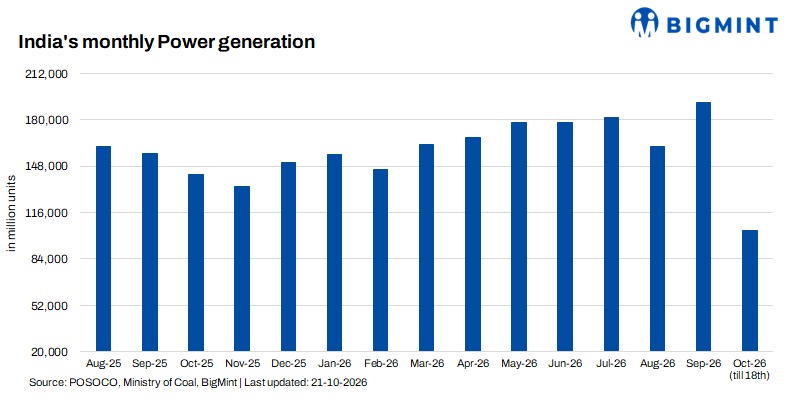
- Coal supplies nearly 80% of additional electricity generation
- Holidays and rainfall in south India help moderate demand
India’s electricity shortages eased sharply after mid-October, as demand moderated during the festival period and rainfall reduced requirements in parts of south India. However, the improvement followed a substantial increase in generation, with coal providing most of the additional electricity.
During 1-18 October 2026, generation increased 21.2% y-o-y to 103,916 MU. Coal output rose 25.2%, while hydro generation declined 23.4%, leaving thermal plants responsible for meeting much of the higher requirement.
The immediate balance has improved, but the reasons matter. Lower demand during holidays and rain-affected weather provides breathing space; it does not necessarily establish a lasting increase in dependable supply.
Coal dominates the generation response
Coal generation increased by 14,486 MU, supplying approximately 80% of the net increase across all sources. Average daily coal generation reached 3,993 MU, around 6.2% above September’s daily average.
Renewables added 4,604 MU year-on-year. However, hydro generation fell by 2,752 MU, offsetting approximately 60% of that increase. Hydro’s share consequently declined from 13.7% to 8.7%.

Gas, naphtha and diesel generation also expanded substantially, although their combined contribution remained relatively small.
Shortages retreat as demand moderates
Maximum demand met remained above 250 GW during 13-15 October, reaching 256.48 GW on 14 October. It subsequently declined to 242.59 GW on 17 October and 226.94 GW on Sunday, 18 October.
The lower requirement continued beyond Sunday. Maximum demand met stood at 232.64 GW on 19 October and 221.45 GW on 20 October.
Reported daily energy shortages fell from 31.32 MU on 14 October to 4.49 MU on 16 October, 0.29 MU on 18 October and zero on 20 October.
The western and northern regions, which together accounted for approximately 92% of national unmet energy on 14 October, reported zero energy shortage on 19 October. Only 0.04 MU remained nationally, in the eastern region.
These figures establish a clear improvement, although maximum demand met measures the load served rather than total demand including shortages.
Festivals change demand pattern
The decline coincided with Durga Puja, Navratri and Dussehra, making working-day effects important.
Holiday closures and fewer shifts can reduce electricity use at factories, offices and institutions. Festival lighting, retail activity and public events add demand, however, so the overall effect differs between regions.
West Bengal’s energy met declined from 246.1 MU on 14 October to 187.7 MU on 20 October, approximately 24%. The timing is consistent with reduced working-day activity during the Puja period, but the aggregate data cannot establish how much came from industry.
There is insufficient evidence to describe this as a broad industrial contraction. Temporary reductions in operating hours should be distinguished from weaker underlying orders or production demand.
The effect was not uniformly negative: Gujarat reported record electricity demand during Navratri on 16 October, illustrating how continuing economic activity and festival requirements can sustain high loads.
Rainfall in south India reduces cooling requirement
Tamil Nadu provides clearer evidence of weather-related relief. Grid India’s reports show maximum demand met falling from 20.53 GW on 13 October to 14.84 GW on 19 October, while energy met declined from 426.7 MU to 303.4 MU.
Contemporary reporting linked lower demand to rainfall and reduced cooling requirements. IMD confirmed rainfall across Tamil Nadu, Kerala and coastal Karnataka, including isolated heavy showers.
Tamil Nadu’s maximum demand met recovered to 17.72 GW on 20 October, demonstrating that the reduction was not continuous.
Nor was cooling uniform nationwide. IMD continued to report above-normal minimum temperatures in several regions, including parts of Gujarat, Rajasthan and central India. Regional rain relief should therefore not be presented as a nationwide cooling trend.
Exchange electricity remains expensive
The simple average of hourly IEX day-ahead market clearing prices during 1-20 October was approximately INR 7.67/kWh.
Daily averages remained high at INR 7.56/kWh on 18 October and INR 7.84/kWh on 19 October, before easing to INR 6.52/kWh on 20 October.
Hourly average prices reached INR 10/kWh in approximately 64% of the period’s hourly observations.
Low national shortages and expensive exchange electricity can coexist: sufficient power may be secured to serve demand while buyers still compete for limited short-term offers.
Reported import decision increases focus on domestic delivery
On 19 October, Reuters relayed a Bloomberg report that India had shelved a proposed mandatory imported-coal blending requirement. Reuters said it could not independently verify the report.
According to the account, policymakers instead sought higher Coal India production and stronger railway deliveries, with elevated international coal prices increasing the cost of imported replenishment.
This would not eliminate imports by plants designed for imported fuel or voluntary purchases by other consumers. It would place greater responsibility on domestic supply to support generation and rebuild inventories.
BigMint assessment
October’s electricity balance has improved through a combination of strong generation and lower demand. Festival holidays and southern rainfall explain part of the relief.
The next test will come as working-day activity normalises. Coal remains central, hydro support is weaker, and exchange prices remain elevated. Lasting improvement requires dependable supply and stronger fuel buffers when demand returns.
Leave a Reply