- Falling molybdenum oxide costs lead to lower Chinese offers
- Rupee appreciation reduces raw material costs in India
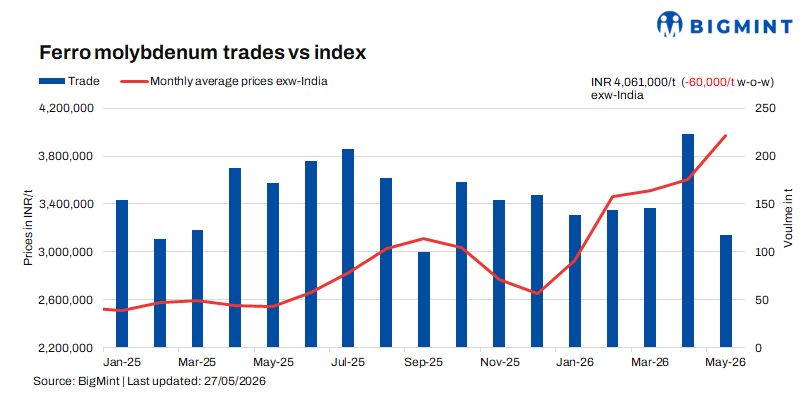
Indian ferro molybdenum (Mo 60%, 10-100 mm) prices declined by INR 60,000/t ($627/t) w-o-w to INR 4,061,000/t ($42,421/t) exw-India on 27 May 2026. Prices fell on lower global rates, particularly in China and a slight appreciation in the Indian rupee, which reduced imported raw material costs.
Buyers also expected further price declines; hence, limited trades were heard during the assessment window in the price bracket of INR 4,060,000-4,070,000/t ($42,411-42,515/t) exw.
Market summary (21-26 May)
Soft global demand weakens sentiment: Ferro molybdenum (Mo:60%) prices in China fell by RMB 18,500/t ($2,726/t) w-o-w to RMB 306,500/t ($45,163/t) exw-Inner Mongolia. Falling prices of molybdenum concentrate and oxide reduced cost support for producers, leading to softer ferro molybdenum offers. Demand from downstream steel mills stayed weak, with buyers purchasing only limited quantities for immediate requirements while continuing to seek lower prices. Traders also turned more aggressive in selling, offering discounts to secure deals amid sluggish market activity. Weak international molybdenum prices further pressured sentiment and kept trading slow.
Ferro molybdenum sentiment also weakened across other regions like the US and South Korea due to sluggish spot demand and limited inquiries from traders and steel mills. Despite the softer sentiment, the market remained relatively tight because of shipment delays from South America and restricted material availability.
Molybdenum futures on the London Metal Exchange also edged down by $0.13/lb w-o-w to $30.6/lb on 26 May.
Indian ferro molybdenum prices also declined in line with weak global market trends.

INR strength leads to reduced raw material costs: A key reason for lower prices was the recent appreciation of the Indian rupee against the US dollar. As molybdenum oxide, the main raw material for ferro molybdenum, is largely imported and traded globally in US dollars, a slightly stronger rupee reduced the landed cost of imports for Indian traders and smelters. This allowed suppliers to offer material at softer prices while protecting margins. Cheaper imports also increased competitive pressure on domestic sellers, while buyers remained cautious and resisted higher offers, expecting further price corrections in the near term.
Stainless steel prices show mixed trends: Prices of 316 grade hot-rolled coils (HRCs) stood steady w-o-w at INR 408,000/t ($4,267/t) exw-Mumbai. India’s stainless steel finished market witnessed mixed trends during the week, while overall sentiment remained firm despite subdued demand from downstream sectors. At the same time, freight rates also moved upward amid ongoing geopolitical tensions and supply chain uncertainties, adding further pressure on import viability. Market participants largely adopted a cautious approach, with buyers focusing mainly on need-based procurement while closely monitoring global developments and currency movements.

Leave a Reply