- Global scrap payabilities stay firm despite LME copper rally
- Trading remains slow due to weak demand during monsoon
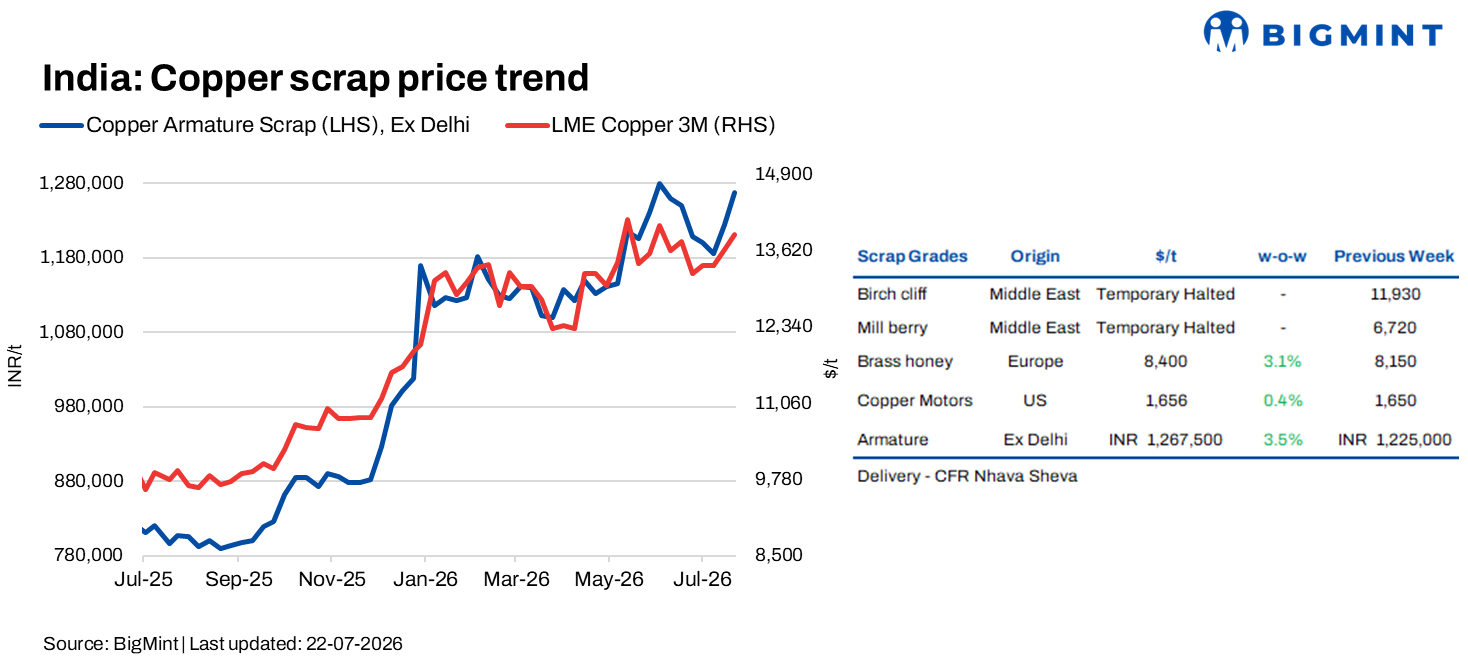
Copper scrap prices in India increased w-o-w on 21 July 2026, tracking the sharp rally in international copper prices, although physical trading activity remained subdued due to seasonally weak demand during the monsoon. London Metal Exchange (LME) copper prices climbed to around $13,700/t from nearly $13,600/t last week after concerns over potential US copper import tariffs fuelled expectations of tighter global trade flows and higher replacement costs.
At the domestic level, buying activity remained largely requirement-driven across major trading hubs. According to BigMint’s assessment, copper armature scrap, ex-Delhi, increased by around 4.4% w-o-w to INR 1,270,000/t from INR 1,217,000/t, mirroring the strength in international copper prices despite muted physical demand.
Market insight
Global copper scrap fundamentals remained supportive during the week. Traditionally, overseas scrap payabilities, or the percentage of the LME copper price paid for scrap, tend to soften during sharp rallies in LME copper prices as buyers negotiate lower percentages of the benchmark to offset higher outright costs.
However, this trend did not materialise as persistent tightness in global scrap availability kept supplier bargaining power intact. As a result, payabilities remained firm despite the rally in copper prices, with premium-grade, millberry scrap continuing to command 98.5-99% of the LME price.
For Indian buyers, who rely on imported copper scrap to supplement domestic availability, the firm overseas payabilities translated into higher replacement costs and supported domestic scrap prices despite subdued physical demand during the monsoon season.
Supply-side sentiment also remained firm after South Korea proposed mandatory export declarations for copper scrap from January 2027. While the regulation is not expected to curb exports, tighter documentation and compliance requirements could marginally slow shipments and reinforce tight global scrap availability. This is likely to support imported scrap replacement costs for Indian buyers, particularly for premium grades, alongside elevated overseas payabilities.
Physical trading remained largely requirement-driven as monsoon-related disruptions and weak downstream demand from secondary manufacturers, wire and cable producers, and brass processors continued to weigh on market activity. Buyers largely avoided inventory build-up, preferring to purchase only against immediate production requirements despite the stronger international market.
High-grade copper scrap continued to command a premium due to limited availability. Pakistani buyers offered around $100/t higher prices than the Indian domestic market for copper motor scrap, to secure a reliable supply of feedstock for downstream processing and re-export markets. The higher bids helped sustain premiums for high-grade scrap despite subdued domestic demand in India.
Overall, the market remained supported by tight global scrap supply, elevated overseas payabilities, and higher LME copper prices, while Indian physical demand continued to remain seasonally subdued, limiting spot trading volumes despite the improvement in price sentiment.
Outlook
India’s copper scrap market is expected to remain cautiously firm in the near term. The ongoing monsoon season is likely to keep physical demand subdued; buyers are likely to continue procuring material only against immediate production requirements, limiting any significant improvement in trading volumes.
However, firm overseas replacement costs are expected to keep imported scrap offers elevated. Unless there is a meaningful recovery in downstream demand, domestic trading activity is expected to remain muted, although scrap prices are likely to stay supported by international market fundamentals rather than local consumption.

Leave a Reply