- IOCL cuts prices sharply, Nayara reverses May gains
- Imported prices soften in May but remain elevated
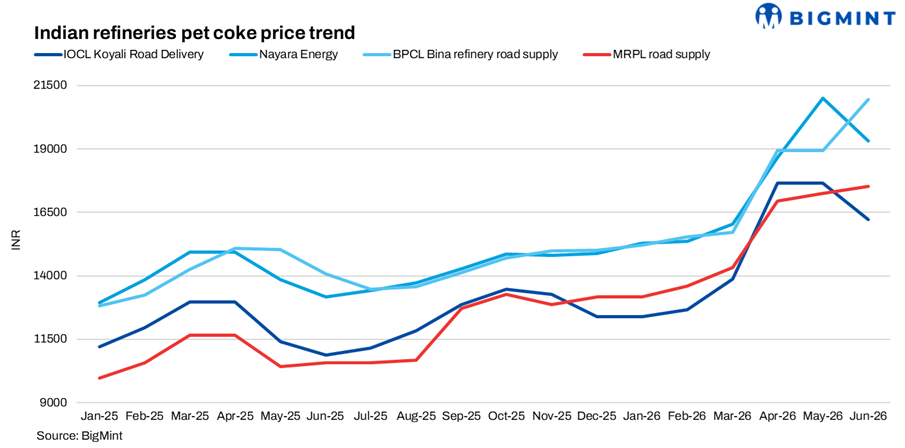
India’s domestic petcoke market witnessed divergent pricing trends in June 2026, reflecting varying regional dynamics and refinery strategies. While IOCL and Nayara reduced prices significantly, attributed to improving supply conditions and easing international concerns, BPCL and MRPL increased offers, supported by tighter local availability and refinery-specific factors. Despite the correction at select refineries, market participants indicated that prices remained elevated compared with historical levels due to higher freight costs and marine insurance premiums linked to the continuing geopolitical uncertainty around the Strait of Hormuz.
IOCL slashes prices after May rollover
Indian Oil Corporation (IOCL), the country’s second-largest petcoke producer and market leader by domestic sales, reduced prices across all refineries effective 9 June 2026 after maintaining prices unchanged in May.
Road prices at Koyali and Panipat declined by INR 1,440/t to INR 16,220/t and INR 17,480/t, respectively. Meanwhile, Paradip and Haldia witnessed steeper cuts of INR 1,720/t, taking prices down to INR 15,260/t and INR 15,430/t, respectively. Rake prices remained INR 200/t lower than road rates, except at Panipat, where no rake loading facility exists.
The sharp reduction followed Nayara’s earlier correction and indicated that the supply tightness witnessed over the previous three to four months had begun to ease.
Nayara and CPCL soften; BPCL moves higher
Nayara Energy reduced its petcoke price effective 1 June 2026 by INR 1,670/t to INR 19,330/t, partially reversing the sharp hikes implemented in previous months. The decline reflected improved availability following the completion of Nayara’s refinery shutdown and softer imported petcoke prices.
Similarly, CPCL reduced prices by INR 450/t to INR 19,300/t, signalling a more moderate correction.
In contrast, BPCL adopted an aggressive pricing strategy. Bina refinery increased rake prices by INR 2,000/t to INR 21,000/t, while road prices remained INR 50/t lower. At Kochi, prices rose by INR 1,500/t to INR 19,500/t. Market participants attributed the increase to lower-than-normal availability, with Bina supplying around 20,000-25,000 t and Kochi expected to dispatch around 70,000-75,000 t during the month.
MRPL increases marginally
MRPL raised its petcoke prices by INR 270/t. Rake prices increased to INR 15,590/t, including INR 70/t towards tarpaulin charges, while road prices rose to INR 17,520/t.
The refinery continued offering an INR 2,000/t volume discount on road purchases exceeding 2,500 t per month, effectively narrowing the difference between rake and road supplies. Market participants noted that MRPL’s revisions remained relatively moderate compared with the sharp movements seen at other refineries.
Global factors still influence pricing
Although domestic prices corrected at several refineries, the market remained influenced by international developments. The easing of supply concerns following Nayara’s restart reduced some upward pressure. However, freight costs and marine insurance premiums continued to remain above normal levels due to vessel rerouting and concerns over transit through the Strait of Hormuz.
Imported petcoke prices also softened during the period. As per BigMint’s assessment, average US-origin 6.5% sulphur petcoke, CNF Vizag, declined to around $149/t in May from $166/t in April, reducing some pressure on domestic consumers.
Outlook
Domestic petcoke sentiment is expected to remain mixed in the near term. While improving supply availability and softer imported petcoke prices may support further corrections at some refineries, refinery-specific supply conditions and elevated logistics costs are likely to prevent a broad-based decline. With the monsoon season approaching and cement demand remaining subdued, buyers are expected to continue adopting cautious, requirement-based procurement strategies.

Leave a Reply