- Safeguard duty keeps imported HRC above domestic levels
- May HRC imports rise on earlier bookings, demand from pipe producers
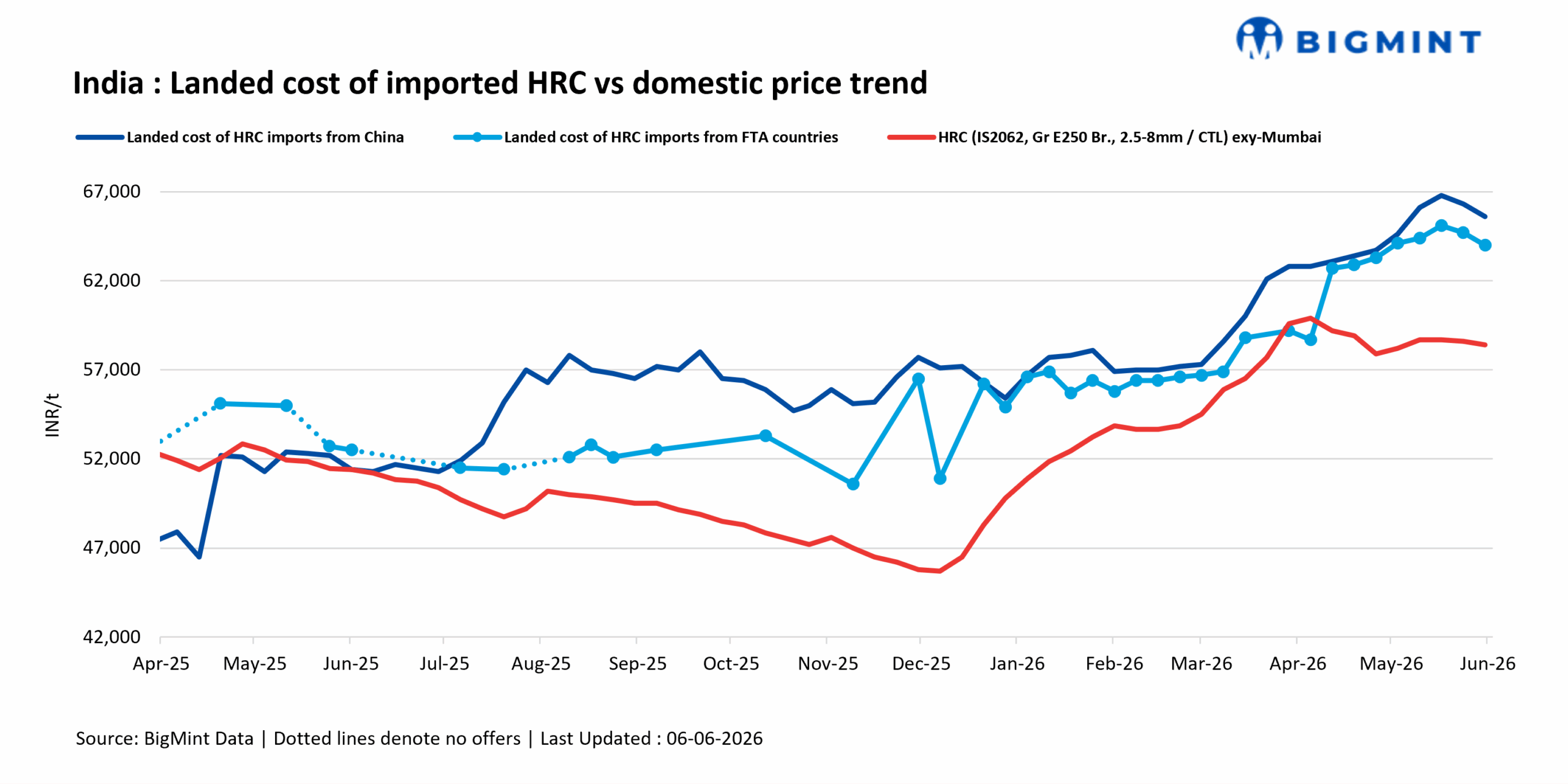
Domestic hot-rolled coil (HRC) prices are seeing an evident gap with imports, with domestic prices lower by around INR 5,700-7,300/t ($60-77/t) compared with imports as of 6 June 2026, according to BigMint calculations.
India’s safeguard duty structure entered its second phase on 21 April 2026, with the duty on flat steel imports reducing from 12% to 11.5%, as per the government’s notified tapering mechanism.
Under the notification, the safeguard duty has been structured on a declining scale:
- 12% ad valorem from 21 April 2025 to 20 April 2026
- 11.5% from 21 April 2026 to 20 April 2027
- 11% from 21 April 2027 to 20 April 2028.
While the lower duty was intended to ease the burden on importers, imported HRC continues to remain costlier than domestic material, creating no room for dumping of cheap HRC.
The CFR price of HRC from non-FTA countries was assessed at around $550/t on 2 June. After adding 7.5% basic customs dusty (BCD) and 0.75% cess, the price comes to approximately $595/t. At an assumed exchange rate of $95/t, the value translates to about INR 56,499/t.
As per the new structure, the 11.5% safeguard duty, along with a 1.15% cess, adds roughly $75/t, taking the cost to about $670/t or INR 63,600/t. After adding port handling charges of around INR 2,000/t, the total landed cost of imports from non-FTA countries is estimated at approximately INR 65,600/t.
Similarly, CFR offers from FTA countries were heard at around $580/t. Due to FTA there is no BCD and after adding the 11.5% safeguard duty, along with 1.15% cess, roughly $73/t, it translates to a landed cost of approximately INR 64,000/t, lower than imports price from non-FTA countries.
Meanwhile, BigMint’s benchmark assessment (bi-weekly) for HRC (IS2062, Gr E250, 2.5-8 mm/CTL), ex-Mumbai, was at INR 58,300/t ($613/t) on 5 June. Prices are assessed at the distributor-to-dealer level and exclude 18% GST.
At current levels, the spread between domestic benchmark prices and the landed cost of imports from non-FTA and FTA countries is estimated at approximately INR 5,700-7,300/t.

Domestic market update
Leading Indian steelmakers have rolled over their mill list prices for June sales. HRC prices (2.5-8 mm, IS2062, Gr E250 Br) are now in the range of INR 59,050-61,000/t ($621-$642/t), ex-Mumbai.
HRC prices showed mixed movement this month. In northern India, distributors raised prices slightly to cope with higher procurement costs and limited availability of some thicknesses. However, ample supply in other regions and weak demand kept prices largely stable. Buyers purchased only for immediate needs and remained cautious, waiting for fresh mill announcements before making larger commitments.
Bulk HRC imports
Bulk HRC imports into India in May amounted to around 423,925 t, an increase of 22% m-o-m from 348,901 t in April, as per BigMint’s vessel line-up data.
However, the same increased by 52% y-o-y compared to 279,250 t in May 2025.
In May, China, South Korea and Japan continued to be the top three bulk HRC exporters to India, shipping 147,417 t, 110,791 t and 53,681 t respectively. Additionally, the volume of imports from China jumped in the month by 96% compared to April. Furthermore, shipments from South Korea rose by 18% m-o-m. However, the shipments from Japan marked a drop of 39% m-o-m compared with April.
India’s HRC imports surged in May, supported by lower safeguard duty from late-April and near parity with domestic prices during March-April, which encouraged fresh bookings. Additional demand from pipe and tube manufacturers serving export markets, particularly Middle East pipeline projects, further boosted imports of HRC as a key feedstock.
Outlook
The Indian HRC market is expected to stay largely balanced in the coming weeks. While import arrivals may remain elevated due to earlier bookings and demand from export-focused pipe and tube makers, the wide gap between domestic and import costs should limit fresh import interest. Domestic prices are therefore likely to remain stable-to-firm due to slow market conditions and approaching monsoon.
Leave a Reply