- Coking coal mining to get special provisions post inclusion in National Critical Mineral Mission
- Imports contribute over 85% of India’s coking coal demand
India has formally classified coking coal as a “critical and strategic mineral” under the Mines and Minerals (Development and Regulation) Act, 1957, a move aimed at accelerating domestic production and reducing the steel sector’s heavy reliance on imports.
The notification, issued by the Ministry of Coal on 29 January, follows recommendations from the High-Level Committee on Implementation of Viksit Bharat Goals and policy inputs from NITI Aayog, which flagged coking coal as a key vulnerability in India’s mineral security framework.
Despite holding an estimated 37.37 billion tonnes (bnt) of coking coal resources, largely concentrated in Jharkhand, India continues to depend on overseas supplies for the majority of its coking coal requirement. Imports increased from 51.20 mnt in FY’21 to 57.58 mnt in FY’25, exposing domestic steelmakers to price volatility, supply disruptions, and foreign exchange risks.
Under the amendment notified pursuant to Section 11C of the MMDR Act, the First Schedule has been revised to explicitly include Coal, including Coking Coal in Part A, while Coking Coal has been inserted into Part D, which lists Critical and Strategic Minerals. Following this classification, coking coal will come under the purview of the National Critical Mineral Mission. This is expected to streamline approvals, fast-track clearances, and enable faster development of deep-seated and technologically complex deposits.
Mining of critical minerals is exempt from public consultation requirements and permits the use of degraded forest land for compensatory afforestation — policy flexibilities that are likely to improve project viability and attract private investment across exploration, mining, and beneficiation.
Market participants expect the move to support supply chain resilience for the domestic steel industry, align with the objectives of the National Steel Policy, and gradually curb import dependence over the medium to long term. Increased investment in advanced mining technologies and beneficiation is also expected to generate employment across the mining and steel value chain.
The government clarified that royalty, auction premiums, and statutory levies will continue to accrue to state governments, even where mineral auctions are conducted by the Centre, ensuring no dilution of state revenues.
The designation of coking coal as a critical mineral underscores India’s broader push to secure strategic raw materials essential for industrial growth and long-term economic resilience.
Rising steel output boosts demand for coking coal
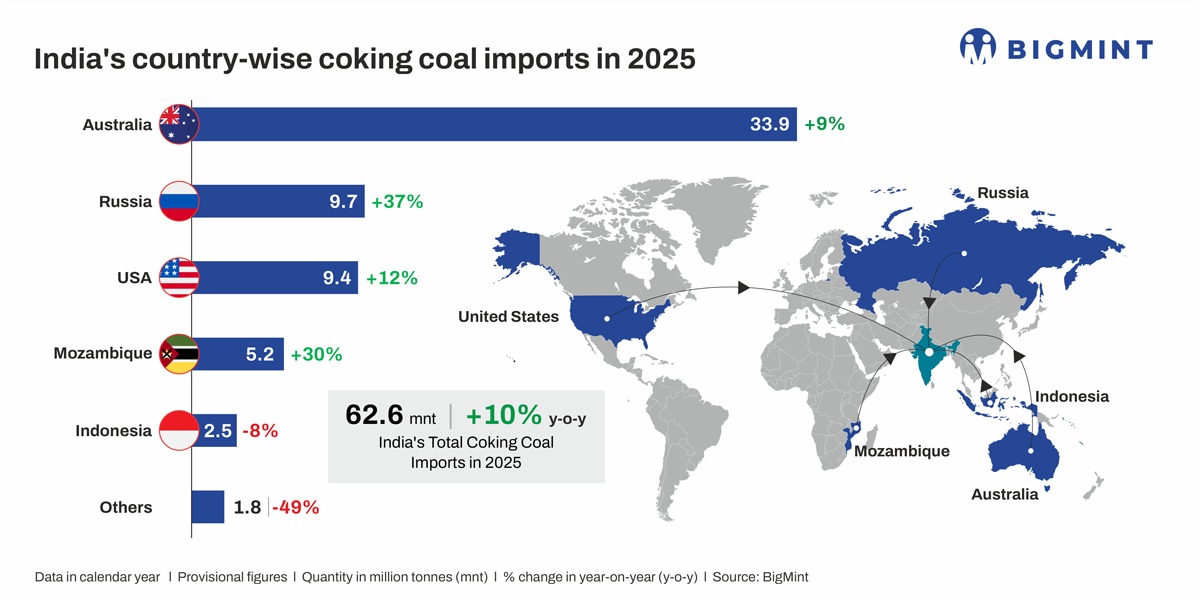
Imports of coking coal in the year CY’25 were assessed at around 62.6 million tonnes (mnt), as per provisional data maintained with BigMint, compared with over 57 mnt in CY’24, an increase of 9.8% y-o-y. Imports increased due to higher steel production in India, the only major economy in the world to witness a surge in steel production in CY’25 amid overall global decline. Notably, India’s crude steel production grew by around 10% y-o-y to 163 mnt in CY’25.
As per BigMint’s estimates, India’s coking coal demand is projected to increase from 48 mnt in FY’24 to over 70 mnt by FY’30. In FY’24, India produced 67 mnt of coking coal, but only 10-12% was washed and converted into coke, meeting just 6-7 mnt of steelmaking demand. Due to the high ash content of domestic coal, India has to import over 85% of its coking coal requirement.
Leave a Reply