- Gujarat and Rajasthan sowing lags normal pace, raising crop uncertainty
- Futures strength driven by supply risk, not export demand
India’s cumin (jeera) prices have remained firm in late December and early January, supported mainly by delayed sowing and low physical arrivals, even as sizeable old stocks are still held by farmers and traders. NCDEX jeera futures have been trading around ₹22,300-22,500 per quintal, while spot prices in key mandis such as Unjha are largely holding within the ₹21,800-22,400 per quintal range, indicating steady price discovery driven by supply-side concerns.
What happened is that rabi sowing progress for cumin has remained slower than normal in the two main producing states, Gujarat and Rajasthan. In Gujarat, cumin acreage by mid-December is estimated at around 3.2-3.3 lakh hectares, nearly 14-15% lower year-on-year, as intermittent rainfall delayed land preparation and planting. Rajasthan has also seen slower sowing compared with its long-term average, with farmers cautious due to last season’s sharp price swings and uneven soil moisture. Although the sowing window extends into early January, trade estimates suggest that only partial recovery in acreage is now possible, keeping final area below last year’s level.
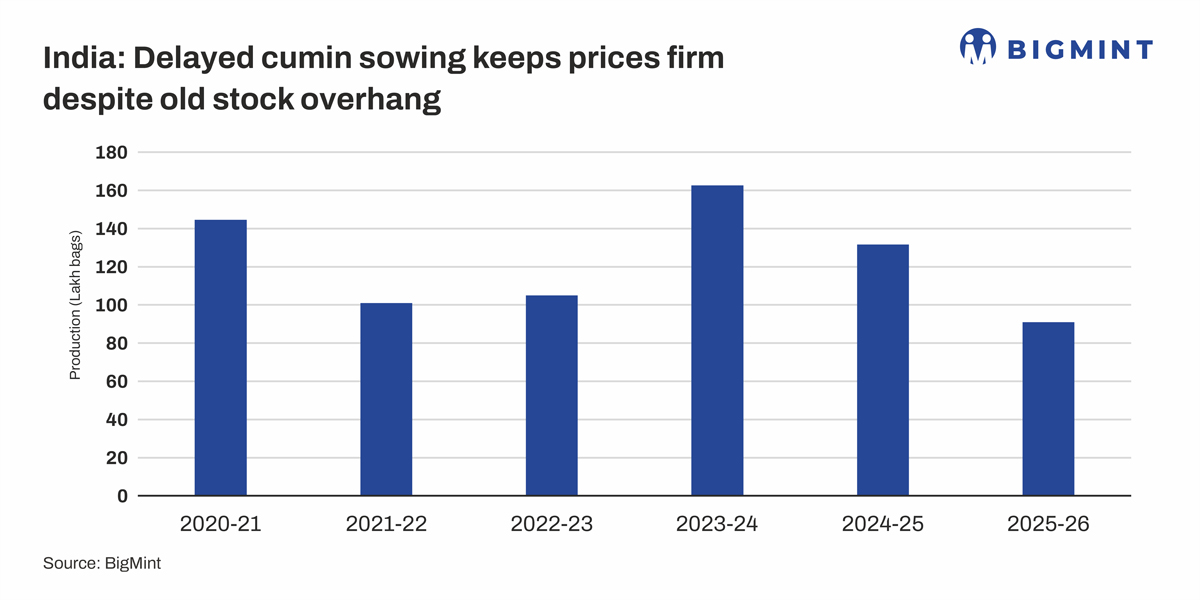
Why prices are holding firm is linked to tight visible supply despite adequate carry-in stocks. Market participants estimate old stock at around 18-20 lakh bags, but selling has been limited as farmers and stockists prefer to wait for clarity on the new crop. Daily arrivals at Unjha remain low, preventing any meaningful price correction. At the same time, production for the 2025-26 season is being tentatively pegged at 90-92 lakh bags, compared with about 1.10 crore bags last season, largely due to lower acreage rather than yield assumptions. Export demand remains present but price-sensitive, especially from West Asia and China, and is not driving the current price strength.
Futures markets are playing a larger role in price discovery. NCDEX jeera futures have moved up along with rising open interest, indicating fresh buying interest rather than short covering. The futures curve remains relatively flat, suggesting that while traders are factoring in supply risk, they are also cautious due to the availability of old stocks and the approaching arrival season from February onwards.
What may happen next will depend on January sowing progress and early crop conditions. If sowing improves meaningfully over the next few weeks, prices could face pressure closer to arrivals. However, if acreage remains structurally lower, cumin prices are likely to stay firm through the arrival season. For traders and brokers, the market remains supply-driven, while exporters are expected to buy hand-to-mouth at higher price levels, keeping volatility elevated in the near term.
Leave a Reply