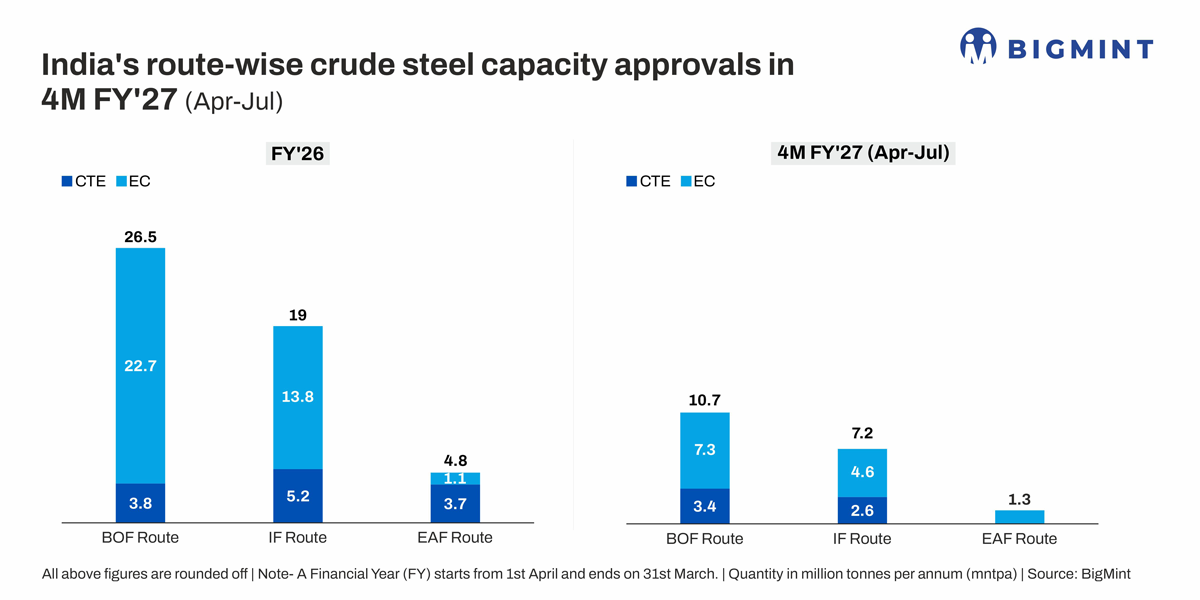
- BOF projects account for 10.67 mnt/y; IF, EAF contribute 8.49 mnt/y
- Karnataka leads approvals; eastern, central India retain major share
- 22 mnt/y pellet, 15 mnt/y iron ore beneficiation capacity announced
Morning Brief: India’s crude steel expansion pipeline gathered pace in the first four months of FY’27, with 19.2 million tonnes (mnt/year) of new capacity receiving environmental clearance (EC) and consent to establish (CTE) during April-July 2026, according to BigMint data. The approvals span both integrated and secondary steelmaking routes, with 13.34 mnt/year of blast furnace (BF) capacity, 10.67 mnt/year through the basic oxygen furnace (BOF) route, 7.19 mnt/year through induction furnaces (IF), and 1.31 mnt/year through electric arc furnaces (EAF).
The pace accelerated sharply in July, when 7.53 mnt/year of crude steel capacity was approved, accounting for about 39% of the four-month total. This followed approvals of 4.86 mnt/year in April, 5.79 mnt/year in May, and 0.98 mnt/year in June, indicating that the investment pipeline strengthened towards the start of the second quarter of FY’27.
Of the 19.2 mnt/year of crude steel capacity, 13.2 mnt/year has received EC, while another 6.0 mnt/year is at the CTE stage. These approvals are leading indicators of future capacity additions rather than immediate production increases, as projects still need to move through construction, commissioning, and consent to operate before commercial production can begin.
It should be noted that EC is an environmental approval that allows a project to proceed subject to specified environmental conditions, while CTE is an approval from the state pollution control authority that permits a company to establish or construct the industrial facility. Projects with EC have therefore crossed a key environmental regulatory hurdle, while those at the CTE stage are moving through the project establishment process.
Karnataka leads capacity approvals
Karnataka accounted for the largest share of crude steel expansion approvals during April-July 2026, with 6.0 mnt/year of capacity, entirely through the BOF route. Odisha followed with 3.37 mnt/year (of BOF capacity again), while Jharkhand and Chhattisgarh received approvals for 2.57 mnt/year (split between EAF and IF) and 2.56 mnt/year (BOF and IF), respectively.

Maharashtra accounted for another 1.60 mnt/year, while West Bengal received approvals for 1.38 mnt/year (EAF and IF in both states). Together, these six states accounted for around 91% of the total approved capacity, highlighting the continued concentration of steel investments in established steelmaking regions.
Karnataka’s position at the top of the latest approval table marks a shift from the eastern India-heavy pattern seen in earlier approval data. However, Odisha, Jharkhand, Chhattisgarh, and West Bengal together accounted for around 9 mnt/year, or more than half of the national pipeline, indicating that eastern and central India continue to attract a substantial share of new capacity.
Expansion spans integrated and secondary routes
The route-wise composition of the latest approvals shows that India’s capacity expansion remains distributed across different steelmaking technologies. BOF-based projects accounted for 10.67 mnt/year, or around 56% of the total, making it the largest route in the April-July 2026 pipeline.
IF-based projects contributed 7.19 mnt/year, equivalent to around 37% of total approvals, while EAF projects accounted for 1.31 mnt/year, or about 7%. Combined IF and EAF approvals therefore totalled 8.49 mnt/year, but the overwhelming share of this electric and secondary capacity came from IF additions.
The relatively large IF component indicates that secondary steelmakers continue to invest alongside integrated producers. IF-based capacity remains an important part of India’s steel industry, particularly in regions with established DRI, scrap, and finished-steel ecosystems.
The 10.67 mnt/year of BOF approvals, together with 13.34 mnt/year of BF capacity, also shows that a sizeable part of the new integrated capacity remains tied to the conventional BF-BOF route. Coke oven approvals reached 6.43 mnt/year during the period, reinforcing the link between the latest investment pipeline and coal-based ironmaking.
The 1.31 mnt/year of EAF approvals remains small compared with total additions. EAF capacity represents only about 7% of the crude steel pipeline, suggesting that the current approval pipeline does not yet point to a major shift towards EAF-based steelmaking despite the industry’s growing focus on decarbonisation.
Upstream approvals point to integrated raw-material planning
The upstream pipeline provides another indication of the scale of the investment cycle. Pellet capacity approvals reached 22 mnt/year during April-July 2026, exceeding the 19.2 mnt/year crude steel approval pipeline over the same period. Sponge iron approvals stood at 6.68 mnt/year, while iron ore beneficiation capacity reached 15.1 mnt/year.

The combination is particularly relevant because India’s steel expansion is likely to increase competition for iron ore, pellets, DRI, and other metallic inputs. The parallel expansion of beneficiation and pellet capacity could improve the availability of processed iron units, while the sponge iron pipeline will add another source of metallic feedstock for secondary steelmakers.
Coal-linked approvals were also significant, with 6.76 mnt/year of coal washery capacity and 6.43 mnt/year of coke oven capacity approved during the period. Together with the 13.34 mnt/year of BF capacity, these numbers indicate that a meaningful part of the pipeline remains linked to conventional coal-based steelmaking.
Downstream expansions skewed towards long steel
The announced downstream expansions are strongly weighted towards long products. During April-July 2026, approvals included 13.47 mnt/year of rolling-long capacity, compared with 0.37 mnt/year of hot-rolled coil (HRC) and 2.68 mnt/year of cold-rolled coil (CRC) capacity.
The much larger long-steel pipeline indicates that a significant part of the demand mix remains linked to India’s infrastructure, construction, and capital expenditure demand. Long products are closely tied to these segments, making the downstream expansion consistent with expectations of sustained domestic steel consumption.
Captive power and ferro alloys add to investment pipeline
The latest approvals also extend into supporting infrastructure. Captive power approvals reached 2,484 MW during April-July 2026, with July alone accounting for 1,059 MW.
The investment in captive power is relevant for steelmakers with energy-intensive operations, particularly secondary producers and integrated plants that seek greater control over power availability and costs. As new steel capacity comes on stream, electricity demand will rise across melting, rolling, beneficiation, pelletising, and other processing operations.
Ferro alloy production capacity approvals reached 0.97 mnt/year during the four-month period. While small compared with crude steel capacity, the addition reinforces the broader pattern of investment across multiple stages of the steel value chain.
Outlook
The 19.2 mnt/year approval pipeline in just four months shows that India’s steel investment cycle remains active, with the pace accelerating sharply in July. The 7.53 mnt/year of crude steel capacity approved in July alone accounted for nearly 40% of the April-July total, while associated approvals across BF, sponge iron, coke ovens, and rolling-long capacity point to several large projects moving through the regulatory pipeline.
However, the latest pipeline does not yet show a decisive shift towards EAF-based production, despite rising pressure on producers to lower carbon intensity. Recurrent shortages of scrap, the primary feedstock in EAFs, remain a concern for the industry given rising global export restrictions.
If the current approval momentum continues, the pipeline could provide a sizeable contribution towards India’s 300 mnt crude steel capacity target by 2030-31. The key variable, however, will be execution rather than approvals alone.
Leave a Reply