- Improved downstream margins lift CCT prices
- Higher imports reflect tight domestic supply
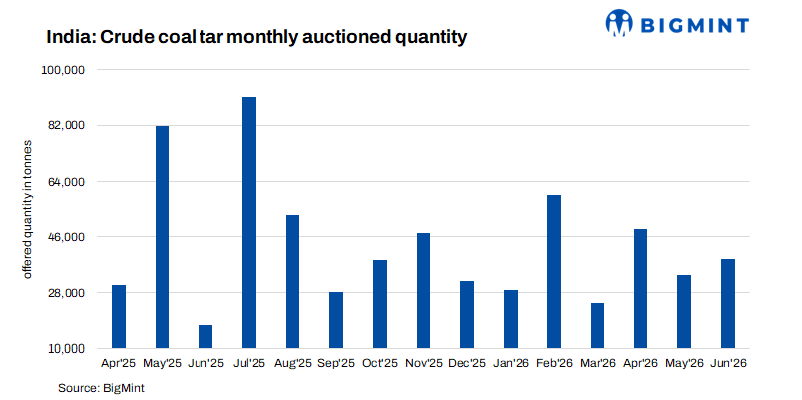
India’s crude coal tar (CCT) market witnessed a notable increase in auction activity during June 2026, with total volumes offered through plant auctions rising by around 16% m-o-m to 39,092 t, according to BigMint’s auction tracking.
The increase was primarily driven by higher auction offerings from integrated steel producers following improved coke oven operations. Despite the rise in volumes, overall spot availability remained relatively balanced, as healthy procurement by coal tar distillation units continued to absorb additional supplies without creating any significant inventory overhang.
Improving downstream realisations propel CCT prices
BigMint’s monthly assessment showed that eastern India crude coal tar prices rose sharply by around INR 5,800/t m-o-m to approximately INR 59,000/t exw Rourkela in June 2026. The price rally was underpinned by a combination of firm downstream demand, constrained spot availability, rising crude oil prices, and continued strength in coal tar pitch and Pitch Creosote Mixture (PCM) prices.
Market participants noted that higher PCM realizations substantially improved processing margins for coal tar distillers, allowing buyers to bid more aggressively during plant auctions. Consequently, competitive participation and full allocation of most auctioned volumes supported higher clearing prices across major suppliers.
SAIL expands offerings while demand remains resilient
Among domestic suppliers, SAIL continued to dominate the market by increasing its aggregate auction volume to 33,172 t in June, compared with 27,490 t in May. SAIL Rourkela increased its offering to 12,000 t from 10,000 t, while SAIL Durgapur auctioned 10,000 t, broadly in line with the previous month’s level. SAIL Bhilai offered 6,512 t, marginally lower than 6,989 t in May. Although auction volumes increased, buying interest remained firm as downstream consumers actively secured feedstock to capitalize on improved derivative margins, enabling complete or near-complete allocation of the offered quantities.

Mixed supply trends seen among other producers
Outside SAIL, NMDC Nagarnar raised its CCT offering to 5,500 t from 4,500 t in May, further contributing to domestic availability. In contrast, RINL reduced its auction volume to 840 t, compared with 1,680 t in the previous month.
Nevertheless, the entire quantity was successfully booked, reflecting sustained regional demand and the limited availability of alternative spot material, particularly in southern markets.
Import surge reflects tightening domestic feedstock balance
BigMint’s trade data indicates that India’s crude coal tar exports during January-May 2026 declined by around 5% y-o-y to 2,702 t, compared with 2,837 t in the corresponding period last year, suggesting that domestic consumption continued to take precedence over export opportunities.
In contrast, imports surged significantly to 13,232 t, against just 409 t during January-May 2025, with Indonesia emerging as the dominant supplier.
The sharp increase in imports highlights buyers’ efforts to supplement domestic feedstock amid firm downstream demand and attractive processing economics. Notably, the import volume during the first five months of 2026 has already significantly exceeded the 3,987 t imported during the entire CY’25, underscoring the rapid shift in India’s sourcing pattern.
Outlook
India’s crude coal tar market is expected to remain firm in the near term, supported by healthy operating rates at coal tar distillation units, sustained strength in coal tar pitch and PCM prices, and stable demand from downstream chemical manufacturers. Although higher auction volumes and elevated imports are likely to improve feedstock availability, the market is expected to remain fundamentally balanced rather than oversupplied.
Unless downstream derivative prices weaken materially or additional domestic supply enters the market, CCT prices are likely to remain supported, with any corrections expected to be limited and driven primarily by changes in processing margins or crude oil-linked sentiment.

Leave a Reply