- MoEFCC halts export permissions in landmark decision
- CPCB to begin ground-level compliance inspections
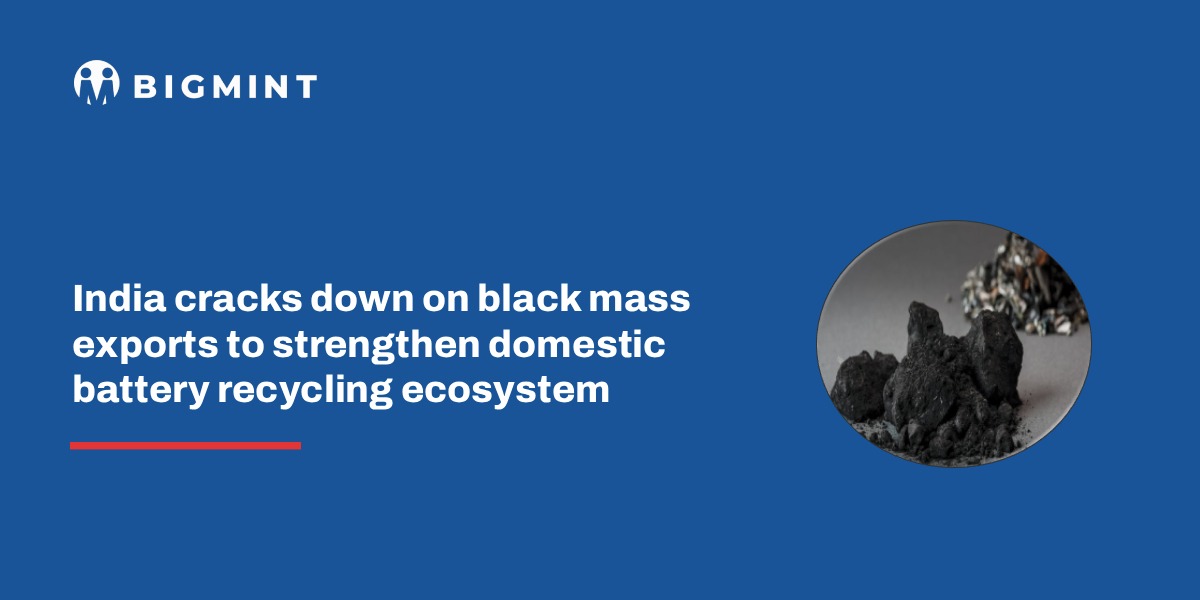
In a landmark policy shift, India’s Ministry of Environment, Forest and Climate Change (MoEFCC) has moved to curb exports of “black mass” — the powdery residue obtained from shredded lithium-ion batteries containing critical metals like lithium, cobalt, and nickel. In its 151st Expert Committee meeting on 12 November, the government deferred all export-permission applications for black mass, effectively tightening controls and signalling a near-term halt.
Push to strengthen circular battery value chain
The move aims to build a resilient domestic battery recycling and refining ecosystem. According to the Committee, exporting black mass undermines India’s resource security and diverts high-value feedstock from domestic refiners who rely on it for recovering critical raw materials.
To reinforce compliance, the Central Pollution Control Board (CPCB) will initiate on-site inspections to verify Standard Operating Procedure (SOP) adherence, technology capability, waste-handling infrastructure, and correct classification under HS Code 85491400. During site inspections, reviewing at least one year of sales invoices will reveal sales to unauthorised traders or other shredders, both prohibited under HWMR. It will also expose units with negligible domestic sales seeking large export permissions, indicating trading irregularities.
Capacity gap & scale of exports
India’s R2 (shredding) capacity stands at nearly 70,000 tonnes (t) per annum, while domestic R4 (refining) capacity is estimated at 60,000 t per annum — creating a structural supply imbalance. Adding to this, India exported roughly 40,000 t of black mass since October 2022, depriving domestic refiners of essential feedstock.
$3.5 billion opportunity
Restricting exports could unlock a $3.5 billion battery-recycling ecosystem by 2030, create 27,000-41,000 jobs, and significantly enhance circularity. India’s black mass recycling market was valued at $1,564.9 million in 2024, projected to grow at a 17.4% CAGR to $6,451.4 million by 2033.
Keeping critical raw materials onshore
By classifying black mass as hazardous waste and deferring exports, MoEFCC is clearly signalling that India intends to retain critical raw materials onshore — securing supply chains and boosting the domestic refining ecosystem.
Outlook
India’s move will fast-track domestic refining capacity, reduce export-linked leakages, and push recyclers toward compliance and consolidation. With stronger CPCB enforcement and assured feedstock, black-mass refining could double by 2026. The policy strengthens circularity, stabilises pricing, and positions India as a future exporter of battery-grade materials.
Leave a Reply