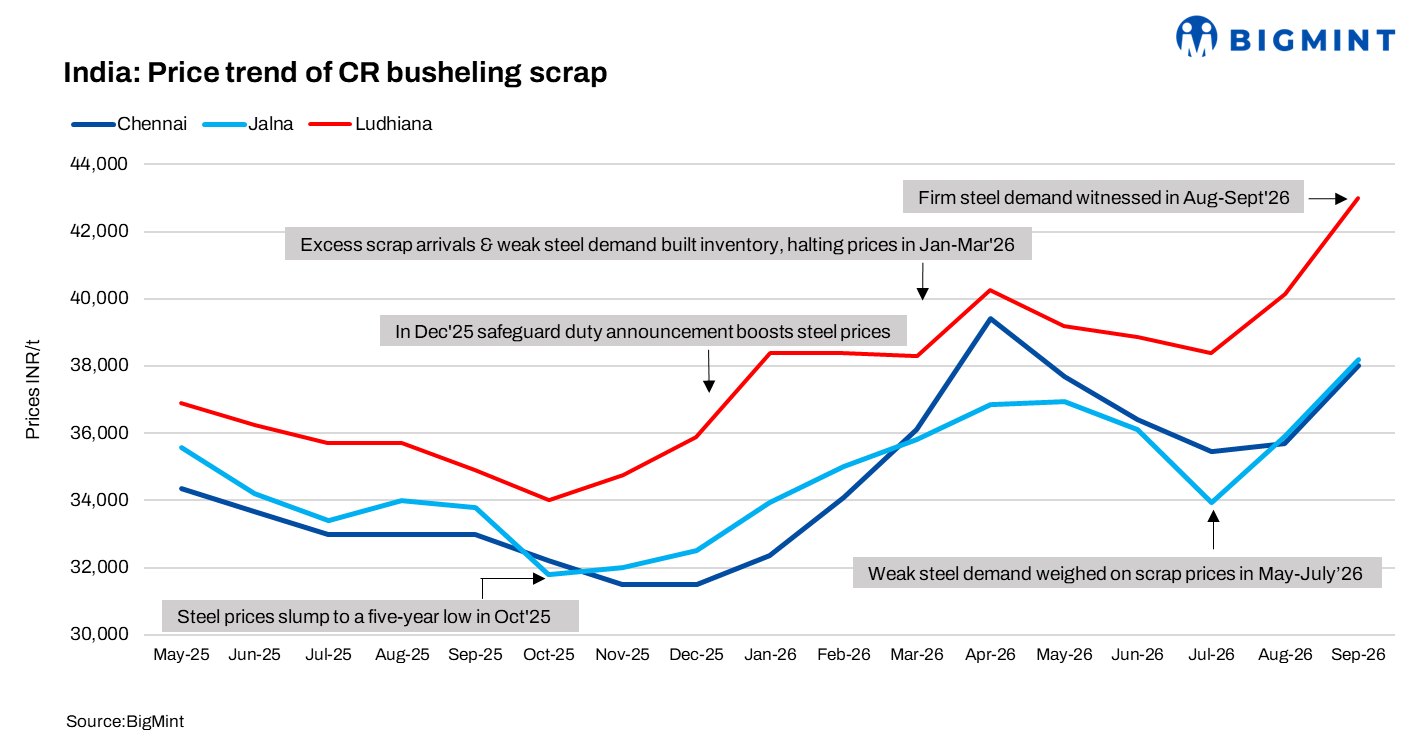
- Regional prices rise INR 2,300-3,650/t m-o-m
- Aggressive participation observed in Sept auctions
India’s CR busheling scrap market remained firm in September 2026, with prices rising across key consuming centres on a m-o-m basis. The rally was led by the western and northern regions, while southern markets also recorded an improvement.
According to BigMint analysis, regional CR busheling scrap prices increased by approximately INR 2,300-3,650/t from August levels. The price gains reflected stronger buying interest from alloy and secondary steel producers, supported by improved order books, firmer finished-steel demand and higher input costs. CR busheling remains an important raw material for alloy steelmakers, making its price movement closely linked to charge-mix economics and production margins.

Regional price movement
On a month-on-month average basis, Ahmedabad recorded the sharpest increase, with CR busheling prices rising by around INR 3,650/t from August. Prices in Mandi and Ludhiana advanced by approximately INR 2,800-2,900/t, while Chennai and Jalna registered comparatively decent gains of around INR 2,300/t.
CR busheling auctions
Indian OEM scrap auction prices rose by approximately INR 600-4,700/t m-o-m in September, supported by stronger end-user demand, aggressive buyer bidding and firmer primary and secondary steel prices, which improved scrap purchase viability.
The western region led the rally, with auction clearances rising nearly 13% from August, signalling stronger buying interest and downstream consumption. Northern markets gained around 2-4%, while Chennai auctions advanced approximately 3%, supported by steady-to-firm demand from rerollers and forging units.
Overall, the September uptrend reflected improved steel realisations and demand visibility, alongside heightened competition for quality OEM scrap.

HRC, CRC price trends
At the trade level, HRC prices increased by INR 4,500/t m-o-m to INR 63,100/t in September from INR 58,600/t in August, while CRC prices rose by INR 6,900/t m-o-m to INR 72,600/t from INR 65,700/t over the same period. The increase was supported by higher mill offers, rising input costs and improved market sentiment, although procurement remained largely requirement-based, reflecting a cautious buying approach among market participants.
Import vs domestic
Imported CR busheling scrap at Kandla and Mundra was assessed at an indicative $425/t, equivalent to approximately INR 43,100-43,500/t DAP after duties in September 2026. In comparison, domestic CR busheling in Ahmedabad was available at around INR 39,100/t DAP, creating a significant cost advantage for locally sourced material. No major import transactions were reported during the month, as buyers continued to prefer domestic procurement through OEM auctions and local suppliers. As a result, overseas material remained largely unattractive despite firm domestic busheling prices, with consumers favouring flexible, requirement-based purchases from the domestic market.
Auto sector performance
India’s automobile retail registrations reached a record 2,536,920 units in September 2026, up 31.82% y-o-y and 4.69% m-o-m. Two-wheelers led volumes at 1,790,188 units, rising 33.08% y-o-y and 4.41% m-o-m. Passenger vehicles reached 427,213 units, up 32.1% y-o-y and 6.17% m-o-m. Commercial vehicles grew 37.62% y-o-y and 14.09% m-o-m.
Outlook
The near-term outlook for CR busheling remains firm, although further price gains will depend on the sustainability of finished-steel demand and mill margins. Continued strength in alloy steel orders, higher primary-steel prices and elevated alternative raw material costs could provide further support to busheling scrap valuations. However, buyers are likely to remain cautious at higher price levels. Any slowdown in finished-steel bookings, pressure on alloy steel margins or improvement in scrap availability could limit the pace of further increases. For alloy steelmakers, procurement discipline and close monitoring of regional price differentials will remain important, particularly as freight and availability continue to influence delivered charge costs.

Leave a Reply