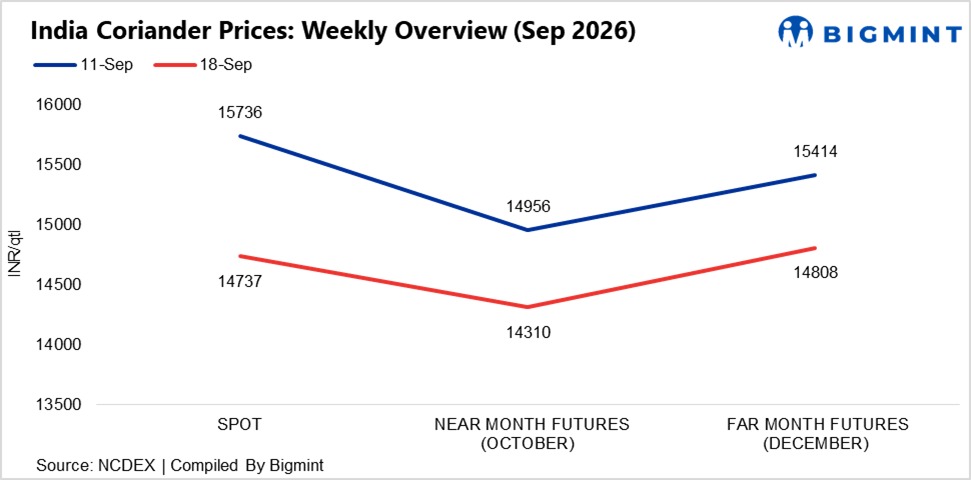
- Kota spot prices fall 6.3% W-o-W, while Gondal prices decline 6.2%
- October and December futures fall 4.3% and 3.9%, respectively
India’s domestic coriander market weakened during the week ended September 18, as higher arrivals exerted pressure on spot prices. Kota spot prices fell to INR 14,737/qtl on September 18 from INR 15,736/qtl a week earlier, while Gondal prices declined to INR 14,872/qtl from INR 15,858/qtl. Domestic arrivals across the tracked markets increased 43.6% W-o-W to 1,172 mt from 816 mt, adding to near-term supply pressure.
Higher arrivals weigh on spot market
The increase in domestic arrivals coincided with a broad decline in spot prices, with both Kota and Gondal registering falls of more than 6% during the week. The rise in fresh market supply appears to have outweighed support from lower reported stocks.
Reported stocks across Kota and Gondal declined 23.9% W-o-W to 10,521 mt from 13,817 mt. Kota stocks fell to 9,914 mt from 12,812 mt, while Gondal stocks declined to 607 mt from 1,005 mt.
Despite the lower stock position, the sharp increase in weekly arrivals indicates that fresh supply remained the dominant factor in the physical market. Continued arrivals could keep prices under pressure if buying interest does not strengthen.
Futures market signals fresh short build up
The weakness in the physical market was also reflected in coriander futures. October futures declined 4.3% W-o-W to INR 14,310/qtl from INR 14,956/qtl, while December futures fell 3.9% to INR 14,808/qtl from INR 15,414/qtl.
Open interest increased alongside the price decline in both contracts. October OI rose 4.9% to 115,750 MT from 110,375 MT, while December OI surged 86.4% to 24,750 MT from 13,275 MT.
The combination of falling prices and rising OI indicates fresh short buildup, pointing to increased selling pressure in the futures market. The sharp increase in December OI also suggests that bearish positioning has increased in the later contract.
Outlook
The near-term domestic coriander market is likely to remain under pressure if arrivals continue at elevated levels and selling interest persists. Lower reported stocks could provide some underlying support, but the recent increase in arrivals and fresh short buildup indicate that supply pressure remains the key market driver. A moderation in arrivals or improvement in domestic buying interest could provide support to prices.
Leave a Reply