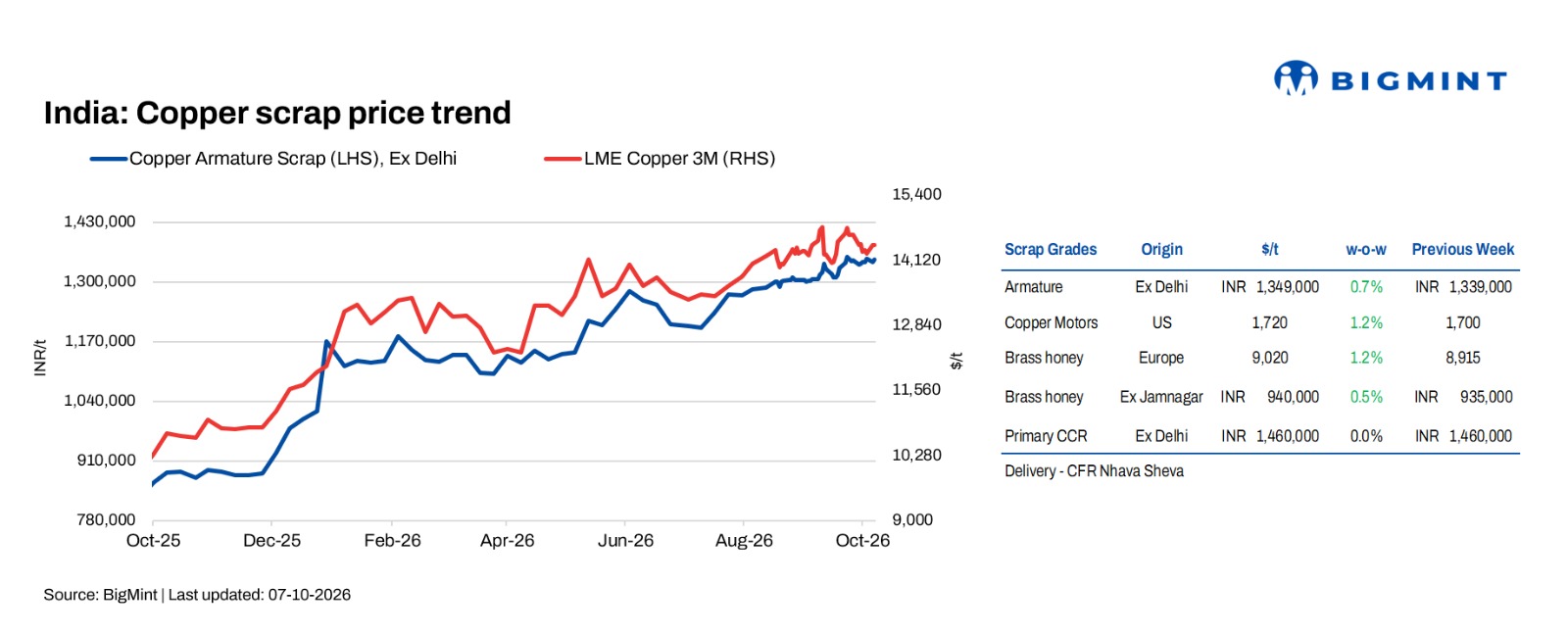
- Tightening exchange inventories offers support to prices
- China and Far East offer stronger returns to global suppliers
India’s copper scrap market remained firm during the assessment on 7 October 2026, despite a 0.1% w-o-w decline in LME copper to $14,415/t from $14,439/t. Tightening exchange inventories and firm physical fundamentals supported prices. The market is increasingly being driven by availability rather than consumption, as Indian buyers face greater competition for high-recovery scrap grades in the international market.
According to BigMint’s assessment, copper armature scrap prices rose 0.7% w-o-w to INR 1,349,000/t ex-Delhi from INR 1,339,000/t.
Festival demand supports domestic buying
Domestic copper scrap demand remained relatively stable, with buyers continuing to procure material based on immediate requirements ahead of the festive season.
Market participants reported that recyclers and secondary manufacturers have maintained regular purchases despite elevated copper prices. However, buying remains measured, with consumers avoiding significant inventory accumulation at current elevated price levels.
The festive season is providing a floor to requirement-based buying, but it has not translated into aggressive inventory building. Buyers are therefore balancing immediate production needs against the risk of purchasing at high prices. This has kept physical demand steady without creating a significant demand-led price surge.
Import economics remain challenging
Imported copper scrap continues to face a wide bid-offer gap in India. Suppliers from Europe, the US and Australia are receiving more competitive bids from China and other Far East destinations, limiting the volume available to Indian buyers.
This competition has become particularly important for higher-recovery grades such as Millberry, Candy Berry and Birch/Cliff. Although import volumes remain relatively healthy, overseas suppliers are offering these grades more readily to China and other Far East markets, where they can secure better netbacks.
The resulting price gap means higher global scrap availability may not translate into greater supply for India. Suppliers are directing material towards markets offering the highest realisation, leaving Indian buyers with fewer competitive offers.
The disparity in replacement costs has kept the Indian market short of imported material, particularly for higher-recovery grades.
European scrap market remains subdued
European copper scrap payables remained unchanged over the past week amid limited trading activity and little change in underlying supply-demand conditions.
EU-origin Millberry remained at 98-98.5% of LME copper, while Candy Berry was assessed at 97-97.5%. Birch/Cliff remained at 90.5-91%.
Market participants reported limited fresh transactions during the week. Subdued downstream demand and lower market participation kept trading within established ranges.
The subdued European market has not resulted in significantly lower export offers for India, as the stronger buying appetite from Asian destinations continues to provide alternative outlets for suppliers.
Offers
Europe-origin copper wire rods (99.5% Cu): 99% of LME, CIF China
Japan-origin off-grade cathodes: 94% of LME, CIF India
USA-origin copper meatballs: $2,710/t, CIF Mundra
UK-origin brass honey: 67% of LME, India, with 3% attachments
UK-origin brass honey: 63% of LME, with 7-8% attachments
India-origin brass ingots: 63% of LME, sold to China
Outlook
India’s copper scrap market is expected to remain firm in the near term. Festival-season demand should continue to support domestic buying as recyclers and secondary manufacturers replenish stocks based on immediate requirements.
However, the key factor to watch is not just domestic demand but the availability of competitively priced imported scrap. If Chinese and Far East buyers continue to offer stronger returns, Indian buyers may remain unable to secure sufficient quantities of higher-recovery grades at workable levels
Consequently, domestic availability is likely to remain the preferred source for Indian consumers, while the persistent bid-offer disparity could keep imported scrap supply tight and limit downside pressure on local prices. Unless international scrap premiums ease or Indian buyers become more competitive against Far East bids, the market is likely to remain characterised by firm prices, selective buying and tight availability of premium grade scrap.
Leave a Reply