- Copper LME correction weighs on Indian prices
- LME correction prompts cautious buying
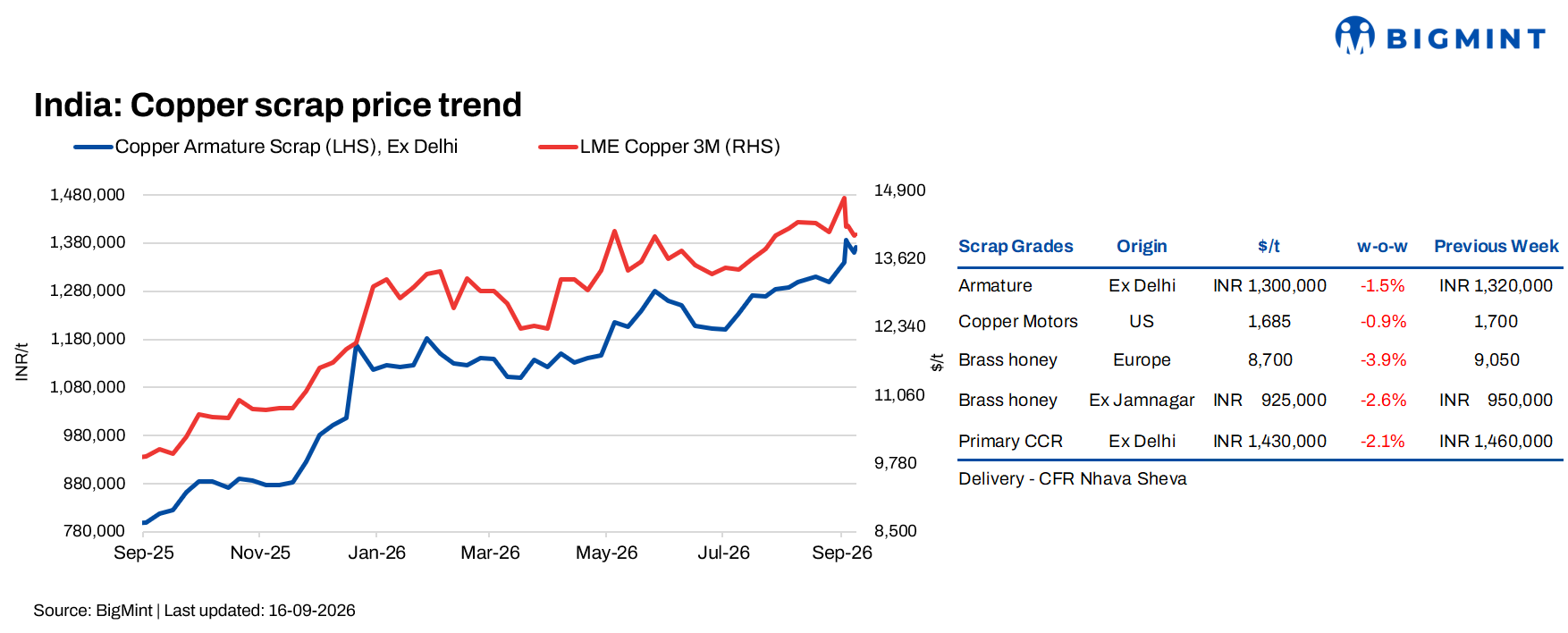
India’s copper scrap prices fell w-o-w on 16 September 2026 as the LME correction weighed on domestic replacement costs. Ahmedabad deals were heard near INR 1,306,000/t, while Ex-Delhi transactions ranged around INR 1,310,000-1,312,000/t. Buyers remained cautious, while regional competition kept imported scrap availability tight.
According to BigMint’s assessment, copper armature scrap, ex-Delhi, stood at INR 1,310,000/t, down from INR 1,320,000/t a week earlier. Trading improved after the festive closure, but buyers remained focused on immediate requirements.
LME correction changes market sentiment
The correction in international copper prices has changed the tone of the physical market. Copper had rallied on expectations of new US tariffs, which encouraged metal flows into US warehouses. However, the absence of a new copper policy has weakened that trade and reduced buying urgency. LME copper stood at $14,084/t, down from $14,709/t a week earlier, a decline of around 4.25%.
The decline briefly pushed copper below $14,000/t on September 14, marking a three-week low. Rising LME inventories added to the softer sentiment, while a stronger US dollar also pressured industrial metals. LME stocks increased to 242,900 t from 236,475 t over the same period. The shift from earlier backwardation to contango also points to more comfortable near-term availability.
The Federal Reserve is due to hold its latest policy meeting on Tuesday and Wednesday. Higher interest rates can weigh on commodities by raising borrowing costs and potentially slowing economic activity. This has added another source of caution across industrial metals.
The weaker US tariff outlook has made buyers more cautious. Traders said Indian consumers are avoiding large inventory positions and focusing on short-term requirements. However, domestic trading activity has improved after the festive closure, with negotiations picking up as participants return to the market.
Buyers focus on short-term requirements
Imported scrap, meanwhile, continues to face a different set of challenges. Market participants reported a significant gap between seller and buyer expectations for copper motor scrap. Sellers were offering material at around $1,720/t, while Indian buyers were willing to bid up to approximately $1,650/t. The wide spread has limited deal flow into India and made competing destinations more attractive for exporters.
Sources said some western-region-origin scrap was consequently diverted toward Pakistan and other regions, where buyers were reportedly able to settle deals around $1,760/t. The diversion highlights the growing importance of regional netbacks in determining scrap flows. With exporters able to secure higher realizations elsewhere, Indian buyers are facing greater difficulty in attracting spot cargoes at current levels.
At the same time, physical demand for copper-containing secondary materials remains relatively stable. Market evidence from the western cluster points to continued procurement ahead of the October festival season, with recyclers and manufacturers rebuilding inventories after the recent shutdown. This suggests that the current slowdown in copper scrap buying is driven more by price uncertainty than by a sharp deterioration in underlying consumption.
EU policy creates future supply risk
European scrap policy could become more important over the medium term. The revised EU Waste Shipment Regulation introduces tighter requirements for shipments to countries outside the OECD.
India is reportedly among the countries under assessment, although the first final list is due by November 21, 2026. Any new export restrictions would generally take effect from May 2027, and no copper scrap ban has been confirmed so far.
Any future restriction on European scrap exports could reduce India’s access to high-grade material. Indian buyers would then compete more actively for alternative supplies. That could tighten scrap availability across Asia and support regional premiums.
For now, LME trends remain the main influence on the Indian market. Higher exchange stocks have reduced some of the tightness seen during the recent copper rally. Buyers are therefore likely to remain price-sensitive. Physical supply, however, remains relatively constrained.
Outlook
India’s copper scrap market is expected to remain cautious in the near term. Lower LME prices and continued volatility should keep buyers focused on short-term needs. Domestic trading may remain active as market participants return after the festive closure. Expectations around tighter monetary policy have also added to the cautious tone across industrial metals.
However, imported scrap availability could stay tight if sellers continue to receive higher netbacks in competing regional markets. Seasonal demand should also provide some support to physical consumption. Any confirmed tightening of European scrap exports to India would add another supply-side risk. That could strengthen Asian scrap premiums over the medium term.
Leave a Reply