- Trading activity remains healthy despite slowdown ahead of Janmashtami
- Quality scrap supply remains tight, suppliers reluctant to release inventories
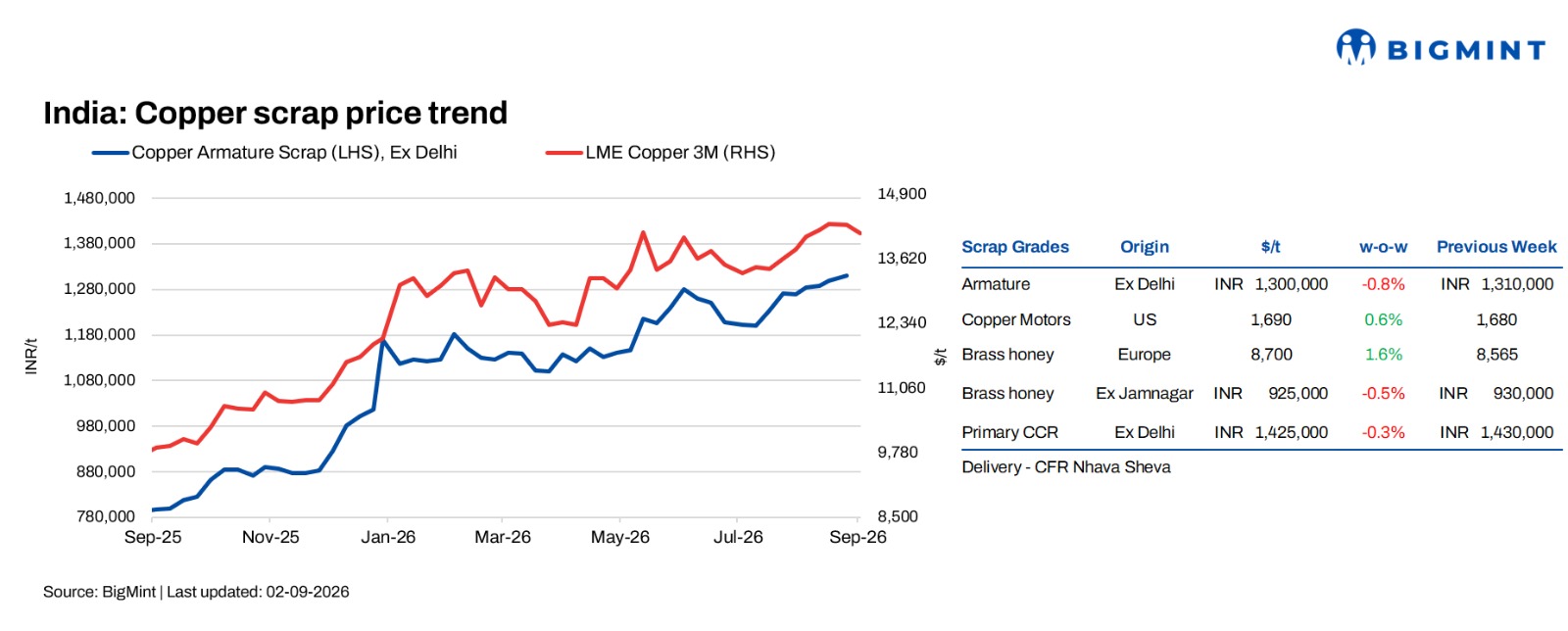
India’s copper scrap prices softened w-o-w on 2 September 2026, driven by a slight correction on the London Metal Exchange (LME), despite healthy demand from wire rod and cable manufacturers, alongside limited availability of premium-grade scrap. Tight domestic supply, elevated import costs, and stronger global copper prices continued to support market sentiment despite some improvement in scrap yard inventories.According to BigMint’s assessment, copper armature scrap, ex-Delhi, was assessed at INR 1,300,000/t, down from INR 1,310,000/t a week earlier.Market participants reported multiple transactions during the assessment week, reflecting stronger buying interest despite constrained spot availability.
Market insight
The domestic scrap market continued to be influenced by the international copper complex. LME copper prices decreased to around $14,150/t during the week from nearly $14,350/t previously.
The Indian copper scrap market witnessed a slight correction in prices during the week; however, the decline was largely driven by sentiment rather than any deterioration in market fundamentals. Demand from wire rod manufacturers, cable producers, brass mills and alloy makers remained healthy, while the availability of quality scrap grades continued to be tight across major consuming regions.Trading activity slowed ahead of the Janmashtami holiday, particularly in western India, where several market participants preferred to defer purchases and fresh bookings until after the festive period. The reduced participation from buyers temporarily softened spot market activity and weighed on domestic prices.
At the same time, renewed geopolitical tensions between the United States and Iran added to market uncertainty. Concerns over potential disruptions to global trade routes, higher energy prices and broader economic volatility have prompted some buyers to adopt a cautious, wait-and-watch approach. Although the conflict has no direct impact on copper demand and supply fundamentals, it has created expectations among some market participants that commodity prices could face short-term pressure amid weaker risk appetite.
Despite the cautious sentiment, the overall market remains fundamentally strong. Traders continue to report limited availability of premium-grade scrap, while suppliers are reluctant to release inventories aggressively in anticipation of firmer prices. Globally, copper continues to be supported by tight mine supply, low concentrate availability, and growing demand from power infrastructure, electrification and AI-related investments.
Market participants expect trading activity to normalise after the festive week, with underlying supply tightness likely to provide support to copper scrap prices in the near term.
Another factor weighing on copper scrap trade flows has been the summer holiday season across Europe during August. A significant number of traders, processors and scrap yards in key exporting countries such as Germany, France, the Netherlands, and Belgium were operating at reduced capacity or remained closed for annual vacations, resulting in slower deal-making and limited spot offers. However, market participants expect most European traders and recyclers to return to business this week following the end of the summer break.
As normal operations resume, enquiry levels and trading activity are likely to improve, potentially increasing scrap availability and market liquidity. Buyers in India are therefore anticipating a gradual pickup in import offers and transaction volumes during September.
Leave a Reply