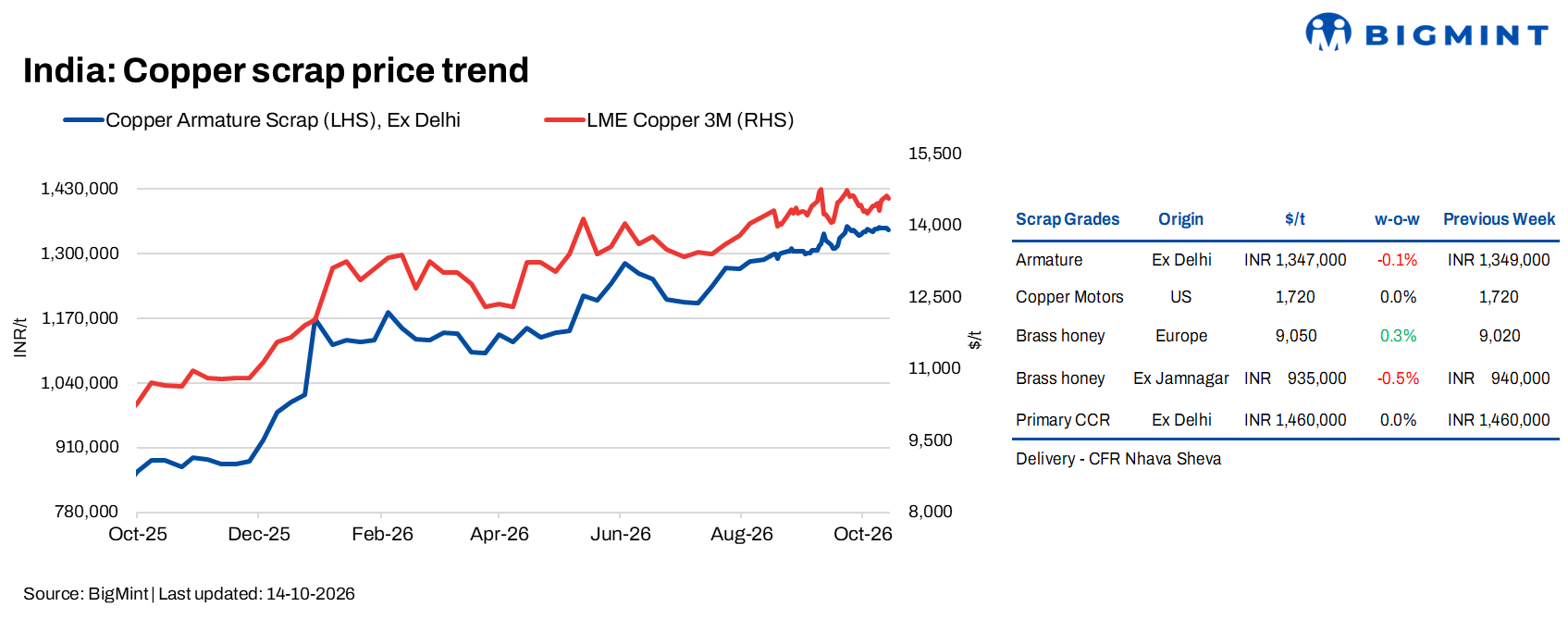
- Domestic price volatility reflects uncertainty over LME movements
- Stronger competing bids in Thailand limit India’s access to imported scrap
India’s copper scrap market remained firm but cautious during the assessment on 14 October 2026. LME copper rose 1.13% w-o-w to $14,578/t from $14,415/t, while exchange inventories declined 5.56% to 231,275 t from 244,900 t. However, domestic copper armature scrap prices fell 0.15% to INR 1,347,000/t ex-Delhi from INR 1,349,000/t in the previous week.
Despite stronger LME prices and declining exchange inventories, domestic trading remained subdued amid high price volatility and elevated inventories. Import viability also remained weak as competing markets offered better returns for copper scrap, while persistent bid-offer gaps restricted transactions across major grades, including Candy Berry, Millberry and Birch/Cliff.
Domestic market remains volatile amid subdued trading
Domestic copper scrap prices experienced high volatility as traders closely followed fluctuations in LME copper. Frequent price movements made it difficult for buyers and sellers to establish workable transaction levels, keeping market participation subdued.
Elevated inventories further limited trading activity. Buyers remained cautious about committing to fresh purchases amid uncertainty over short-term price direction. Consequently, market activity continued to focus on immediate requirements rather than aggressive stock accumulation.
The market continued to rely on requirement-based buying, while elevated prices, cautious procurement and inventory levels kept trading sensitive to LME movements and limited stronger demand-led gains.
Import economics unfavourable as bid-offer gaps widen
Import viability for India remained low as competing markets offered better realisations. Western-origin copper meatballs (21% Cu) were offered at $2,950-2,975/t in Thailand, compared with around $2,850/t in India, encouraging suppliers to prioritise destinations offering higher returns.
Persistent bid-offer gaps also restricted trading across major copper scrap grades:
Candy Berry: Indian buyers offered 95% of LME, while sellers expected 98%.
Millberry: Offers stood at flat LME or LME plus premiums, limiting trading amid pricing differences.
Birch/Cliff: Buyers bid 91.5-92% of LME, while sellers quoted 93%.
The price disparity has kept transactions subdued as buyers remain cautious about replacement costs and sellers seek better returns elsewhere. Unless these gaps narrow, India’s import activity is likely to remain constrained, limiting the availability of competitively priced scrap.
Global market developments keep supply risks in focus
Copper supply concerns intensified as labour disputes at Chile’s Centinela and Escondida mines threatened production. Centinela’s striking unions resumed negotiations on 13 October, while Escondida supervisors planned strike action from 14 October. Separately, Codelco suspended activity in part of its El Teniente mine after a landslide killed two workers.
Meanwhile, confidence in AI-driven copper demand weakened amid a global sell-off in technology stocks, as investors questioned the sustainability and financing of data centre investments. This has added uncertainty to the demand outlook, although it does not yet establish a decline in physical copper consumption.
LME copper inventories continued to decline amid mine supply disruptions, supporting prices despite mixed demand signals. Meanwhile, a narrowing COMEX-LME premium could slow shipments to the US, while rising post-holiday inventories in China point to improved near-term availability. A global technology sell-off has also clouded the outlook for AI-related copper demand.
Offers
The following trade indications were observed during the week:
USA origin birch cliff: 92% of LME, CIF Mundra
USA origin candy berry: 95% of LME, CIF Mundra
USA-origin copper meatballs: $2,850/t, CIF Mundra
Copper Armature scrap – INR 1,340,000 – 1,345,000/t, Ex-Gujarat
Outlook
India’s copper scrap market is expected to remain volatile, with subdued trading and weak import economics limiting price gains. Stronger offers in Thailand and other competing markets could continue to divert Western-origin scrap away from India, while persistent bid-offer gaps across copper scrap grades may restrict transactions.
Declining LME inventories and mine supply disruptions could support international prices, but higher replacement costs may further weaken Indian import viability. Domestic price direction will depend on LME movements, inventory levels and whether buyers and sellers narrow their price expectations. Trading is likely to remain selective until import competitiveness improves and bid-offer gaps narrow.
Leave a Reply