- India accounts for 15% of Asia’s copper scrap trade
- Cathode imports drop on BIS quality control order
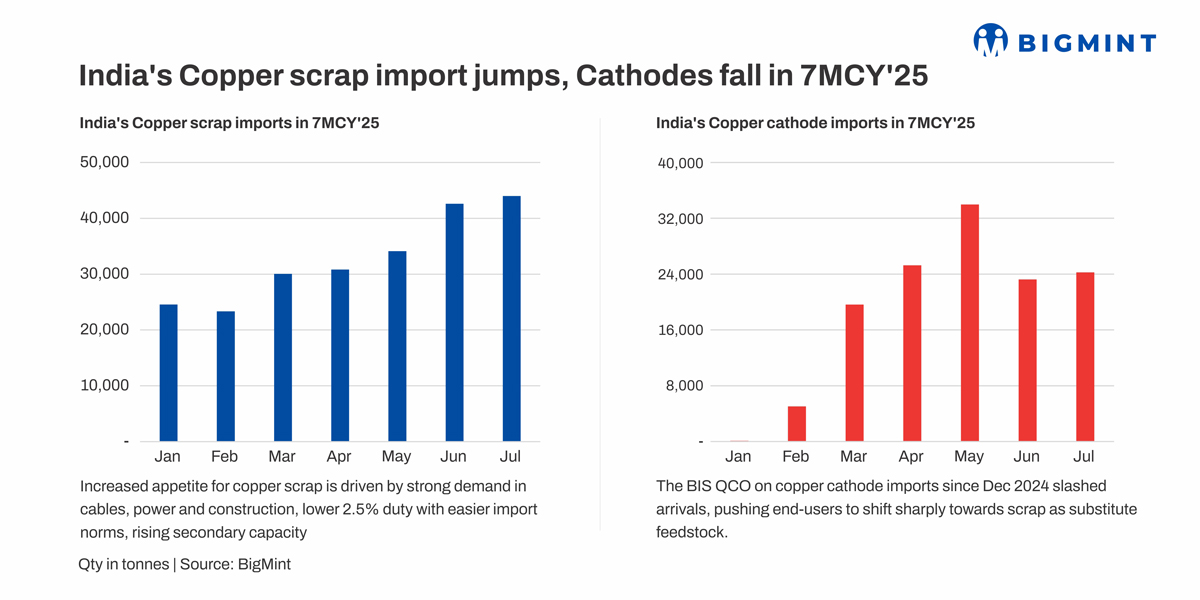
India’s copper scrap imports continued to rise sharply in the first seven months of 2025, climbing 36% y-o-y to 229,548 t, supported by strong demand from the cable, power, and construction sectors, along with zero import duty and easier norms. Scrap inflows steadily rose through the period, peaking at 44,005 t in July, almost double the volume of imports in January.
India now accounts for nearly 15% of Asia’s total copper scrap trade, overtaking South Korea as the region’s second-largest buyer after China, as per reports.
In contrast, copper cathode imports fell 24% y-o-y to 131,486 t in 7MCY’25, with volumes still lagging last year despite a rebound after February. May recorded the highest inflow at 33,965 t, but arrivals remained well below 2024 levels amid disruptions from the BIS Quality Control Order (QCO).
The QCO, which came into effect in December 2024, imposed stringent certification requirements on cathode imports, slashing monthly arrivals from an average of 27,000 t to just 2,000 t in the initial months. Though some recovery came by mid-2025 as suppliers began securing BIS approvals, volumes remain far below pre-QCO levels, forcing processors and end-users to pivot towards scrap.
Industry sources suggest nearly 60% of India’s small- and mid-scale wire and cable manufacturers shifted at least partially to scrap-based feedstock between January-July to avoid production disruptions.
Supply mix and grade trends
The US emerged as India’s top copper scrap supplier in 7MCY’25, with shipments jumping 92.3% y-o-y to 40,258 t, aided by surplus availability and trade diversions from China. Saudi Arabia followed with 29,345 t (+25.7%), while imports from the UAE dropped 39%. Germany supplied 20,776 t (+22.3%), while inflows from “Others” surged 45.5% to 126,475 t.

Notably, US-origin Millberry scrap commanded a premium of $50-70/t over Middle Eastern supply, yet remained attractive due to higher consistency and quality.
On a grade-wise basis, Brass Honey led with 71,015 t (+83%), followed by Druid at 59,606 t (–2%), Birch at 34,486 t (+45%), and Berry at 23,014 t (+77%). Barley imports inched up 11% to 14,039 t, while “Others” rose 36% to 27,388 t.
Domestic expansion momentum
On the domestic front, copper demand drivers were reinforced by capacity additions. Precision Wires India approved a INR 70 crore expansion program, including INR 33 crore for copper rod capacity (INR 28 crore at Zaroli, INR 5 crore at Valvada) and INR 37 crore for modernisation at Silvassa, which will add 4,400 tonnes per annum by Q4FY’27, raising total capacity to 65,400 tonnes per annum.
This expansion aligns with India’s annual wire rod demand growth of 8–9%, driven by power and EV infrastructure projects.
Similarly, Delton Cables commissioned a new telecom cable plant at Prithla, Haryana on 7 June, its third facility, to serve rising demand from major operators.

Market drivers
- The sharp rise in scrap imports was underpinned by three factors:
- Limited cathode availability due to the QCO.
- Removal of basic customs duty on scrap, improving landed costs.
- Rising secondary consumption driven by cable makers like Polycab, RR Kabel, KEI, and new capacity additions from Precision Wires and Delton.
Additionally, high-grade scrap such as Millberry and Berry is increasingly used as a substitute for cathodes in industrial applications, given its near-refined purity.
Market estimate that secondary copper already meets 45-50% of India’s total copper demand in 2025, compared with just 35% in 2022.
Outlook
Scrap inflows are expected to remain strong in the near term as buyers seek cost-effective substitutes to cover supply gaps. While cathode imports may gradually recover later in 2025 as more suppliers secure BIS approvals, scrap will continue to play a central role in India’s copper supply chain, especially with fresh downstream expansions boosting demand.
With India’s green manufacturing policies targeting 50% recycling in copper by 2030, scrap will likely outpace cathode in driving future supply.
Leave a Reply